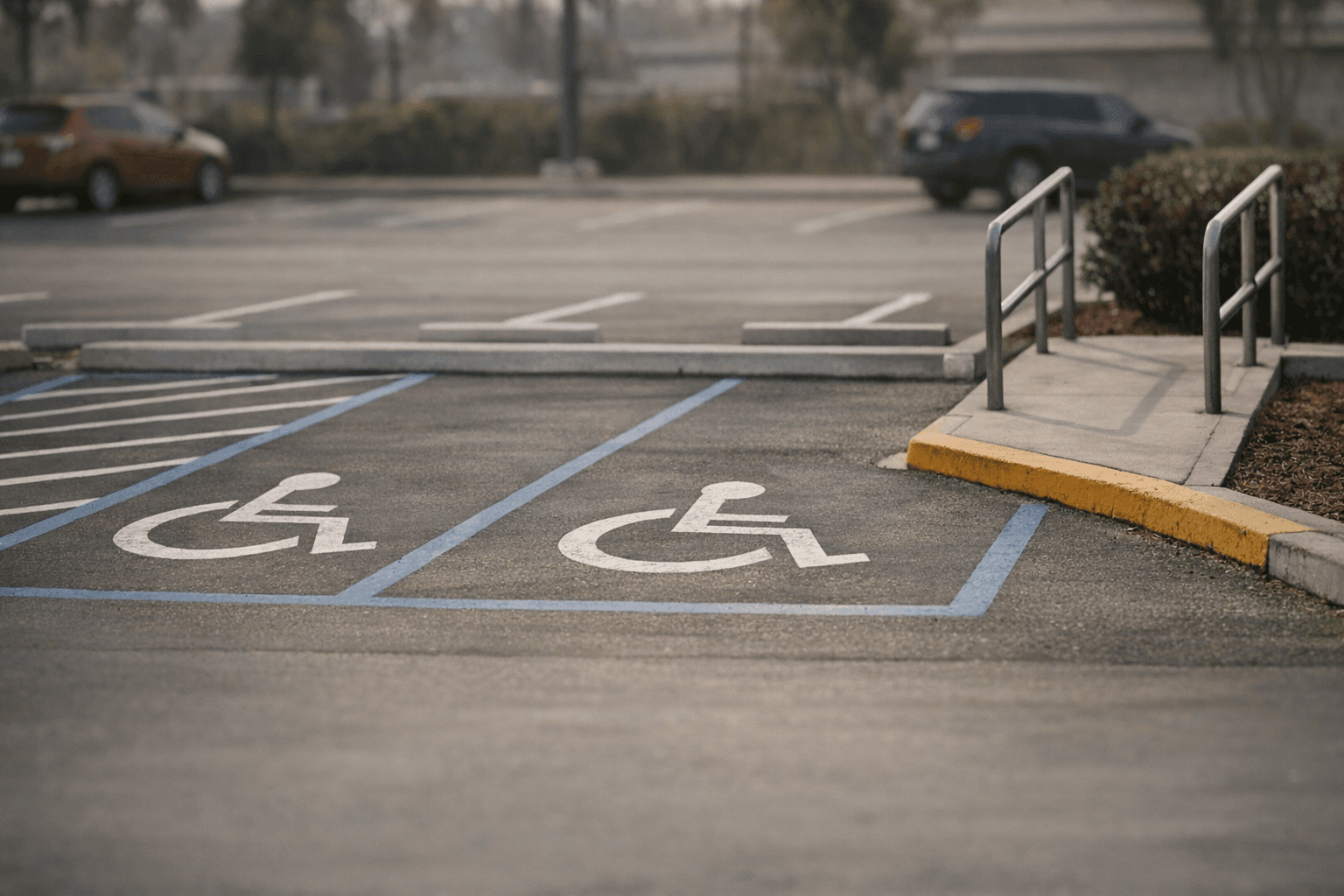
Introduction
Accessible parking spaces are mandated by federal and state law, but the obligation does not end with painting lines. The standard requires specific stripe widths, access aisle dimensions and vertical clearances. These are not recommendations — they are published requirements, and an authority having jurisdiction inspects against them. What frequently goes unexamined is the licensing question: who is permitted to perform the work, what the permit application must state, and what happens when the work is done without a license.
The striping itself is governed by the ADA Standards for Accessible Design and by state accessibility codes as adopted locally. The licensing question is separate. California law requires that a contractor performing construction, alteration or improvement work hold a license issued by the Contractors State License Board. Striping a parking lot is construction work. The permit application must include a signed statement that the applicant is licensed or exempt, and the local jurisdiction checks that statement before issuing the permit.
When a contractor submits a bid or performs work without the required license, the consequences are immediate. The contractor cannot bring an action to collect payment, and the registrar may issue a citation or stop-work order. If you authorize work and later discover the contractor was unlicensed, you may have no enforceable agreement and no remedy for defective performance. The record you retain — the signed contract, the permit with the license number, and the final inspection report — is what closes the compliance question. Without that record, you cannot demonstrate that the work was performed in compliance with state licensing law, and that gap remains open whether or not the striping itself meets the dimensional standard.
For property owners navigating compliance obligations, understanding the intersection of accessibility standards and contractor licensing is critical. If you're dealing with insurance claims related to property damage or compliance issues, you may find it helpful to review the Insurance Adjuster Contact Timeline: California Regulations to understand how timelines and documentation requirements apply in those contexts.
Problem Statement
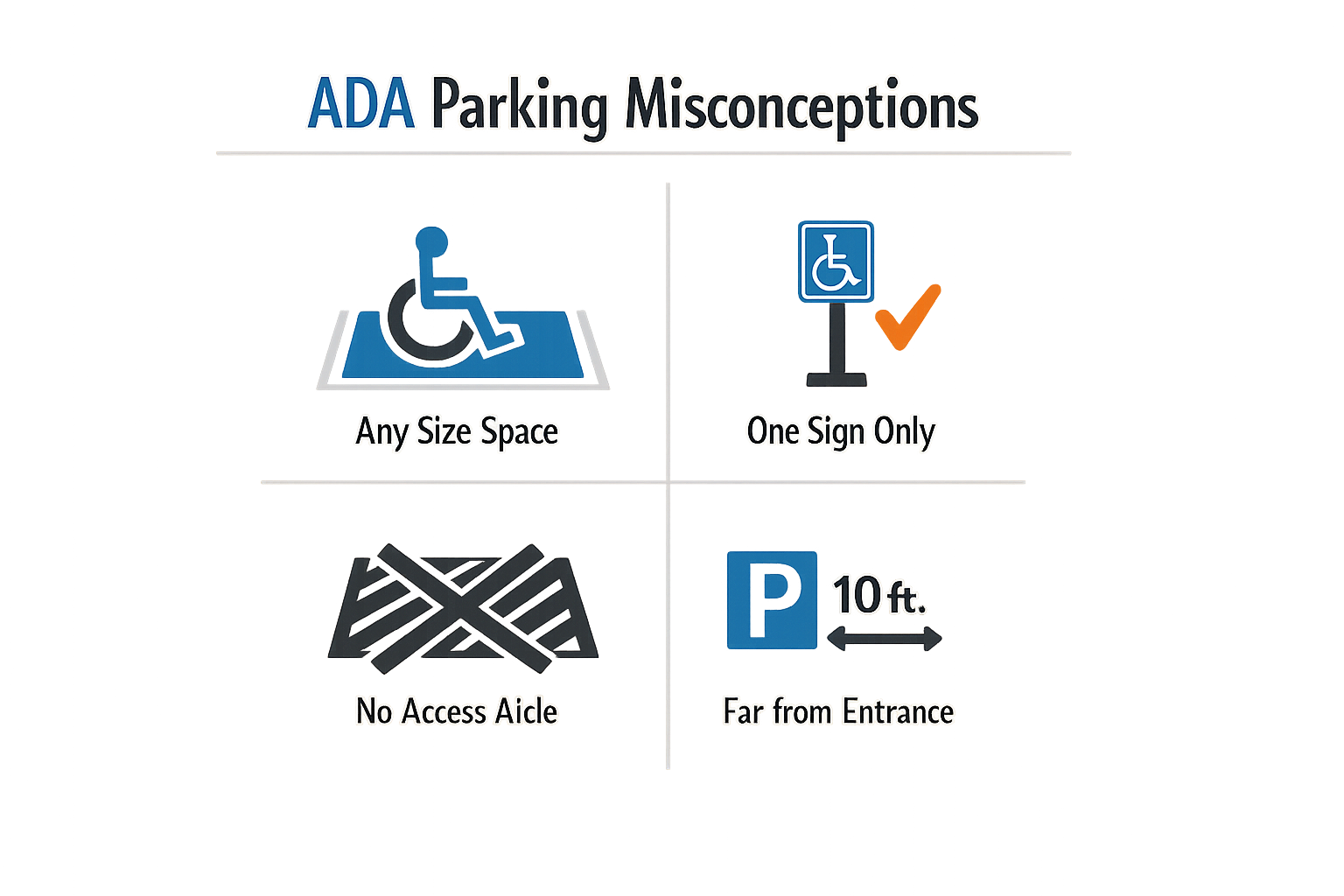
The standard requires accessible parking spaces, and the provision permits more than one compliant configuration. The problem begins when an owner approves a striping contract without establishing what the agreement actually provides — whether it includes the van-accessible width, the required signage mounting height, or the access aisle that connects two adjacent spaces. Separately priced items appear as one line, and the difference between a compliant installation and one that fails inspection is rarely visible until the authority having jurisdiction opens a violation.
Common Misconceptions About Licensing and Compliance
A frequent misunderstanding involves who is permitted to perform the work and what documentation closes a code failure. In California, striping work that alters or installs permanent pavement markings on commercial property typically requires a contractor's license. The California Business and Professions Code mandates that contractors display their license number on vehicles, in contracts, and on permit applications. A contractor with a license suspended or revoked two or more times within an eight-year period must disclose this information prior to entering into a contract for residential property — a requirement that applies to certain commercial work as well when the property includes residential units.
Another issue arises when an owner assumes that any contractor can close an ADA violation. The authority having jurisdiction determines what evidence satisfies the standard. If the original installation failed because the access aisle was too narrow or the signage was mounted at the wrong height, the correction must address the specific deficiency cited in the violation notice. The obligated party on the service agreement — not the individual who signed it — is responsible for bringing the work into compliance within the window the AHJ provides. Ask for it in writing: which entity is performing the correction, what the report actually says about the deficiency, and whether the proposed remedy matches the cited provision.
The Split Between Design and Installation
The standard separates what must be designed from what must be installed. ADA parking lot striping requirements specify the number of accessible spaces based on total parking capacity, the dimensions of each space and its access aisle, the slope and cross-slope of the surface, and the location relative to the accessible entrance. A licensed contractor performs the striping and signage installation; the owner or the owner's design professional determines the layout that satisfies the standard as adopted locally. When a contractor quotes a turnkey job that includes both layout and installation, establish whether the layout component is separately priced and whether the contractor holds the classification that permits design work in that jurisdiction.
Check the date on the edition the local jurisdiction has adopted. The 2010 ADA Standards for Accessible Design is the federal baseline, but California and other states have adopted state-specific accessibility codes that may impose stricter requirements. The edition matters because the number of van-accessible spaces, the required signage text, and the acceptable surface slope can differ between editions. A contractor quoting work under an outdated standard delivers a compliant installation only if the local code permits it — and if the AHJ later cites the current edition, the owner bears the cost of bringing the work into compliance.
Not the whole provision — just the part the authority having jurisdiction cited — determines what closes the failure.
For property managers navigating compliance intervals and service agreement terms, understanding the insurance adjuster contact timeline can provide useful context when coordinating post-incident repairs that may affect accessible parking areas.
Solution Steps for Compliance
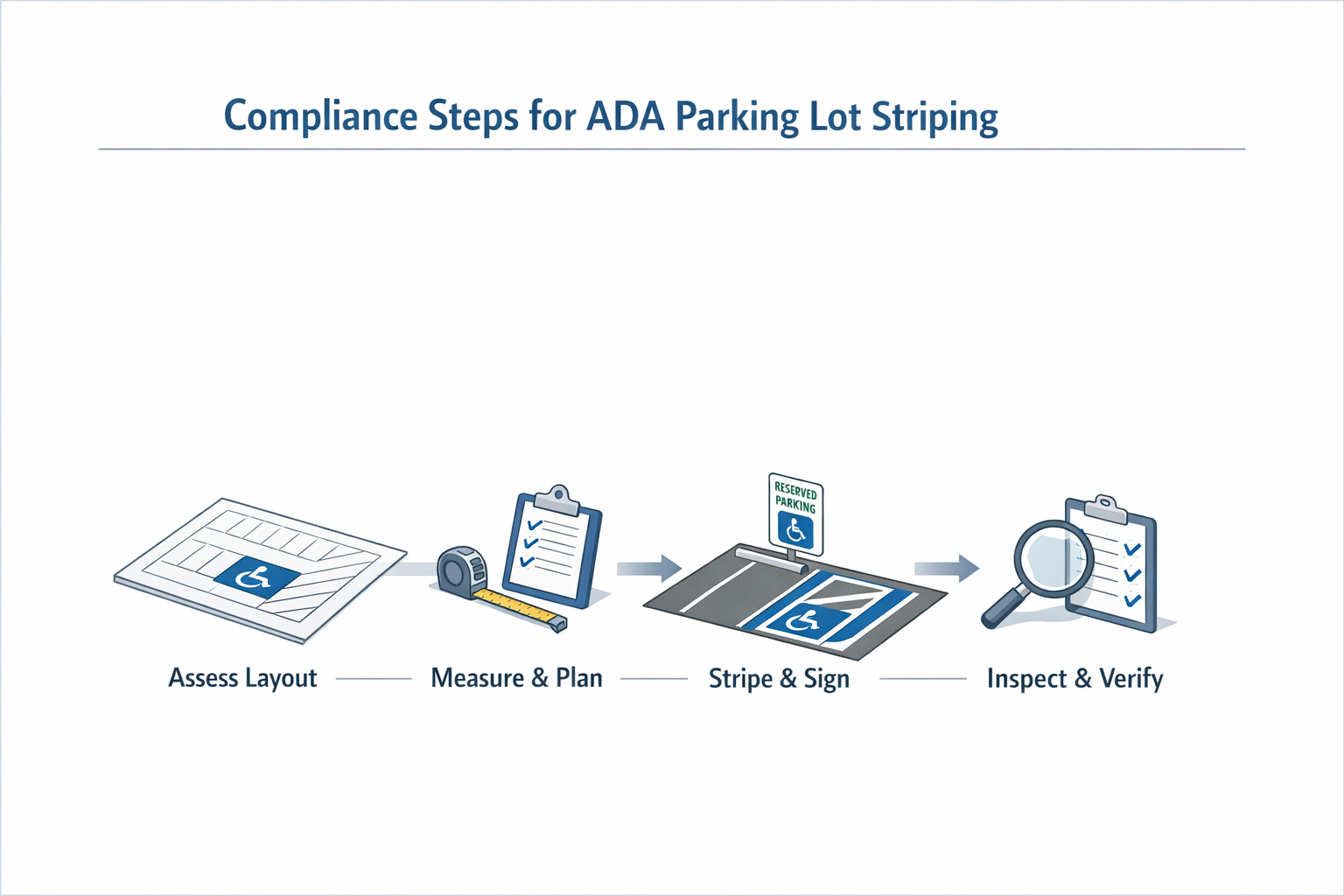
The standard requires specific procedures before any striping work begins. Establishing who performs the work, what the contract states, and what documentation the owner retains closes the compliance gap before the first line is painted.
Verify the Contractor's License Status
Step 1
Confirm active licensure before signing
Every contractor performing parking lot striping work must hold a valid California contractor license. Before you authorize a quote or sign an agreement, verify the license number through the Contractors State License Board database. The license must be active and in good standing on the date the contract is executed and throughout the performance period.
Step 2
Require disclosure of prior suspensions or revocations
A contractor with a license suspended or revoked two or more times within an eight-year period must disclose this information prior to entering into a contract for residential property. While most parking lot striping occurs on commercial property, the disclosure requirement reflects a broader pattern: ask for the disciplinary history in writing. If the contractor has a suspension or revocation history, the agreement must include that disclosure in 10-point boldface type or contrasting red print in at least 8-point boldface.
Step 3
Document the scope and the obligated party
The written contract must identify the entity performing the work and the entity obligated on the agreement. If the contractor operates under a business name, confirm that the name and license number on the agreement match the name and number displayed on the contractor's commercial vehicle. Retain a copy of the signed agreement showing the contractor's business name, permanent business address, and license number.
Establish What the Agreement Provides
The provision permits either remedy when a dispute arises: the owner may pursue the contractor directly, or the owner may file a complaint with the Contractors State License Board. The agreement should state the dispute window—the period during which the owner may raise a defect or non-compliance claim. If the agreement is silent on the window, the owner retains the statutory period for contract claims.
Before you approve the final payment, establish that the striping work satisfies the applicable accessibility standard as adopted locally. The authority having jurisdiction—typically the building department or the fire marshal—determines what closes a compliance failure. Retain the record: a dated photograph of the completed striping, the contractor's invoice showing the date of completion, and any inspection report or approval issued by the AHJ.
For additional context on how California regulations govern contractor obligations and dispute timelines, see Filing a Complaint With the California Department of Insurance.
Understand the Penalty Structure for Non-Disclosure
Penalties for violations of the disclosure requirement escalate with each violation. The first violation results in a $1,000 penalty. The second violation carries a $2,500 penalty. The third violation results in a $5,000 penalty plus a one-year license suspension. A fourth violation results in the revocation of the contractor's license. These penalties apply to the contractor, not the property owner, but the owner's documentation—specifically, proof that the contractor provided or failed to provide the required disclosure—becomes the record that supports or defeats the penalty.
Tips and Tricks for Proper Striping

The standard requires accessible striping, but the provision permits either remedy: a full re-stripe or a targeted repair. Knowing which one closes the failure determines what you authorize and what the record shows.
Verify the Contractor License Before Work Begins
Check the date on the contractor's license and confirm it matches the classification for the work. The agreement provides for a licensed contractor to perform the striping; if the entity on the agreement does not hold an active license, the work may not satisfy the requirement. Ask for it in writing—license number, classification, and expiration date—before you authorize any mobilization.
Retain the record of the license verification. If an authority having jurisdiction opens a violation, the documentation you produce must show that a properly licensed contractor performed the work at the time it was completed.
Separately Price the Accessible Spaces and the Standard Spaces
The provision permits a contractor to quote accessible striping as a line item distinct from the remainder of the lot. When the quote bundles accessible spaces with standard striping, you cannot determine whether the accessible portion meets the interval or whether the contractor is charging for work the standard does not require. Separately priced items let you compare the accessible remedy to the published dimension and close only the failure that exists.
What the report actually says determines what closes the failure—if the report identifies only the accessible spaces, the remedy need not include the entire lot.
If the contractor resists separating the line items, establish in writing which portion of the total satisfies the accessible requirement. Without that breakdown, you cannot demonstrate compliance when the next inspection arrives.
Understand the Obligated Party on the Agreement
The agreement provides for performance by a named entity. If the entity is a sole proprietorship, the individual is the obligated party. If the entity is a corporation or LLC, the corporation or LLC is obligated, and a personal guarantee block may or may not appear. Before you authorize payment, confirm that the entity on the invoice matches the entity on the agreement and the entity on the license.
When a dispute arises, the window to contest the work begins on the date the contractor declares completion. If the agreement does not define that date, the window may not open until you accept the work in writing. Ask for the completion declaration in writing, and retain it with the agreement and the license documentation.
Retain Documentation for the Full Interval
The standard requires accessible striping by interval, and the authority having jurisdiction expects you to produce the record on demand. Retain the agreement, the license verification, the completion declaration, and any inspection report for the full period between re-stripes. If the interval is five years, the record must survive five years. If the interval is shorter as adopted locally, adjust the retention period to match.
Some jurisdictions require you to produce the record within a specific window after a violation is opened. If you cannot produce it, the violation may remain open regardless of whether the work was performed. The record closes the failure only if you can hand it to the inspector.
For additional guidance on managing compliance timelines and documentation requirements, see Insurance Adjuster Contact Timeline: California Regulations.
Conclusion
ADA parking lot striping requirements rest on two distinct foundations: the federal design standard and the state contractor licensing framework. The 2010 ADA Standards for Accessible Design establishes the dimensional, marking, and signage provisions that govern compliant accessible spaces. The California Business and Professions Code, Division 3, Chapter 9, governs who may perform the work and what disclosures accompany the contract. Neither document substitutes for the other, and compliance with one does not satisfy the other.
The standard requires specific width, slope, and marking criteria for accessible stalls and access aisles. The contractor licensing statute requires a valid license for work above the de minimis threshold and mandates disclosure of prior suspensions or revocations when the contractor's history meets the statutory trigger. An owner who retains an unlicensed entity cannot enforce the contract in California courts, regardless of whether the striping itself meets ADA dimensions. An owner who accepts a compliant layout from a licensed contractor whose disclosure obligation was not satisfied may face a dispute over contract enforceability if the contractor's history later emerges.
Retain the signed contract, the contractor's license verification, any required disclosures, and the as-built documentation that confirms stall width, access aisle configuration, slope measurements, and signage placement. The authority having jurisdiction reviews those records when opening or closing a violation. The standard permits certain dimensional alternatives depending on the total parking count and the facility type; document which alternative applies and confirm that the installed layout satisfies it. Ask for the measurements and the signage inventory in writing before you authorize final payment.
For guidance on California regulatory procedures and documentation requirements in other compliance contexts, see Filing a Complaint With the California Department of Insurance. The principle remains consistent: the record you retain determines what you can prove when the authority asks.
Related reading
California Fire Sprinkler Inspection Requirements: Who Can Inspect?
Fire Alarm Inspection Requirements: Code Insights and Quotes