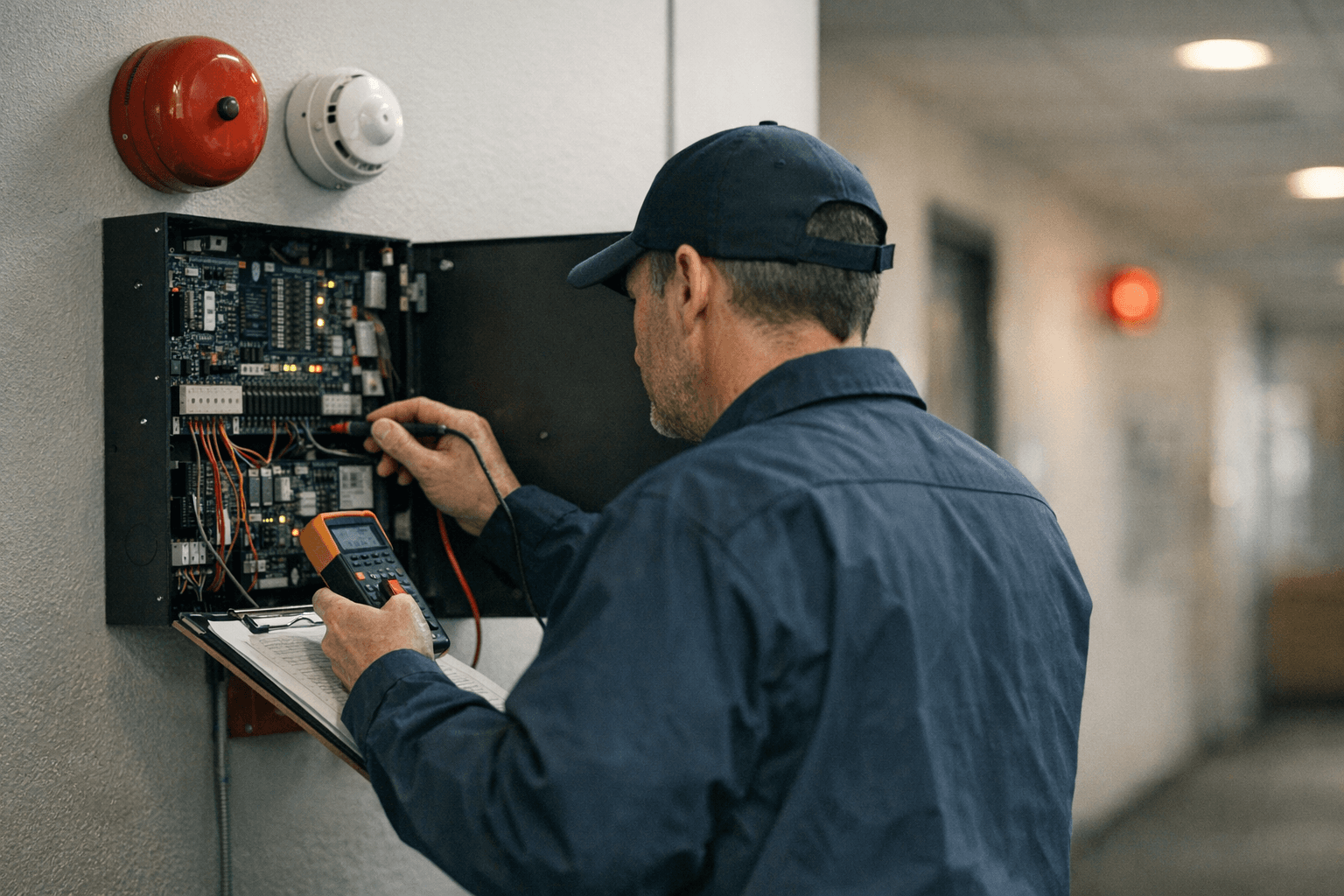
Introduction to Annual Fire Alarm Inspection Costs
The annual fire alarm inspection is a twelve-month interval item under NFPA 72. It is not the same as the monthly owner check or the quarterly device test. Each interval carries its own requirements, and the standard permits no substitution between them. When a service agreement quotes "annual inspection," establish which edition of NFPA 72 applies as adopted locally, and confirm that the scope matches what the standard requires for that interval.
Most commercial properties operate under service agreements that bundle the annual inspection with other intervals. The agreement provides dispute windows—typically fourteen to thirty days—and defines what triggers default, acceleration, or suspension. Before you authorize the work, identify the obligated party on the signature block. If the agreement includes a personal guarantee, that block shows who remains liable if the entity dissolves. Retain the signed agreement and every inspection report; the authority having jurisdiction expects you to produce both.
The inspection report says the system passed or failed. If it failed, the report must state what closes the failure. A licensed agency performs the repair, and the follow-up report confirms compliance. The owner does not close a code violation by performing the remedy; the standard assigns that work to a qualified technician. Ask for the closure documentation in writing, and confirm that it references the original failure by date and description. Without that link, the record does not satisfy the authority having jurisdiction.
Understanding insurance adjuster contact timelines can help you navigate related compliance and documentation requirements when fire alarm issues intersect with property insurance claims.
Service agreements frequently separate the annual inspection from the five-year internal assessment or the ten-year device replacement. These are not the whole provision; they are line items within NFPA 72's full maintenance schedule. When you receive a proposal, check the date on the last inspection of each type, and verify that the quoted scope includes what the standard requires by interval. A proposal that omits a mandated item leaves you out of compliance, even if the work it does include is performed correctly.
Explore the factors influencing annual fire alarm inspection costs and understand what to expect during the process.
What is an Annual Fire Alarm Inspection?
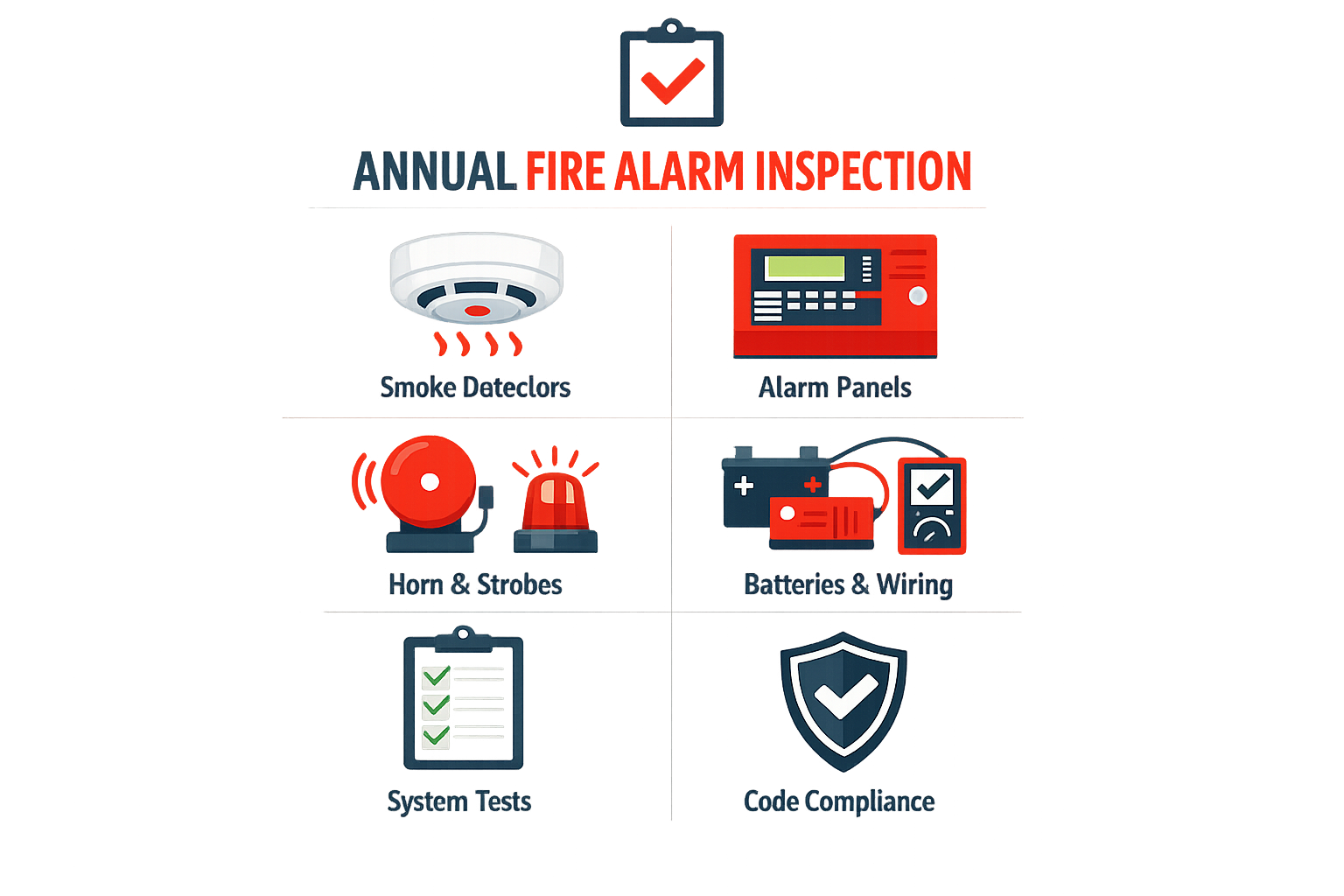
An annual fire alarm inspection is a mandatory service interval established by NFPA 72, the National Fire Alarm and Signaling Code. The standard requires a licensed agency to test and document the performance of every fire alarm device, notification appliance, and circuit in the system once every twelve months. This is distinct from the semi-annual visual checks or monthly owner-performed tests that some jurisdictions also require.
The inspection verifies that initiating devices—smoke detectors, heat sensors, pull stations—activate the system as designed. Notification appliances such as horns, strobes, and speakers must produce the required decibel levels and candela ratings at measured distances. Control panels undergo functional testing of power supplies, battery backup, and supervisory circuits. The technician documents every device by location, tests circuits for continuity and ground faults, and confirms that signals reach the monitoring station or fire department connection as intended.
What the Standard Requires
NFPA 72 specifies the testing methodology, the acceptance criteria, and the documentation format. The edition adopted by your authority having jurisdiction determines which devices require annual testing and which fall on longer intervals. For example, the 2019 edition introduced sensitivity testing requirements for certain smoke detectors that were not present in the 2016 edition. The contractor must follow the edition your jurisdiction adopted, not the most recent edition published by NFPA.
The inspection produces a written report listing every device tested, the result of each test, and any deficiencies that require correction. The report must identify the contractor's license number, the technician who performed the work, and the standard edition followed. Retain this report. When an authority having jurisdiction opens a violation, the dated inspection report and the contractor's license verification are what close it. For guidance on regulatory timelines in California, see Insurance Adjuster Contact Timeline: California Regulations.
Who Performs the Inspection
Only a contractor holding the appropriate state license may perform and certify an annual fire alarm inspection. In California, this work falls under the Fire/Life Safety or Low Voltage Systems classifications, depending on system voltage and complexity. The contractor must execute a certification statement confirming compliance with the applicable code edition and provide the physical address and license details in the service agreement.
The owner does not perform the annual inspection. Monthly functional tests and visual checks are owner-performed items under NFPA 72, but the annual inspection requires calibrated test equipment, technical training, and a state license. An unlicensed party cannot produce a compliant inspection report, and an authority having jurisdiction will not accept it to close a cited deficiency.
Why Annual Fire Alarm Inspections Matter
The standard requires annual inspection. That interval is not discretionary, and the inspection is not optional. NFPA 72 mandates that fire alarm systems be tested and inspected at least annually by a qualified technician, and most authorities having jurisdiction adopt that requirement as adopted locally. The annual visit verifies that notification appliances sound, detectors respond, and the system communicates with the monitoring station or building occupants as designed. Without that annual check, a silent failure can persist until the next emergency — when the system is expected to perform and does not.
Compliance and Code Enforcement
A missed inspection opens a code violation. The authority having jurisdiction can issue a notice of violation, and in some cases can restrict occupancy or close portions of a building until the deficiency is corrected. What closes the failure is documentation: a completed inspection report signed by a licensed technician, showing that the system was tested and any deficiencies were remedied. Retain the record. Fire marshals and building inspectors expect to see the current year's report and often ask for the prior year's as well. The report is the proof that the requirement was met, and without it the violation remains open.
Risk Management and Liability
The annual inspection reduces the owner's exposure. A documented inspection shows that the owner took reasonable steps to maintain a working fire alarm system. If a fire occurs and the system fails, the absence of current inspection records can become a factor in liability claims. Conversely, a complete inspection history demonstrates that the system was maintained in service and that any known deficiencies were addressed within the intervals the standard prescribes. Ask for it in writing. The inspection report should list every device tested, every deficiency found, and every remedy completed. That level of detail is what the report actually says, and it is what protects the owner when questions arise.
Protecting Occupants and Property
The fire alarm system is the first line of notification. When it works, occupants evacuate before conditions become untenable, and emergency responders arrive while suppression is still possible. When it does not work, the delay can be fatal. The annual inspection identifies failing batteries, corroded connections, obstructed notification appliances, and detectors that no longer respond to test smoke. These are not theoretical risks. They are the documented causes of fire alarm failures in occupied buildings. The standard requires the inspection because the interval is short enough to catch degradation before it results in a complete system failure.
The annual inspection is the documented proof that the system was maintained in service and that known deficiencies were addressed within the intervals the standard prescribes.
For building owners navigating compliance timelines and documentation requirements, understanding insurance adjuster contact timelines can provide additional context for managing risk and maintaining proper records across multiple regulatory domains.
How to Prepare for an Annual Fire Alarm Inspection
The annual inspection is a licensed-agency service, not an owner-performed check. Preparation means confirming that the required documentation exists, that access paths are clear, and that the person scheduling the visit understands what the inspector must complete. Many properties fail not because the system is defective, but because the record from the prior interval is missing or the inspector cannot reach every device.
Confirm the Service Agreement Covers the Annual Interval
The agreement should state the inspection frequency by name — "annual," "twelve-month," or "365-day." If the contract lists only "quarterly" or "semiannual" visits, the annual inspection may not be included. Ask for the scope in writing before the technician arrives. Separately priced services are common; do not assume that a standing agreement covers every interval the standard requires.
Check the date on the last completed inspection report. NFPA 72 requires annual service at intervals not exceeding one year; scheduling the visit at eleven months protects against calendar drift. If the prior report is dated more than thirteen months ago, document the gap and confirm that the upcoming visit will close it.
Assemble Required Documentation
The inspector will ask for the system's as-built drawings, the prior year's inspection report, and any deficiency-closure records from interim visits. Retain the record in a location accessible to the person who schedules service. California law requires that licensees retain all documents related to fire alarm installation and service for five years and provide them to the board within thirty days of a written request. The same retention expectation applies to the building owner.
If a deficiency was noted in the prior report and a follow-up visit closed it, both documents must be available. The annual inspection does not replace the record of corrective work; it confirms that the system currently meets the standard.
Clear Access to All Devices and Control Panels
The inspector must physically reach every initiating device, notification appliance, and control panel listed in the system's inventory. Storage, furniture, and temporary partitions frequently block access. Walk the property before the scheduled visit and remove obstructions. If a device is in a locked room or a tenant-occupied suite, arrange access in advance.
Fire alarm devices in ceilings above twenty feet or in mechanical penthouses require safe access. If the building does not maintain portable ladders or scaffolding that meet the inspector's requirements, the service agreement may include equipment rental as a separate line. Confirm what the agency provides and what the owner must supply.
Notify Tenants and Coordinate Building Access
The inspection will trigger audible and visual notification appliances throughout the building. Notify tenants at least seventy-two hours in advance, and confirm that the fire alarm system will be tested during business hours unless the lease or local ordinance requires otherwise. If the building operates continuously, coordinate the visit during a low-occupancy period.
Some jurisdictions require that the authority having jurisdiction receive advance notice of testing. Confirm the local procedure and submit the notice within the required window. A missed notification can result in an unnecessary dispatch and a billable false-alarm fee.
Understand What the Inspector Will Test
The annual inspection includes functional testing of initiating devices, notification appliances, and control-panel circuits. The inspector will also verify that the system's battery backup operates within specification and that all required signage remains legible. The visit does not include internal assessment of detectors — that is a separate five-year service — and it does not include repair of deficiencies found during testing.
If the inspector identifies a failure, the report will state what failed and what remedy is required. Before you authorize corrective work, establish who is permitted to close that failure. Some deficiencies require a licensed fire alarm company; others may be resolved by the building's maintenance staff if the work does not alter the system's configuration.
The agreement provides the inspection; it does not guarantee that the system will pass.
For guidance on managing disputes that arise after an inspection, see Filing a Complaint With the California Department of Insurance.
Annual Fire Alarm Inspection Cost Breakdown
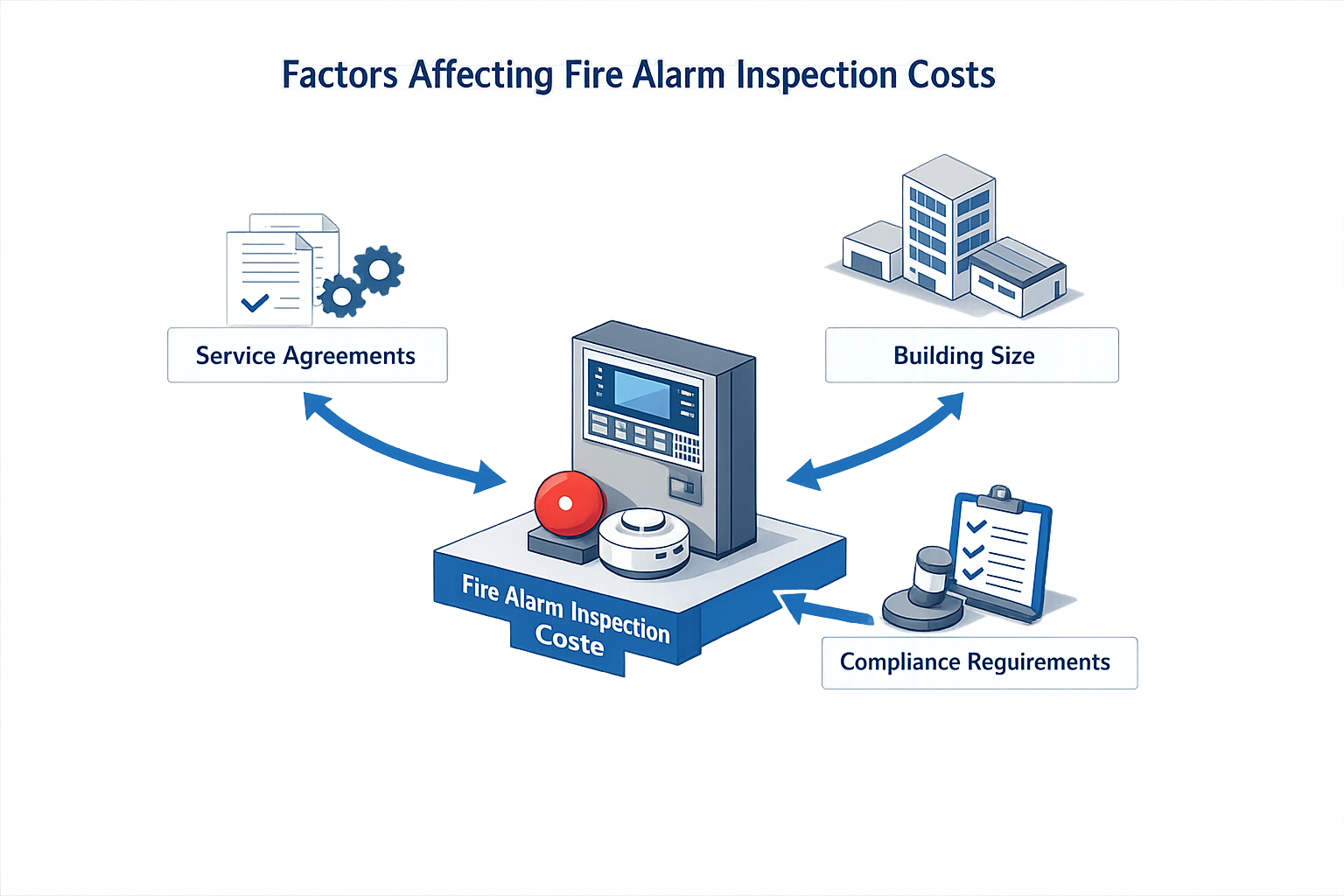
The standard requires an annual inspection, but what that inspection includes depends on the edition adopted locally and the system complexity. The provision does not itemize labor separately from testing, travel, or documentation — the quoted line is the service as a whole. When a quote arrives as one number without a breakdown, ask for it in writing: which tasks are included, which intervals they satisfy, and what triggers a separately priced visit.
What the Agreement Provides
A service agreement binds the obligated party to perform the work at the stated interval. The agreement provides the scope, the price, and the dispute window. If the scope says "annual inspection per NFPA 72" without naming the edition, the edition matters — different editions add or remove tasks. Before you authorize, confirm which edition the agreement references and whether that edition matches the code as adopted locally.
Some agreements bundle the annual visit with quarterly or semiannual checks. Others price them separately. Either remedy satisfies the standard if the interval and scope align. What closes the failure is the documentation: a report stating the system passed, signed by a licensed agency, with the date and the tasks performed.
Service Agreement Mechanics
The contract identifies the obligated party. If the agreement names a corporation, the corporation is liable; if it names an individual, that individual is liable. A personal guarantee block extends liability beyond the corporate entity. Check the signature block: who signed, in what capacity, and whether a guarantee appears below the signature line.
Default provisions specify what triggers acceleration or suspension. Common triggers include nonpayment, denial of access, or failure to correct a deficiency within the stated window. The dispute window starts when the obligated party receives written notice. If the agreement says "30 days to cure," that means 30 days from receipt of the notice, not from the date of the deficiency.
Factors That Influence the Quoted Line
System complexity drives the quoted line more than building size alone. A large building with a simple addressable panel may cost less to inspect than a small building with multiple networked panels, voice evacuation, and mass notification. The licensed agency prices what it must test, not the square footage.
The standard requires testing by device type and quantity. More devices mean more labor. More device types mean more test equipment and more documentation. A system with smoke detectors, heat detectors, manual pull stations, notification appliances, and supervisory devices requires more tasks than a system with only smoke detectors and pull stations.
Retain the record for the full interval. If the authority having jurisdiction requests proof of compliance, the record is what you produce. The report must show the date, the tasks performed, the devices tested, and the results. A report that says "system tested and passed" without itemizing the tasks does not close a code violation in most jurisdictions.
What the Report Actually Says
The report says the system passed or failed. If it failed, the report must state what failed and what remedy is required. Some failures permit two compliant remedies at different prices: repair the device or replace it. Only one of those reaches most quotes. Ask which remedy the quote includes and whether the alternative is available.
If the report says a component is obsolete or discontinued, that does not mean replacement is mandatory. The standard requires the system to function, not that every component be current-production. A discontinued device that still functions and can be tested satisfies the standard unless a specific provision requires replacement.
For more context on how regulatory timelines work in California property matters, see Insurance Adjuster Contact Timeline: California Regulations.
What closes the failure is the documentation: a report stating the system passed, signed by a licensed agency, with the date and the tasks performed.
Compliance Requirements and Intervals
NFPA 72 specifies annual inspections for most system components. Some components require semiannual or quarterly checks; others require testing every five years. The annual visit does not include the five-year internal assessment, and the two are frequently quoted as one line. Verify which interval the quote satisfies.
The owner performs some checks; a licensed agency performs others. Monthly and quarterly checks are often owner-performed. Annual inspections and five-year testing typically require a licensed agency. The division varies by jurisdiction and by system type. Confirm which tasks the owner can perform and which require outside service.
The edition adopted locally determines which tasks are mandatory. California adopts NFPA standards by reference, but the adoption may lag the current edition by several years. A contractor quoting to the 2022 edition when the jurisdiction adopted the 2019 edition is quoting tasks that may not be required — or omitting tasks that are.
Agreement Terms and Dispute Windows
The agreement provides a dispute window for challenging a deficiency. If the report says a device failed and you believe it did not, the window starts when you receive the report. Most agreements allow 10 to 30 days. After the window closes, the deficiency stands unless you can show the report was factually incorrect.
Some agreements include a guarantee: if the system fails inspection by the authority having jurisdiction within a stated period after service, the licensed agency will return and correct the deficiency at no additional charge. The guarantee block specifies the duration and the conditions. Read it carefully: some guarantees exclude deficiencies caused by owner modifications, environmental changes, or third-party work.
If the agreement permits acceleration — demanding full payment of future visits upon default — the trigger and the notice requirement matter. Acceleration clauses typically require written notice and a cure period. Without those, the clause may not be enforceable. Ask for it in writing if the agency claims the right to accelerate.
Best Practices for Managing Inspection Costs
The standard requires an annual inspection. What you pay for it depends on how you structure the agreement, what you retain in writing, and whether you separate the mandated visit from optional work. Most overruns trace to one of three gaps: the scope was never priced separately, the interval was never confirmed in the agreement, or the obligated party changed and no one amended the contract.
Read the Agreement Before You Authorize
The provision permits either remedy when a component fails testing. A licensed agency can replace the device or certify a repair, and both satisfy the standard. The quote you receive should state which remedy the contractor will perform and what triggers the alternate. If the agreement says "repair as needed" without a separate line for replacement, ask for it in writing. The difference matters when a smoke detector ages out or a pull station requires a part the manufacturer discontinued.
Retain the record of what was separately priced. When a dispute arises over whether the annual visit included internal assessment of a backflow preventer or testing of a fire pump controller, the agreement provides the answer. If the document is silent, the contractor's interpretation usually prevails. Before you sign, confirm that the interval matches the standard and that each mandated task appears as a line item.
Separate Owner-Performed Checks from Licensed-Agency Service
The owner performs monthly visual inspections and quarterly functional tests on certain devices. A licensed agency performs the annual inspection and any work that requires certification. Mixing the two in a single agreement creates confusion about who is responsible when a component fails between visits. The standard distinguishes these tasks by interval and by the qualifications required to close a deficiency.
If your agreement bundles monthly checks with the annual visit, confirm that the contractor will document each separately. The authority having jurisdiction expects to see a log of owner-performed tasks and a separate report from the licensed agency. One does not substitute for the other, and neither closes a code violation unless the record shows the date, the finding, and the signature of the person who performed the work.
Establish What Closes a Failure
The report says the system failed. Before you approve the remedy, establish who is permitted to close that failure. Some deficiencies require a licensed fire alarm contractor; others permit an electrician or a building engineer to perform the correction if they document it properly. The edition matters—NFPA 72 defines who may certify specific repairs, and the local adoption may impose additional restrictions.
Within the dispute window, you can challenge a finding if the contractor's report does not match what the standard actually says. Service agreements typically allow 10 to 30 days to raise a dispute in writing. After that window closes, the finding stands, and the obligated party must either complete the remedy or accept default. Check the date on the report and count forward; if you wait too long, the option to contest disappears.
The cheapest agreement is the one whose scope you can defend to the authority having jurisdiction without requesting an extension or a variance.
Budget for the Interval, Not the Visit
The internal assessment is a five-year item. The annual visit does not include it, and the two are frequently quoted as one line. When you budget for "annual fire alarm inspection," confirm whether the figure covers only the mandated yearly tasks or whether it includes items due at longer intervals. If the agreement rolls all inspections into a single annual fee, ask for a breakdown. Otherwise, you may face an unexpected charge in year five when the contractor arrives to perform the internal assessment.
Replace the gauge every five years, or test it against a calibrated instrument. Only one of those reaches most quotes. If your budget assumes testing and the agreement specifies replacement, the cost will exceed your estimate. As adopted locally, the standard may permit either remedy, but the agreement governs which one the contractor will perform. Read it before the work begins, not after the invoice arrives.
Retain Documentation the Standard Requires
Retain the record of every mandated inspection for the period the standard specifies. NFPA 72 requires a permanent log of all inspections, tests, and maintenance. The authority having jurisdiction can request this documentation at any time, and failure to produce it may result in a notice of violation even if the work was performed. The agreement should state who maintains the log and in what format.
If the contractor provides a digital report, confirm that you can access it after the agreement expires. Some service platforms lock records behind a subscription; if you switch providers, you may lose the history. Ask for it in writing: either the contractor delivers a portable copy of all records at the end of the term, or you maintain your own parallel log. Either satisfies the standard, but one party must hold the complete record.
Review the Agreement for Default and Acceleration Clauses
Service agreements often include default provisions that accelerate payment if the owner fails to grant access or delays a mandated repair. If the contractor arrives for the annual inspection and cannot enter the building, the agreement may treat that as a material breach. The obligated party remains liable for the full term's fees, even if no work was performed.
Suspension clauses permit the contractor to pause work if payment is overdue, but they do not suspend the owner's obligation to maintain code compliance. If the agreement is suspended and the authority having jurisdiction cites a deficiency, the owner cannot use the suspension as a defense. The standard requires the system to remain in service regardless of the contract's status. Before you authorize any agreement with default or acceleration language, confirm that your access procedures and payment timelines align with the contractor's requirements.
For guidance on how regulatory timelines affect service agreements, see Insurance Adjuster Contact Timeline: California Regulations.
Common Mistakes to Avoid During Inspections

The annual fire alarm inspection process contains predictable failure points. Most arise from confusion about what the standard requires, who performs each element, and what documentation closes a cited deficiency. Understanding these patterns helps building owners avoid delays, duplicate charges, and compliance gaps.
Confusing Owner-Performed Checks With Licensed-Agency Service
NFPA 72 distinguishes between visual checks the owner performs and testing a licensed agency performs. The monthly battery test and quarterly panel indicator check are owner responsibilities. The annual inspection — including device sensitivity testing, circuit verification, and system documentation — requires a licensed technician.
Quoting the annual visit without clarifying which party performs the monthly and quarterly items creates confusion. Some agreements bundle all intervals into one annual price; others price only the licensed work and assume the owner handles the rest. Before you authorize a quote, establish which intervals the contractor performs and which remain your obligation.
Failing to Retain Inspection Records
The standard requires retention of all inspection, testing, and maintenance records for the life of the system or as adopted locally — whichever is longer. California fire code typically mandates a minimum retention period. When an authority having jurisdiction requests documentation, the owner must produce it.
Many owners assume the contractor retains these records on their behalf. Unless the service agreement explicitly obligates the contractor to maintain and produce records, that responsibility remains with the building owner. Ask for copies of all reports in writing, and store them where you can retrieve them during an inspection or lease audit.
Authorizing Repairs Without Understanding What Closes the Failure
When a report identifies a deficiency, the authority having jurisdiction determines what remedy closes it. Some failures require only documentation of corrective action; others require re-inspection by the original citing agency. Authorizing a repair without confirming the closure process can result in duplicate visits and charges.
Before you approve a remedy, ask the contractor whether the work closes the violation or whether the AHJ must verify compliance. If re-inspection is required, establish who schedules it, who pays for it, and what happens if the first attempt does not satisfy the inspector. Separately priced re-inspection visits should appear in the original quote, not as surprise charges later.
Assuming All Quoted Work Satisfies the Same Standard Edition
NFPA standards are updated on a cycle, and local adoption lags behind publication. A contractor quoting work under NFPA 72-2019 may be using a different interval or testing method than the edition your jurisdiction adopted. If the quoted scope does not match the locally adopted standard, the inspection will not close the compliance requirement.
Check the date on the locally adopted code before you authorize any work. If the contractor's quote references a different edition, ask them to confirm that the scope satisfies the edition your AHJ enforces. The edition matters — what closes a deficiency under one version may not satisfy another.
Treating the Agreement as a Guarantee of Compliance
A service agreement obligates the contractor to perform specified work at specified intervals. It does not guarantee that the building will pass inspection, that no deficiencies will be found, or that the system will not fail between visits. The agreement provides service; compliance depends on the system's condition, the completeness of prior maintenance, and whether the owner has performed the checks assigned to them.
Some agreements include a guarantee block identifying the obligated party and the scope of any warranty. Read it carefully. If the guarantee covers only the work performed during the visit — not the system's overall compliance — a failure discovered one month later may not trigger any remedy from the contractor. For guidance on handling disputes with service providers, see Filing a Complaint With the California Department of Insurance.
Scheduling the Inspection Too Close to the Deadline
The standard specifies intervals from the last compliant inspection, not from the calendar year. If the previous inspection occurred in March, the next annual visit must occur by the following March. Scheduling it for late February leaves no margin for discovered deficiencies, required repairs, or re-inspection.
Building owners who schedule within days of the deadline risk citation if the contractor identifies work that cannot be completed before the interval expires. Schedule the annual visit at least 30 days before the compliance deadline. This provides time to address any findings, obtain required parts, and complete re-inspection if the AHJ requires it.
Accepting Verbal Explanations Without Written Documentation
When a contractor states that a deficiency is minor, that a component does not require replacement, or that a cited item is outside the scope of the standard, ask for it in writing. Verbal assurances do not satisfy an AHJ, and they provide no record if the explanation later proves incorrect.
What the report actually says controls the compliance outcome. If the written report identifies a deficiency, the authority having jurisdiction will expect documentation that it was corrected — regardless of what the technician told you on site. Request written clarification of any verbal statement that contradicts the inspection report, and retain that clarification with the report itself.
Frequently Asked Questions About Annual Fire Alarm Inspections
How often does the standard require an annual fire alarm inspection?
NFPA 72 requires annual testing and inspection of fire alarm systems. The interval is calendar-based — twelve months from the last annual service, not from installation or occupancy. The standard does not permit skipping a year because no deficiencies appeared in the prior cycle. The annual visit is separate from any semi-annual, quarterly, or monthly checks the standard also mandates for specific components.
What is the difference between the annual inspection and the owner's weekly or monthly checks?
The owner performs visual checks — confirming panel indicators, testing manual pull stations on rotation, and verifying that notification appliances are unobstructed. These checks do not require a licensed agency. The annual inspection includes functional testing of detectors, verification of circuit supervision, and documentation that closes the compliance interval. Only a qualified technician operating under a licensed agency performs the annual inspection.
Does the annual inspection include the five-year internal detector assessment?
No. The five-year internal assessment is a separate line item under NFPA 72. The annual visit does not open detectors for internal contamination checks or sensitivity testing. Quotes that bundle the annual inspection and the five-year assessment as a single service obscure two distinct requirements. Ask for them separately priced, and verify that the service agreement identifies which interval each line satisfies.
Can the building owner perform the annual inspection to reduce costs?
The standard requires that the inspection be performed by qualified personnel. Most authorities having jurisdiction interpret this to mean a licensed fire alarm company or a technician holding the appropriate state certification. An owner who holds that certification and works under a licensed entity may perform the inspection, but the documentation must show the license number and the entity responsible for the work. Self-performed inspections by unlicensed owners do not close the compliance interval.
What happens if the annual inspection reveals a deficiency?
The technician documents the deficiency in the inspection report and provides a recommended remedy. The standard does not require immediate correction of every deficiency, but it does require that the deficiency be addressed within a timeframe appropriate to the hazard. A failed detector that leaves a zone unprotected is more urgent than a cosmetic panel issue. Retain the report, obtain a written scope for the repair, and confirm that the follow-up documentation closes the deficiency before the next annual interval.
Does a service agreement guarantee a fixed annual inspection cost?
A service agreement typically fixes the base inspection fee for the contract term. It does not fix the cost of repairs, replacements, or additional testing triggered by deficiencies found during the inspection. Read the agreement to identify what the annual fee covers — the inspection visit, the report, and a defined scope of minor adjustments — and what triggers a separately priced remedy. Agreements that promise "all-inclusive" annual service without listing exclusions often shift repair costs into ambiguous categories when deficiencies appear.
Who is the obligated party on a fire alarm service agreement?
The entity that signs the agreement is the obligated party. If the building owner signs, the owner is obligated. If a property management company signs on behalf of the owner, verify whether the agreement names the owner as the principal or whether the management company alone is liable. A personal guarantee block signed by an individual makes that person liable if the entity defaults. Before you authorize a multi-year agreement, confirm who the contract binds and whether a change in property management or ownership terminates or transfers the obligation.
How long must the building owner retain annual inspection records?
NFPA 72 requires that inspection and testing records be retained until the next inspection, but most authorities having jurisdiction require retention for at least three years. California fire code adoption typically mandates a five-year retention period for fire protection system records. Retain the annual report, any deficiency notices, repair documentation, and proof that the licensed agency closed each deficiency. These records are the first items an inspector requests during a compliance audit, and their absence can reopen a closed violation.
Can an authority having jurisdiction require more frequent inspections than the annual interval?
Yes. The standard sets a minimum interval; a local authority may adopt a more stringent requirement. Some jurisdictions require semi-annual inspections for high-occupancy buildings or facilities with a history of system failures. The authority's order supersedes the standard's baseline interval. If you receive a notice requiring inspection more frequently than annually, ask for it in writing and confirm which local ordinance or fire district regulation establishes the interval. For guidance on navigating regulatory disputes in California, see Filing a Complaint With the California Department of Insurance.
What does the report actually say when a system fails the annual inspection?
The report identifies the specific deficiency — a non-responsive detector, a supervision fault, a failed notification appliance — and states whether the deficiency prevents the system from meeting the standard's requirements. The report does not typically use the word "fail" as a pass/fail grade; it describes what does not comply and what remedy the standard permits. A report that says "system operational with noted deficiencies" means the system functions but does not fully satisfy the edition in force. A report that says "system not in compliance" means a deficiency exists that the authority can cite.
Conclusion
The annual fire alarm inspection is a mandated interval under NFPA 72, and the cost reflects the work the standard requires—not what a vendor chooses to include. The provision specifies testing of notification appliances, control equipment, and initiating devices; what appears on the quote depends on how the contractor reads the applicable edition and whether they separate items the standard permits an owner to perform. Retain the inspection report with the date, the technician's license number, and the deficiencies identified. That record is what an authority having jurisdiction reviews, and it is what closes a code violation when the follow-up work is complete.
Before you authorize a remedy, confirm which entity is obligated under the service agreement and whether the quote addresses the actual deficiency or adds scope the report does not require. The agreement provides a dispute window; use it. Ask for clarification in writing, separately priced, so you understand what the standard demands and what the contractor recommends beyond it. The edition matters, the interval matters, and the documentation you retain determines whether the next inspection starts with a clean record or an open failure.
Managing inspection costs begins with knowing what the standard requires by interval and what a licensed agency must perform versus what an owner may check. The record you keep today is the record an auditor or fire marshal examines tomorrow. For guidance on regulatory timelines and documentation requirements in California, see our article on Insurance Adjuster Contact Timeline: California Regulations. When the work is complete, the paper trail should show exactly what was tested, what failed, and what remedy closed it—no more, no less.