Introduction
The standard requires periodic inspection of fire sprinkler systems by interval. California law determines who may perform that work and what documentation closes a compliance obligation. When an authority having jurisdiction opens a violation, the owner must produce records showing that the inspection was performed by a party authorized under state statute.
The distinction between owner-performed checks and licensed-agency service matters because the two are frequently quoted as one line. The annual visit does not include the internal assessment, and the five-year item does not appear on the monthly checklist. Before you authorize any work, establish which interval the quote addresses and whether the contractor holds the classification required to close that interval.
Permit requirements apply to construction, alteration, improvement, demolition, or repair of any building or structure. Applicants must file a statement confirming they are licensed under the relevant provisions or provide the basis for any claimed exemption. The statement is a condition precedent to issuance — no statement, no permit. If you're unsure whether your jurisdiction requires additional insurance adjuster contact timeline documentation alongside the permit statement, ask for it in writing before the work begins.
The edition matters. California adopts NFPA standards on a cycle, and the adopted edition determines which intervals apply. A contractor quoting 2019 intervals when the locally adopted code references 2016 is not quoting the standard you must satisfy. Check the date on the adoption ordinance before you compare quotes.
Problem Statement
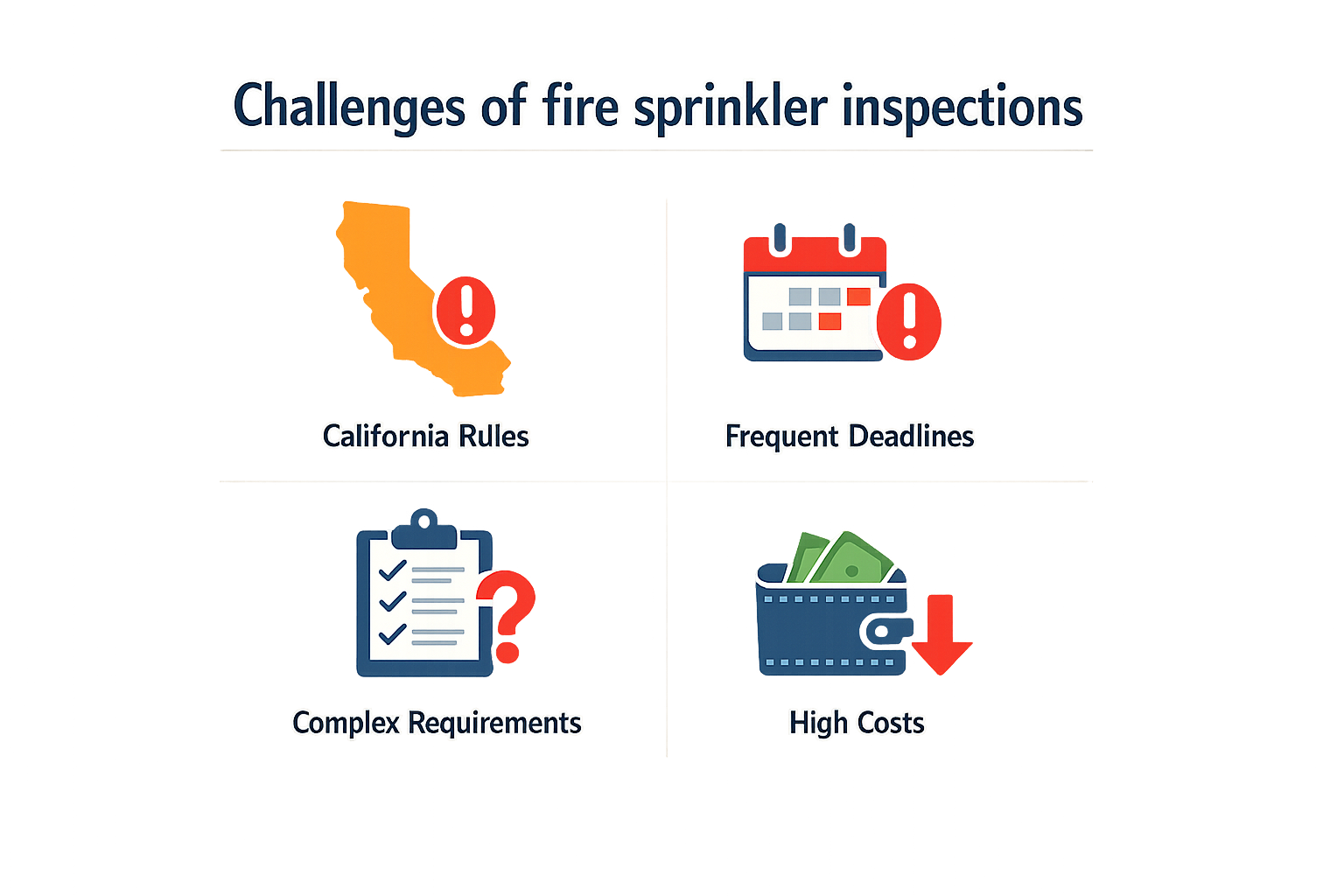
Property owners face a recurring question when an inspection notice arrives: who is permitted to perform the work? The answer splits along lines that are not obvious from the invoice. Installation, servicing, and inspection of fire protection systems in California require a contractor holding a fire protection contractor classification. An owner-builder exemption exists, but it applies only to owner-occupied single-family dwellings where no more than two units are involved — a narrow carve-out that excludes commercial property entirely.
The permit application itself creates a compliance checkpoint. Each jurisdiction that requires a permit for construction, alteration, or repair also requires the applicant to file a signed statement confirming licensure under the California Business and Professions Code. Violations of this permit application requirement carry a civil penalty of up to $500. The penalty attaches to the permit application, not to the inspection itself, but the two are frequently bundled in a single service agreement.
California Fire Sprinkler Inspection Requirements and Reporting Obligations
Licensees must report certain civil actions to the registrar within 90 days of knowledge. The criteria for reportable actions include allegations of fraud or negligence, judgments of $1 million or more, claims related to multifamily rental structures, and designation as a complex case by a court. This reporting obligation runs parallel to the inspection schedule — a contractor who performs annual or five-year service may also be obligated to disclose litigation that arose from prior work. The owner does not receive automatic notice of such disclosures, and the agreement rarely specifies whether a reportable event triggers a right to substitute contractors mid-term.
Service agreements for fire alarm systems sold in conjunction with alarm systems follow a separate contract regime under the Alarm Company Act. The fire protection contractor classification and the alarm company license do not overlap cleanly, and an invoice that bundles both services may obscure which entity is obligated on each line. When a dispute arises, the agreement's entity identification block and any personal guarantee provisions determine who answers — but many agreements list only a trade name, leaving the owner to chase down the registered entity after the fact. For more on navigating disputes with service providers, see Filing a Complaint With the California Department of Insurance.
The interval matters. Annual inspections, five-year internal assessments, and gauge replacements are frequently quoted as a single bundled service, but the standard treats them as distinct items with distinct documentation requirements. An agreement that does not separately price each interval leaves the owner unable to verify compliance when only one of the three is performed. The record the owner must retain and produce to the authority having jurisdiction is the record of the specific interval that was due — not a generic certificate of service.
Solution Steps
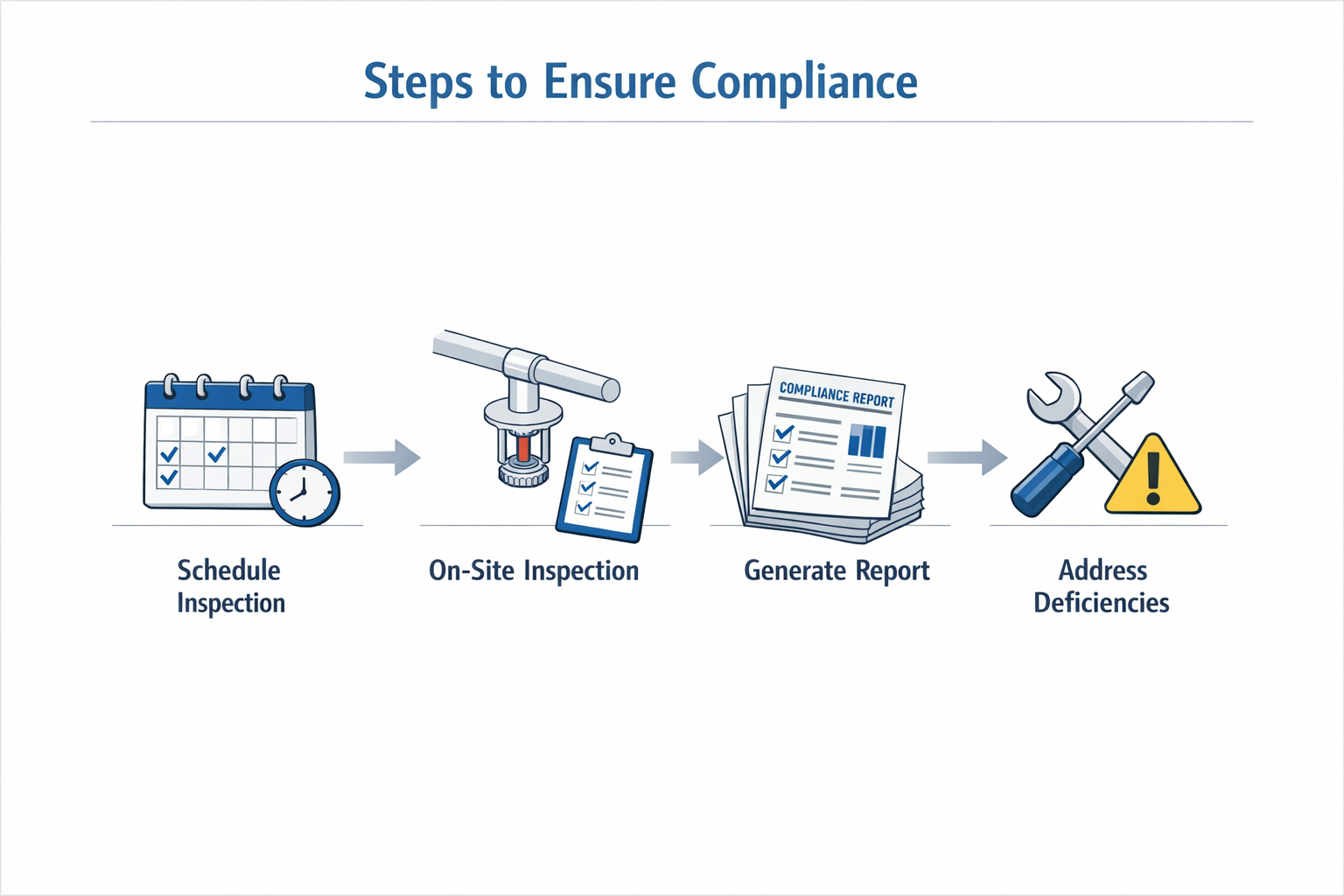
Compliance with California fire sprinkler inspection requirements follows a defined sequence. The standard requires specific intervals, the contractor must hold the correct license, and the owner retains the documentation. Each step closes a piece of the compliance obligation.
Step 1
Verify the inspection interval
The standard specifies the interval by system type and component. NFPA 25 governs most commercial sprinkler inspections, and California adopts it by reference. Annual inspections cover gauges, valves, and alarm devices. Five-year internal assessments address pipe condition and corrosion. The edition matters — confirm which year your jurisdiction adopted, because intervals and permitted alternatives change between editions.
Step 2
Confirm the contractor holds the required license
California law requires licensees performing fire sprinkler work to comply with contract requirements and execute a certification statement. The contractor must provide documentation to the contracting party before work begins. Ask for the license number in writing, verify it against the state database, and confirm the classification matches the scope of work. A C-16 Fire Protection license is the standard classification for sprinkler inspection and service.
Step 3
Obtain a written service agreement
The agreement must identify the obligated party, specify the inspection scope, and state the interval. Separately priced items prevent disputes later — the annual visit and the five-year internal assessment are not the same line item. The agreement should provide a dispute window, define what constitutes default, and specify whether the contract accelerates upon a missed payment. If the contractor is an individual or small entity, check whether a personal guarantee block appears and who signed it.
Step 4
Retain the inspection report
The report documents what the inspector found and what remedy, if any, the standard requires. Retain the record for the full compliance cycle. If the report identifies a deficiency, establish who is permitted to close that failure before you authorize the work. Some deficiencies require a licensed contractor; others permit owner-performed corrections. The report itself does not close a code violation — the corrective work and its documentation do.
Step 5
Coordinate with the authority having jurisdiction
The AHJ opens violations and determines what documentation closes them. If an inspection reveals a non-compliance, ask the AHJ in writing what they require to close the finding. Some jurisdictions accept a contractor's certification; others require a re-inspection. The standard does not dictate the AHJ's process — the adopted local code and the inspector's discretion do. Confirm the requirement before you schedule corrective work.
For property owners navigating disputes with contractors or insurers over fire protection system compliance, understanding California Department of Insurance complaint procedures can clarify your options when documentation or service quality is in question.
Tips and Tricks

Retain the record for five years, and keep it where you can produce it within thirty days. The Business and Professions Code requires licensees to maintain all documents for five years and make them available to the board within thirty days of a written request. As the building owner, you inherit that same retention window when a contractor hands you an inspection report or a service agreement. Store the document where you can retrieve it quickly — if an authority having jurisdiction asks for proof of compliance, a missing report is treated the same as an incomplete inspection.
Ask for the License Number in Writing
Before you authorize any inspection or repair, confirm the contractor holds a current C-16 license and ask them to provide the license number in writing on the proposal or service agreement. California law ties the document-retention obligation to the licensee, and you cannot verify compliance if the contractor's identity is ambiguous. If a dispute arises later, the license number establishes which entity is obligated on the agreement and whether a personal guarantee block applies.
When reviewing a proposal, check that the scope separates the annual inspection from the five-year internal assessment. The two are frequently quoted as one line, but the standard requires them at different intervals, and only the five-year item includes opening the sprinkler heads. A combined price obscures what you are actually purchasing and makes it harder to verify that the contractor performed the correct procedure at the correct interval.
All documents required must be retained by the licensee for five years and made available to the board within thirty days of a written request.
Verify Compliance with Building Permit Requirements
Any modification to a fire sprinkler system — including replacing components during an inspection — may trigger a building permit requirement under state and local law. Before you approve a repair that involves cutting pipe, relocating a head, or replacing a valve, ask the contractor whether the work requires a permit and who is responsible for obtaining it. Some jurisdictions permit minor repairs without a permit; others require one for any change to the system's configuration. The contractor should know the local rule and should state it in writing on the proposal.
If you are managing a property subject to insurance or regulatory timelines, consider linking your inspection schedule to those deadlines. For example, if your insurer requires an annual sprinkler inspection as a condition of coverage, schedule the inspection at least sixty days before the policy renewal date. That buffer gives you time to complete any required repairs and obtain the updated documentation before the renewal deadline. For more on managing regulatory timelines, see our guide on Insurance Adjuster Contact Timeline: California Regulations.
What to Do When a Report Shows a Failure
When an inspection report identifies a deficiency, establish who is permitted to close that failure before you approve the remedy. Some deficiencies can be corrected by the building owner; others require a licensed contractor. The report should state the deficiency in terms that reference the applicable standard — for example, "low water pressure at the most remote head" or "missing tamper switch on the main valve." If the report uses vague language like "system not in service" without specifying the deficiency, ask the contractor to revise the report with the specific finding.
Once you receive a revised report, verify that the proposed remedy matches the deficiency. A contractor who finds a missing tamper switch should quote the cost of installing a tamper switch, not the cost of replacing the entire valve assembly. If the quote includes work that was not identified in the inspection report, ask the contractor to separate the required repair from the recommended upgrade. The two may both be worthwhile, but only the required repair is needed to close the deficiency.
Conclusion
California fire sprinkler inspection requirements rest on three pillars: the standard names the interval, the contractor classification defines who performs the work, and the documentation closes the violation. Property owners who understand these distinctions avoid the common pitfall of treating every inspection as interchangeable when the provision actually separates owner-performed checks from licensed-agency service.
The record you retain determines what an authority having jurisdiction accepts. When a contractor states that an inspection satisfies the requirement, ask which standard, which edition, and which section. When a service agreement bundles multiple intervals into one annual line, separate them on paper before you authorize payment. The cheapest quote often omits the five-year items or assumes the owner will perform the weekly and monthly checks without stating that assumption in writing.
Willful or deliberate disregard of building laws can trigger disciplinary action against a licensee, and permit violations carry civil penalties. The system protects owners who verify credentials, read the agreement's dispute window, and retain the inspection report with the date and the performing entity's license number. What closes a code violation is not the invoice—it is the compliant record, signed by someone the jurisdiction recognizes as qualified to perform that specific inspection at that specific interval.
For broader guidance on managing compliance timelines and documentation expectations in California, see our article on Insurance Adjuster Contact Timeline: California Regulations. When a dispute arises over service quality or contract terms, understanding your options under state oversight can clarify the next step—our guide to Filing a Complaint With the California Department of Insurance walks through the process and the documentation the department expects.
The standard requires it. The contractor classification permits it. The record proves it. Everything else is negotiation.