
Introduction
The commercial fire alarm inspection cost question arrives when a property receives its first quote, when a service agreement comes up for renewal, or when an authority having jurisdiction opens a violation. In each case, the owner needs to know what the standard requires by interval, what a licensed agency must perform versus what the owner performs, and how to read a quote that may combine multiple intervals into a single line. The edition of NFPA 72 adopted locally determines the inspection frequency and the tasks at each interval. A quote that does not name the standard, the edition, and the interval it satisfies leaves the owner unable to verify compliance or compare vendors on equivalent scope.
California law requires that individuals performing installation, maintenance, and servicing of alarm systems hold an alarm company operator's license. The installation of fire protection systems must be performed by a contractor holding a fire protection contractor classification, except in limited owner-builder scenarios for single-family dwellings. These licensing requirements establish who is permitted to sign an inspection report and close a code violation. When evaluating service quotes, confirm that the entity named on the agreement holds the appropriate license and that the individual performing the work is authorized under that license. For more context on regulatory timelines and compliance documentation, see Insurance Adjuster Contact Timeline: California Regulations.
Understanding commercial fire alarm inspection cost begins with separating what the standard mandates from what a vendor proposes. The standard specifies tasks by interval — weekly, monthly, quarterly, semi-annual, annual, and multi-year. Some tasks the owner performs; others require a licensed agency. A compliant quote identifies each interval, states what that interval includes, and prices separately any item the standard permits as an alternative remedy. When a quote does not break out the intervals, the owner cannot verify that the scope matches the adopted edition or that the price reflects the actual labor required. The goal is not to find the lowest number, but to confirm that the quote covers what the standard requires and that the documentation will satisfy the authority having jurisdiction when the record is requested.
Problem Statement
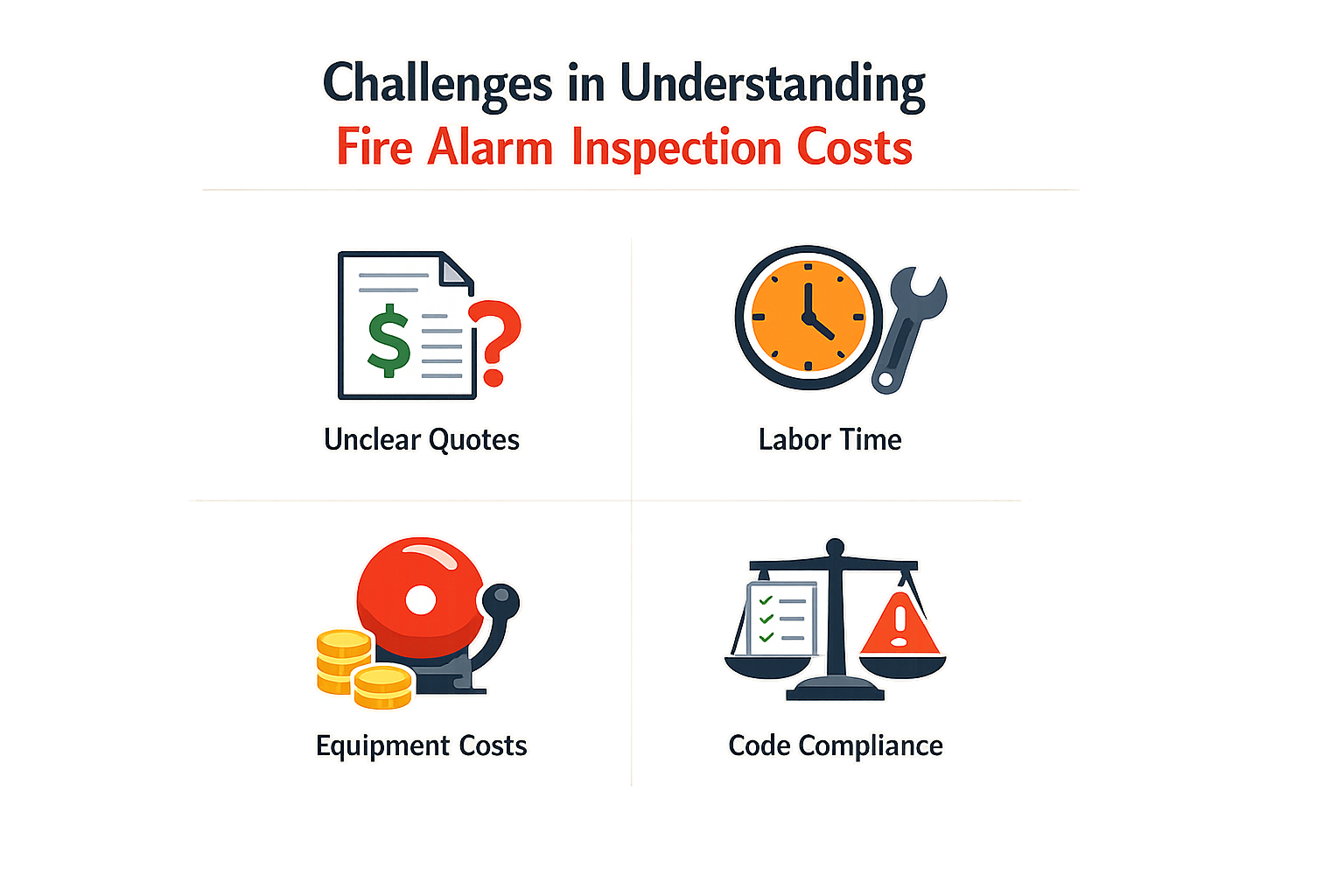
A commercial fire alarm inspection cost quote arrives with line items that reference standards by number, intervals that sound similar but carry different labor requirements, and scope language that may or may not include the work the standard actually requires. The quote does not explain which tasks are owner-performed checks and which require a licensed agency, nor does it clarify whether the price covers the full provision or only part of it. When a second quote arrives at a different price for what appears to be the same service, the difference is rarely transparent.
Who May Perform the Work
California law restricts fire protection system installation and alteration to contractors holding a fire protection contractor classification. Alarm system work—installation, maintenance, monitoring, selling, alteration, or servicing—falls under a separate licensing regime: the alarm company operator's license. The distinction matters because the entity performing the inspection determines both the legal compliance of the work and the enforceability of the service agreement. A quote that does not identify the licensed entity leaves the obligated party unclear.
Scope Ambiguity in Standard Quotes
NFPA standards specify inspection tasks by interval: annual, semiannual, quarterly, monthly. A quote that lists "annual fire alarm inspection" without breaking out the individual tasks required by the applicable edition of NFPA 72 does not permit a line-by-line comparison against the standard. When the standard permits two compliant remedies at different prices—such as replacing a component versus testing it against a calibrated instrument—a quote that bundles both into a single line obscures which remedy the contractor intends to perform. The cheaper remedy may satisfy the standard, but the quote does not say which one is priced.
Interval Confusion and Overlapping Requirements
The annual visit does not include every task the standard requires. Some tasks recur at five-year intervals; others are quarterly or monthly owner-performed checks. A quote that presents the annual visit and the five-year internal assessment as a single line conflates two separate obligations with different labor requirements and different personnel qualifications. When a quote does not separately price the owner-performed checks, it is unclear whether the contractor is assuming those tasks or expecting the owner to perform them without guidance.
Documentation and Compliance Gaps
The standard requires retention of inspection records, and an authority having jurisdiction expects to see those records when a violation is opened. A quote that does not specify what documentation the contractor will deliver—test results, deficiency reports, certifications—leaves the owner without a clear understanding of what closes a code violation. If you're navigating a regulatory dispute and need guidance on timelines and documentation requirements, understanding insurance adjuster contact timelines can clarify the expectations around record production and response windows.
The quote does not explain which tasks are owner-performed checks and which require a licensed agency, nor does it clarify whether the price covers the full provision or only part of it.
Service Agreement Terms and Dispute Windows
A service agreement attached to a quote may include default provisions, acceleration clauses, or suspension terms that shift financial risk to the owner if a dispute arises. The agreement may not specify a dispute window—the period within which the owner can challenge a deficiency finding or a recommended remedy before the contractor proceeds with billable work. When the agreement does not name the obligated party or include a personal guarantee block, enforcement becomes uncertain if the contractor's corporate status changes or if the work is subcontracted.
Edition and Adoption Uncertainty
The standard edition adopted locally determines which tasks are required and at what intervals. A quote that does not name the edition being applied—NFPA 72-2010, 2013, 2016, 2019, or 2022—cannot be verified against the local code. California jurisdictions adopt editions on different schedules, and a contractor quoting under an outdated edition may be pricing work that no longer satisfies the current requirement. The edition matters, and the quote should say which one governs.
Solution Steps for Evaluating Inspection Costs
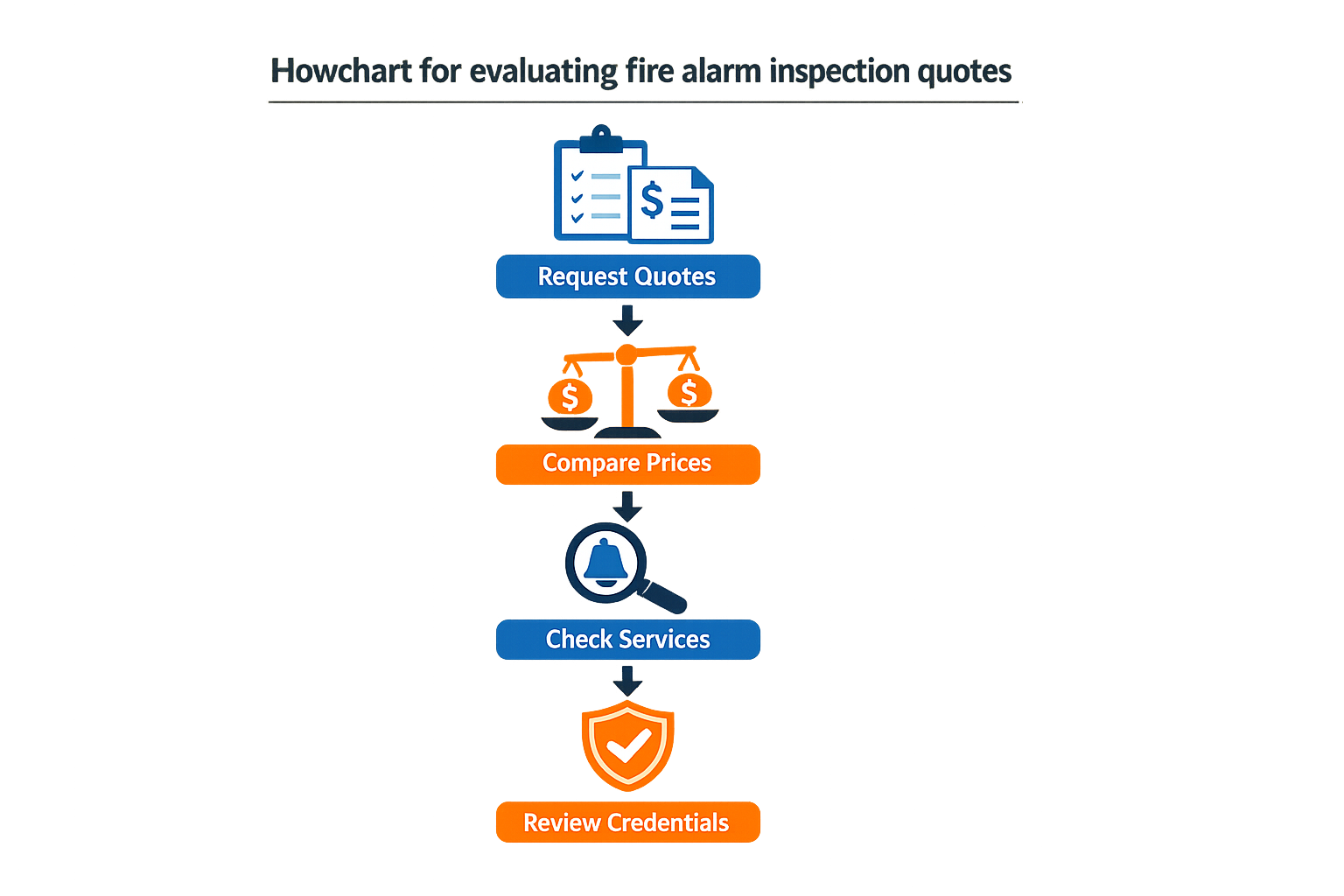
Evaluating a quote requires separating what the standard requires from what the contractor bundles. The interval determines the scope; the scope determines the labor; the labor drives the line item. Walk through the quote with the standard open, and confirm that each priced task corresponds to a mandated interval.
Step 1
Identify the interval and the applicable standard
Ask the contractor which edition of NFPA 72 applies to the building and which interval the quote covers. Annual, semiannual, quarterly, and monthly tasks are separately defined. A quote that lists "annual inspection" without naming the standard or the specific tasks may bundle owner-performed checks with licensed-agency work, inflating the scope. Confirm that the interval matches the adopted edition in your jurisdiction.
Step 2
Match each line item to a provision
Request that the contractor cite the NFPA 72 section number for each priced task. The standard lists tasks by device type and by interval. If a line item does not correspond to a numbered provision, ask whether it is required by the standard or offered as an optional service. Separately priced items that exceed the standard's scope are not part of the mandated inspection.
Step 3
Distinguish owner-performed checks from licensed work
NFPA 72 assigns certain checks to the owner and others to a qualified technician. Weekly, monthly, and some quarterly tasks are typically owner-performed; semiannual and annual inspections require a licensed agency. A quote that prices owner-performed tasks as contractor labor overstates the commercial fire alarm inspection cost. Ask the contractor to separate owner tasks from licensed tasks and to provide the relevant standard sections for each.
Step 4
Verify entity identification and insurance disclosure
The agreement must identify the obligated party—the legal entity performing the work—and disclose whether the contractor carries commercial general liability and workers' compensation insurance. California Business and Professions Code requires that service contracts include these notices and that the contractor's details appear in legible text. If the quote omits entity identification or insurance status, request it in writing before authorizing work.
Step 5
Confirm documentation and record retention terms
The contractor must provide a written report documenting each inspection, listing deficiencies, and certifying compliance or identifying failures. Ask whether the agreement specifies report delivery timelines, deficiency escalation procedures, and record retention responsibilities. The owner retains the inspection record; the contractor retains service documentation. If the agreement is silent on documentation, add a provision requiring delivery within a stated window after each visit.
Comparing Quotes Across Contractors
When you receive multiple quotes, align them by interval and by task. One contractor may price the annual inspection; another may bundle the annual and semiannual visits. If the intervals differ, the quotes are not comparable. Request that each contractor separate the quote by interval and by standard section, so that you can compare labor for identical tasks.
Some contractors offer a multi-year agreement with a discount. The discount applies to the total contract value, not to the per-visit cost. If a contractor accelerates payment on default or suspends service during a dispute window, the discount may not offset the risk. Review the agreement's dispute resolution, default, and acceleration clauses before committing to a multi-year term.
The cheapest quote is the one that prices only what the standard requires and documents what it performed.
What the Agreement Must Provide
A service agreement is a contract between the building owner and the licensed contractor. It must state the interval, the tasks, the price, the payment terms, and the documentation the contractor will deliver. It must identify the obligated party and disclose insurance status. If the agreement includes a personal guarantee block, it names the individual who guarantees the contractor's performance; that individual is separately liable if the contractor defaults.
The agreement should specify the window within which the owner may dispute a deficiency finding or a proposed remedy. If the contractor identifies a failure and proposes a repair, the owner has a stated number of days to request a second opinion or to challenge the finding. After that window closes, the contractor may proceed with the remedy or escalate the deficiency to the authority having jurisdiction. If the agreement is silent on the dispute window, negotiate one before signing.
For additional guidance on timelines and dispute windows in service agreements, see Insurance Adjuster Contact Timeline: California Regulations.
Tips and Tricks for Understanding Inspection Quotes

The quote you receive is not the final word — it is a proposal you evaluate against what the standard requires and what the agreement actually provides. Before you authorize work, confirm that the scope matches the interval, that the entity signing is the one you can hold to the terms, and that the documentation obligation is clear.
Ask for the scope in writing before you authorize
A verbal estimate does not satisfy your record retention obligation. The agreement must identify what the licensed agency will perform, at what interval, and under which edition of the standard. If the quote bundles annual and five-year items into one line, ask for them separately priced. The standard requires different procedures at different intervals, and a single bundled figure obscures whether both are included.
Verify the obligated party on the agreement
The entity that signs the service agreement is the one you pursue if the work fails or the documentation is incomplete. If the quote comes from a salesperson but the agreement names a different corporation, confirm which entity is obligated. A personal guarantee block on the agreement shows whether an individual backs the corporation's performance — ask for it in writing if the quote does not include it.
When a licensed agency subcontracts portions of the work, the agreement should state who retains responsibility for the full scope. The owner's obligation to retain records for the mandated inspection does not change when the contractor delegates tasks.
Confirm what documentation you will receive
The agreement should specify that the licensed agency will provide a written report after each visit, identifying what was inspected, what passed, what failed, and what remedy closes any failure. You must retain these records and produce them when the authority having jurisdiction requests them. If the quote does not mention documentation, ask what you will receive and in what format.
If the report says the system failed, the next step is to establish who is permitted to close that failure. Not every contractor can perform every remedy — the license class and the scope of work both matter. Before you approve a remedy, confirm that the entity quoting it holds the appropriate license and that the work falls within the agreement's dispute window.
Understand what the agreement provides within the dispute window
Service agreements typically include a window — often 30 or 60 days — during which you may dispute the scope, the performance, or the documentation. Outside that window, the terms may provide for default, acceleration, or suspension. Read the dispute provision before you sign, and calendar the deadline after each visit.
If you receive a report that conflicts with what the agreement promised, document the discrepancy in writing within the window. The agreement may require written notice to preserve your right to dispute the charge or the scope.
Check the date on the standard edition
The authority having jurisdiction adopts a specific edition of NFPA 25, 72, or 10, and that edition governs what the inspection must include. A quote based on an older edition may omit procedures the current edition requires. Ask the agency which edition they are quoting against, and verify that it matches what your jurisdiction has adopted locally.
When the edition changes, the interval or the procedure may change with it. A remedy that satisfied the prior edition may not satisfy the current one. If you are comparing quotes from multiple agencies, confirm that all are quoting the same edition — otherwise, you are not comparing equivalent scopes.
Separately price owner-performed checks and licensed-agency service
Some checks the owner performs; others require a licensed agency. The standard distinguishes between the two, and the quote should reflect that distinction. If the agreement bundles owner-performed checks into the licensed-agency price, you are paying for work you can perform yourself.
Before you authorize a bundled quote, ask which items the standard permits the owner to perform and which require a licensed agency. The provision permits either remedy to satisfy certain requirements — choose the one that fits your operation and your documentation capability.
Review the agreement's acceleration and suspension terms
If you miss a payment or fail to provide access for a scheduled visit, the agreement may provide for acceleration — the entire remaining balance becomes due immediately. Some agreements also permit suspension, where the agency stops work but the obligation to pay continues. Read these terms before you sign, and understand what triggers them.
For guidance on how regulatory timelines affect service agreements in California, see Insurance Adjuster Contact Timeline: California Regulations.
Conclusion
Commercial fire alarm inspection cost is not a single number. The standard requires different procedures at different intervals, and what you pay reflects the labor hours, the system's device count, and whether the work is owner-performed or requires a licensed agency. A quote that bundles the annual visit with the five-year internal assessment will look different from one that prices them separately, and neither is wrong—the edition matters, and the provision permits both.
Before you authorize payment, confirm three things: the standard and edition cited, the interval being satisfied, and what documentation the contractor will deliver. The report closes the requirement; without it, the inspection did not happen in the eyes of the authority having jurisdiction. Retain every record, ask for line-item pricing when the quote aggregates multiple intervals, and verify that the obligated party on the service agreement matches the entity you intend to hold accountable.
The agreement provides dispute windows, default terms, and acceleration clauses. Read them before you sign, not after a failure appears on an inspection report. What the report actually says determines who is permitted to close that failure, and a contractor's verbal assurance does not override the written standard. If you need guidance on regulatory timelines or filing procedures when a dispute arises, resources like Filing a Complaint With the California Department of Insurance explain the documentation an authority expects and the windows within which you must act.
The cheapest bid is not always the compliant bid. Check the date on the standard, confirm the interval, and keep the paper trail that proves the work was done to the edition adopted locally. That record is what you produce when the inspector asks, and it is the only thing that closes the line item.