
Introduction
The monthly rate for commercial fire alarm monitoring cost reflects transmission to a central station, not the full scope of what keeps a system compliant. The standard requires periodic inspection, testing, and maintenance by interval, and monitoring does not satisfy those requirements. When a property changes hands or a tenant improvement triggers a new certificate of occupancy, the new owner inherits the monitoring agreement unless the contract provides otherwise. The obligated party is named in the signature block, and a personal guarantee block — if present — extends liability beyond the entity.
Most quotes bundle monitoring with an annual inspection, and the two are frequently presented as a single service. They are not. The annual visit satisfies one interval under the standard; monitoring satisfies the transmission requirement. If the agreement terminates, monitoring stops immediately, but the inspection interval does not reset. For more context on regulatory timelines and compliance documentation, see Insurance Adjuster Contact Timeline: California Regulations.
The agreement provides the dispute window, the default trigger, and the acceleration clause. The dispute window is the period during which you may contest an invoice or a failure determination without triggering default. The default trigger is the event — typically nonpayment or a missed inspection — that permits the contractor to suspend service or accelerate the remaining term. The acceleration clause converts future monthly charges into a lump sum due immediately. These provisions are negotiable before signing; they are not negotiable after the first invoice.
Before you authorize the first payment, establish what the contract price includes. It includes monitoring transmission. It may include an annual inspection, a quarterly inspection, or no inspection at all. It does not include remedial work unless the agreement explicitly states otherwise. When the system fails and the contractor quotes a repair, that repair is separately priced unless the agreement caps remedial work or includes a defined scope of covered failures. Ask for it in writing, and retain the record.
Problem Statement
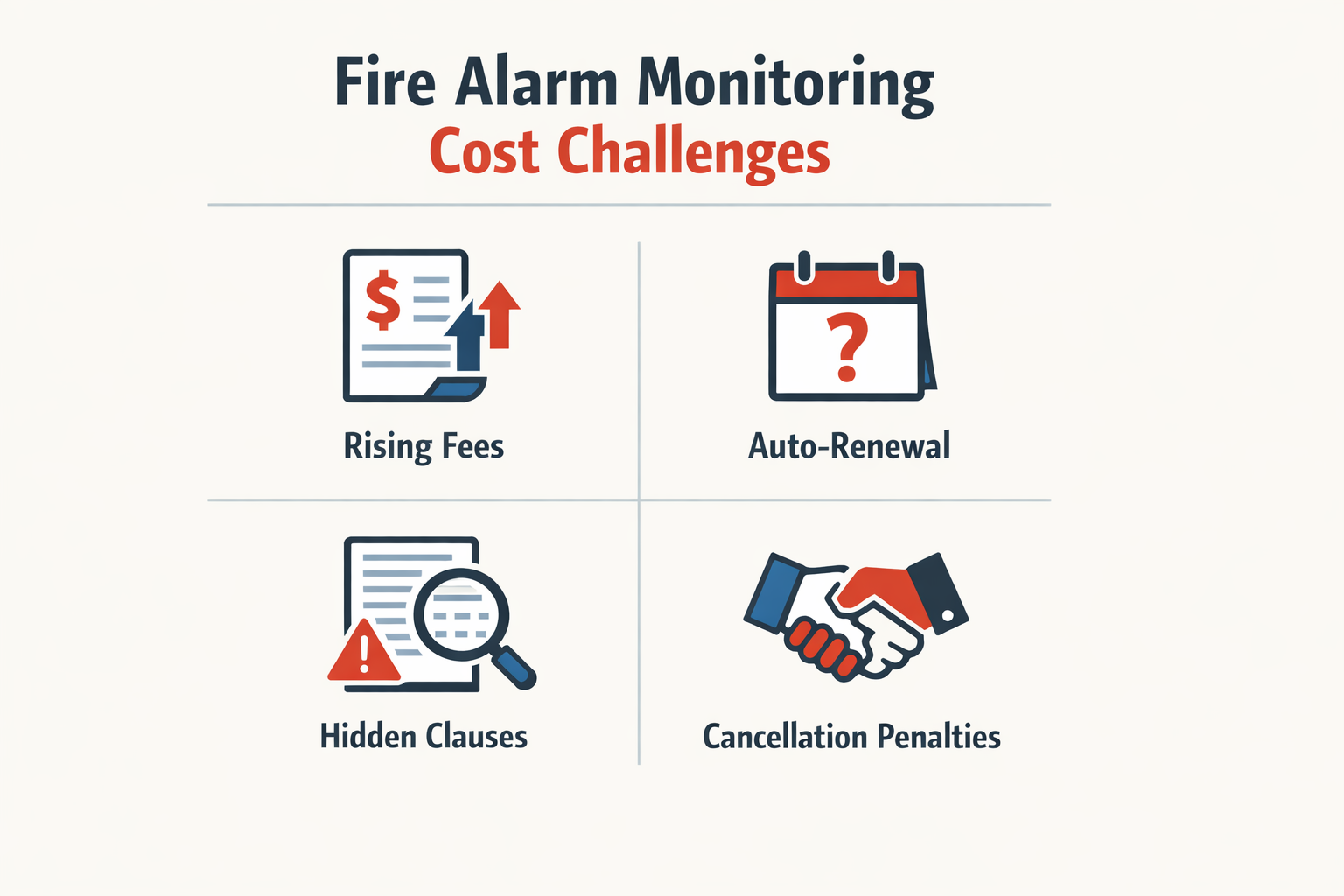
The monthly rate for commercial fire alarm monitoring cost appears straightforward until the agreement defaults or a compliance question surfaces. At that moment, what seemed like a simple monitoring fee reveals layers of obligation the owner did not anticipate. The contract may bundle monitoring with annual inspection, quarterly testing, or system maintenance under a single line item, and the owner learns only during a dispute that the monthly charge covered one service while another was separately priced all along.
Most agreements state the monitoring rate but leave the remedy for a failed inspection to a separate schedule or a verbal understanding. When the authority having jurisdiction issues a notice, the owner asks the monitoring company to close the violation, only to discover that the agreement provides monitoring only — the licensed agency that performs the annual inspection is a different entity, with a different contract and a different dispute window. The two services were never bundled, but the monthly invoice suggested they were.
Mismatched Expectations Around Commercial Fire Alarm Monitoring Cost
The standard requires specific inspections by interval, and the monitoring agreement does not satisfy those intervals by itself. NFPA 72 mandates testing and inspection of alarm systems at defined frequencies, and a monitoring contract that transmits signals to a central station does not replace the on-site inspection a licensed technician must perform. The owner who assumes the monthly monitoring fee covers compliance discovers, often during an audit or after a system failure, that the agreement provided only signal transmission and that the required inspection was never scheduled.
Another common misalignment: the agreement permits the monitoring company to suspend service for non-payment after a short notice period, but it does not permit the owner to suspend payment when the system fails and the company has not yet dispatched a technician. The contract's default and acceleration clauses are asymmetric, and the owner who withholds payment to secure faster service finds the account in default and the monitoring discontinued, leaving the building out of compliance and the violation open.
The entity identification block on the agreement matters. If the monitoring company is a separate legal entity from the inspection contractor, a claim against one does not bind the other, and the owner must pursue each separately. The personal guarantee block, if present, may obligate an individual when the corporate entity dissolves, but only if the block was completed and signed at execution. An incomplete guarantee block provides no fallback, and the owner's remedy ends when the company closes.
Contract Terms That Obscure the True Commercial Fire Alarm Monitoring Cost
Service agreements frequently state a base monitoring rate and add charges for after-hours dispatch, parts, or travel as separately priced items. The monthly statement lists the monitoring fee, and the owner assumes that fee includes the technician's response when the system signals trouble. When the technician arrives and presents a separate invoice for the service call, the owner objects, but the agreement permitted the additional charge all along — it was listed in a schedule the owner signed but did not retain.
Another issue: the agreement may provide a dispute window of thirty or sixty days, but the owner who receives an invoice and waits to dispute it until the next billing cycle has already passed the window. The contract treats silence as acceptance, and the charge becomes non-disputable. For more on how regulatory timelines govern disputes, see Insurance Adjuster Contact Timeline: California Regulations.
The agreement may also state that the monitoring company will "maintain" the system, but the term "maintain" is not defined, and the owner assumes it includes all repairs. When a component fails and the company quotes a replacement, the owner argues that maintenance should have prevented the failure. The agreement, however, defined maintenance as periodic testing only, and repair was always a separately priced remedy. The two were never equivalent, but the contract did not make that distinction clear.
The cheapest monitoring rate is the one whose contract you can read to the end without discovering a separately priced obligation mid-dispute.
Record retention becomes critical when a dispute escalates. The owner must produce the signed agreement, the service history, and any written amendments to establish what the contract actually required. If the monitoring company claims the owner authorized an upgrade or a rate increase, the owner who cannot produce a written authorization will find the claim difficult to contest. The agreement provides that all amendments must be in writing, but the owner who accepted a verbal assurance and did not ask for it in writing has no evidence the amendment was unauthorized.
The standard requires the owner to retain inspection records for the life of the system or a specified retention period, whichever is longer. A monitoring agreement that does not provide copies of those records, or that charges separately for record retrieval, leaves the owner unable to demonstrate compliance when the authority having jurisdiction requests documentation. The monthly monitoring fee did not include record retention, and the owner learns that only when the records are needed.
Solution Steps
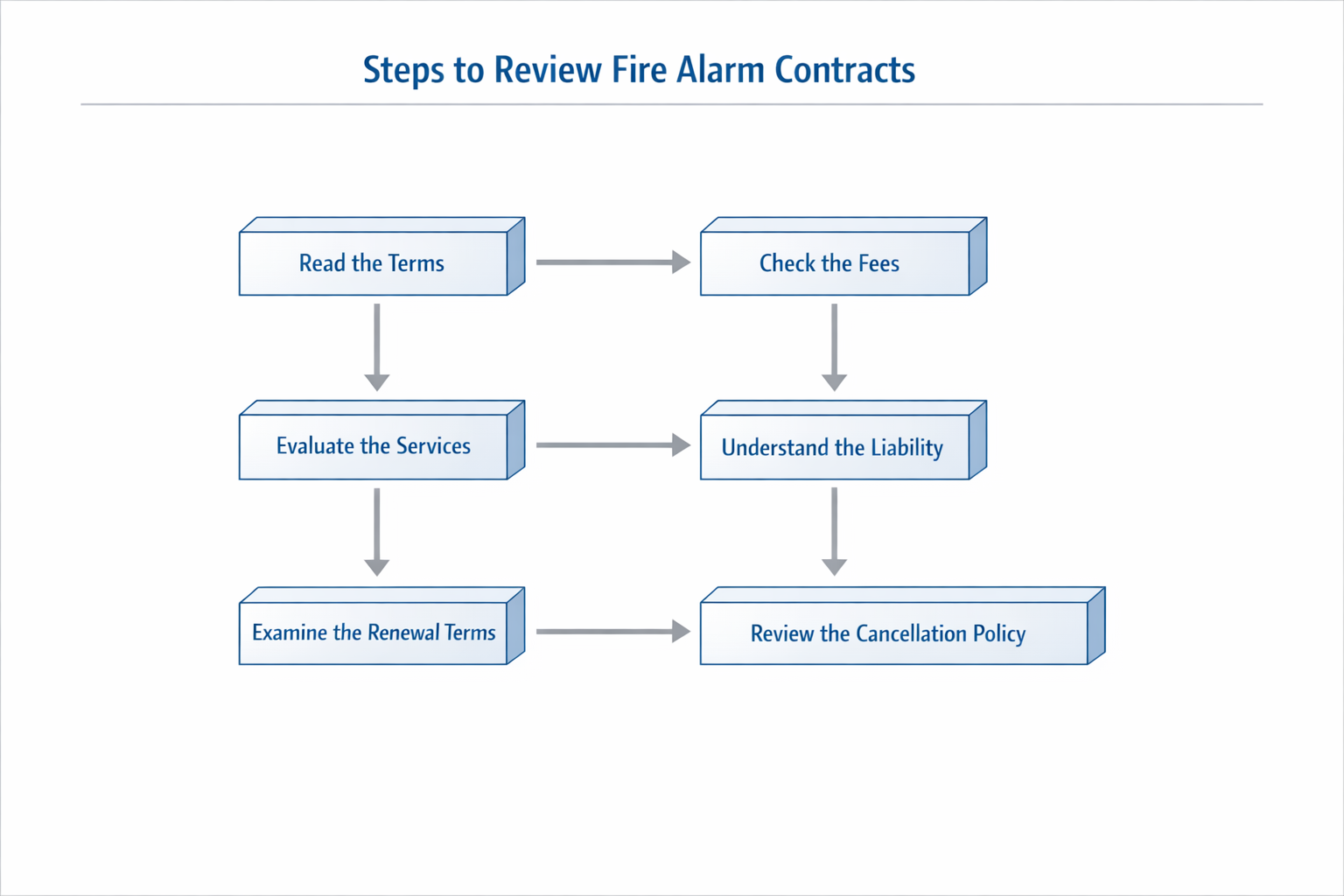
Reviewing a monitoring agreement before signing protects the owner from incomplete pricing, undefined intervals, and obligations that extend beyond the service window. The steps below establish what the contract actually provides and what the owner retains.
Verify the Written Agreement and Contractor Details
The contract must be in writing. Service and repair contracts require legible text, the contractor's name and license number, and a business address. Confirm that the entity named on the signature block matches the entity performing the monitoring service. If the contract names a parent company but the monthly invoice comes from a subsidiary, establish which entity is obligated and whether a personal guarantee block appears.
Step 1
Confirm contractor identification
Check that the contractor's name, license number, and business address appear on the first page. The license number permits verification against the state registry. The business address establishes where notice must be sent if a dispute arises.
Step 2
Identify the obligated entity
Confirm that the entity signing the contract is the entity performing the monitoring service. If a parent company signs but a subsidiary invoices, ask for clarification in writing before the first payment.
Establish the Contract Price and Payment Terms
The agreement must state the contract amount. When the price is not fixed, the contract must provide either a guaranteed maximum price or a good faith estimate of the reasonable value of the work. Payments cannot exceed the value of the work performed or materials delivered. Monthly monitoring fees are typically stated as a fixed recurring charge, but installation, inspection, or repair work may appear on separate line items.
Separately priced items — installation, annual testing, five-year internal inspections — should appear as distinct line items with their own intervals. A single monthly rate that purports to include all mandated inspections may not satisfy NFPA 72 requirements if the intervals differ. Ask for a schedule that names each service, its interval, and its separate price.
Review Insurance and Dispute Provisions
Service and repair contracts must include notices about commercial general liability insurance and workers' compensation insurance. The contract should state whether the contractor carries these coverages and, if so, the policy limits. If the contractor does not carry commercial general liability insurance, the contract must include a specific notice to that effect.
Dispute windows, default provisions, and acceleration clauses determine what happens when a payment is late or a service is missed. Establish the number of days the owner has to dispute an invoice, what constitutes default, and whether a single missed payment accelerates the entire remaining balance. Some agreements permit the contractor to suspend monitoring if payment is more than thirty days overdue; others require written notice and a cure period.
Step 3
Identify the dispute window
Locate the provision that states how many days the owner has to dispute an invoice or a service deficiency. If the contract is silent, ask for it in writing. The dispute window determines when the owner must act to preserve a claim.
Step 4
Check default and acceleration terms
Confirm what constitutes default and whether a single missed payment accelerates the full contract balance. Acceleration clauses can convert a monthly obligation into an immediate lump-sum debt.
Confirm Retention and Production Obligations
The owner must retain records of mandated inspections and produce them on request by the authority having jurisdiction. The monitoring agreement should specify which party retains the inspection reports and for how long. NFPA 72 requires that records be maintained for the life of the system or until the next inspection, whichever is longer. If the contractor retains the records, the agreement should state how the owner requests copies and whether a fee applies.
When a code violation is opened, the authority having jurisdiction determines what documentation closes the failure. The monitoring company may perform the corrective work, but only a licensed agency or the owner — depending on the standard and the local adoption — can certify that the deficiency is resolved. Establish who is permitted to close a failure before authorizing any repair work. For guidance on regulatory timelines and complaint procedures, see Filing a Complaint With the California Department of Insurance.
Tips and Tricks
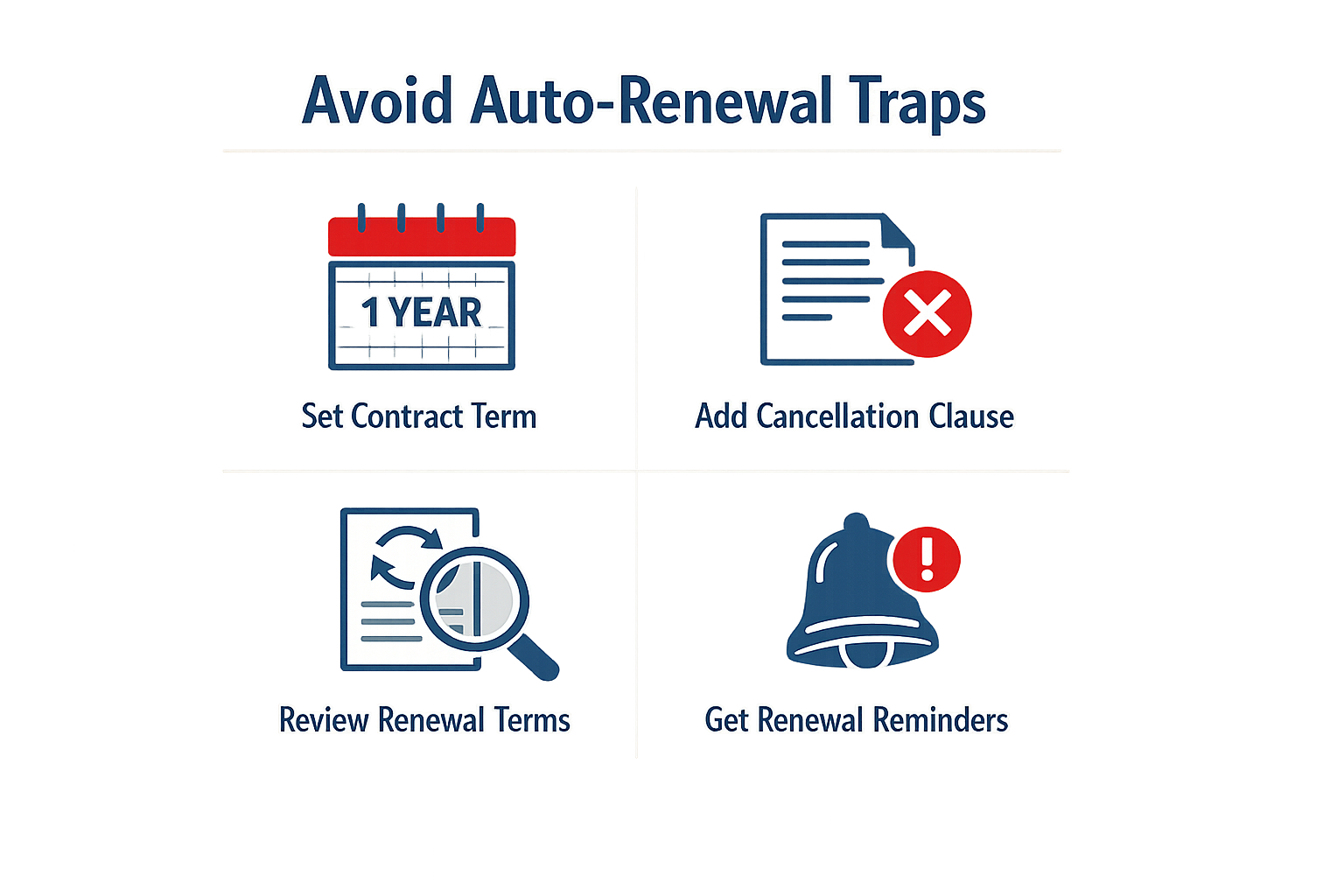
The agreement provides what it provides — read the entire document before you authorize anyone to bind the entity. A service and repair contract is defined by statute, and the provisions that must appear are not optional. The contractor details, the insurance notices, and the legible text requirements exist because disputes turn on what the paper actually says, not what the salesperson said during the walkthrough.
Ask for the Service Charge in Writing
A service charge must be disclosed in advertisements and stated when the customer initiates the call. If the quote arrives without that charge itemized separately, ask for it in writing before the agreement is signed. The charge is not the whole provision — it is one line in a larger structure. When a contractor states a monthly monitoring rate and omits the service charge, the statement was accurate but incomplete. That omission does not make the contractor dishonest; it makes the quote insufficient for comparison.
Establish Who Is Obligated on the Agreement
The entity that signs the contract is the obligated party. If the agreement includes a personal guarantee block, the individual named in that block assumes liability beyond the entity's assets. Before you authorize a signature, confirm whether the signer is binding a corporation, an LLC, a partnership, or themselves personally. A property manager who signs on behalf of the owner must verify that their authority extends to multi-year service commitments — many management agreements limit the manager's contracting authority to agreements under a specified dollar threshold or duration.
Understand the Dispute Window and Default Provisions
The agreement will specify a window within which the owner may dispute a charge or a reported deficiency. That window is measured in days, and it starts when the report is delivered or when the invoice is generated, depending on the contract's terms. Missing the window converts a disputable charge into an undisputed obligation. Default provisions describe what triggers acceleration — when the full remaining balance becomes due immediately — and what constitutes a material breach. Read the default section before the first payment is due, not after a dispute arises.
The cheapest bid is the one whose dispute provisions you understand well enough to enforce without retaining counsel.
Separately Price the Licensed-Agency Work and the Owner-Performed Checks
NFPA 25 and NFPA 72 divide responsibilities between the owner and the licensed agency. The owner performs weekly and monthly checks; the licensed agency performs the annual, semi-annual, and five-year inspections. When a quote bundles all intervals into one monthly rate, you cannot verify whether the contractor is pricing work the owner is required to perform internally. Ask for the licensed-agency items to be separately priced. If the contractor resists, the resistance itself is information.
If you're navigating a related issue with your insurer's timeline obligations, see our guide on Insurance Adjuster Contact Timeline: California Regulations for statutory requirements that parallel the contractor dispute windows discussed here.
Verify the Edition of the Standard Being Enforced
The edition matters. NFPA 25-2017 and NFPA 25-2020 impose different inspection intervals for certain components. The authority having jurisdiction adopts a specific edition, and that adoption determines which intervals apply. A contractor quoting based on an older edition may underprice the work if the locally adopted code requires more frequent service. Before you compare bids, confirm which edition the AHJ has adopted and verify that each bidder is quoting the same standard.
Retain the Record the Standard Requires
The standard requires documentation of each inspection, and the owner must retain that documentation for the period specified by the AHJ or by the applicable retention statute. When a contractor completes an annual inspection, the report closes the compliance obligation only if the report itself meets the standard's content requirements. Ask for the report format during the bidding process, and confirm that it includes the component list, the test results, and the signature of the individual who performed the work. A report that omits any of those elements does not close the failure, even if the work was performed correctly.
Conclusion
Understanding commercial fire alarm monitoring cost begins with reading the contract to the end. The monthly rate is one line; the agreement that surrounds it defines who is obligated, what the interval covers, and where the owner's obligation stops and the licensed agency's begins. A monitoring contract is not a single service—it is a collection of separately priced obligations, and the standard requires each by name and by interval.
The edition matters. NFPA 72 defines what constitutes monitoring, what constitutes inspection, and what constitutes testing. A contract that bundles all three under one monthly line may satisfy the monitoring requirement but leave the inspection and testing intervals unaddressed. Before you authorize payment, establish what the agreement actually provides and what it does not. Ask for it in writing, retain the record, and verify that the obligated party matches the entity on the license.
The dispute window is real. If the agreement provides a notice period for challenging an invoice or a deficiency report, that window closes whether you use it or not. What closes a code violation is documentation—an inspection report signed by a licensed agency, dated, and filed with the authority having jurisdiction. The monthly monitoring fee does not produce that documentation unless the contract explicitly obligates the agency to perform the inspection, file the report, and provide you a copy within the compliance interval.
Service agreement mechanics—default, acceleration, suspension—are not boilerplate. They define what happens when payment stops, when the system fails, and when the authority having jurisdiction issues a notice. Read the provision that addresses suspension: does the agency continue monitoring during a payment dispute, or does monitoring cease immediately? If monitoring ceases, does the owner receive written notice, and does that notice go to the tenant or the fire district? These are not hypothetical questions; they determine who is liable when a failure occurs during a suspension period.
The contract you sign today governs the documentation you must produce tomorrow. Retain every inspection report, every test record, and every invoice that shows the interval was met. When the authority having jurisdiction asks for proof, the standard does not permit you to reconstruct it from memory or from a vendor's assurance. The record either exists or it does not, and the obligation to retain it is yours—not the monitoring company's, not the installer's, not the tenant's.
For property owners navigating compliance disputes or seeking clarity on regulatory obligations, additional guidance is available through resources such as Filing a Complaint With the California Department of Insurance, which outlines the formal process for addressing service agreement conflicts that may intersect with insurance coverage or claims.
Commercial fire alarm monitoring cost is not a single number. It is a monthly obligation embedded in a multi-year agreement that allocates responsibility, defines intervals, and establishes the documentation standard that closes a code violation. Read the contract, verify the edition, and retain the record. That is what the standard requires, and that is what the authority having jurisdiction will ask to see.
Related reading
ADA Parking Lot Striping Requirements and Licenses
Related reading
Understanding Your Denied Fire Insurance Claim: Key Insights