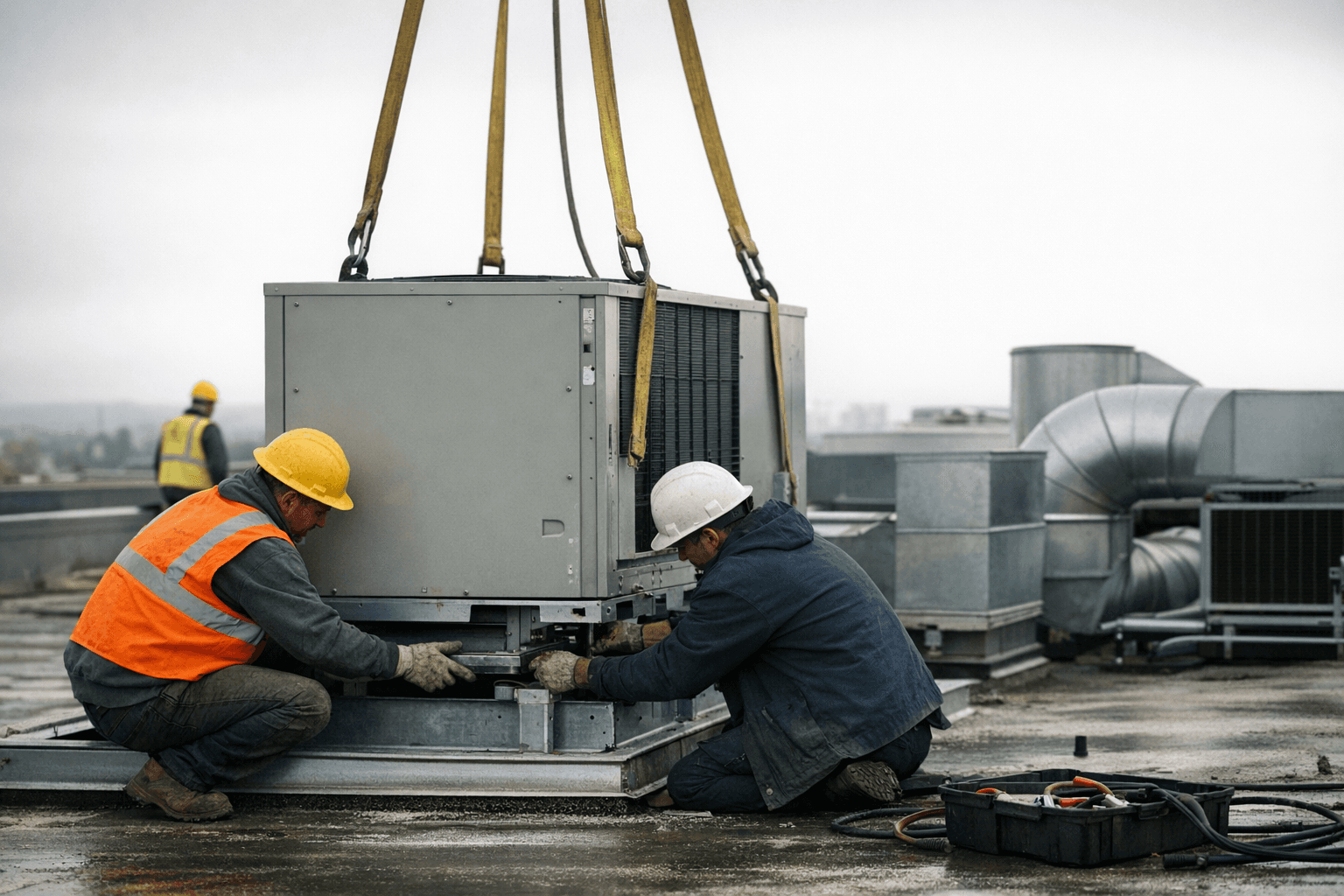
Introduction
Commercial HVAC replacement cost is the total expense of removing an existing system and installing a new one, including equipment, labor, permits, disposal, and compliance documentation. The quote arrives with a number at the bottom. Before that number means anything, establish what the contractor is licensed to perform and what the contract obligates them to deliver. Commercial HVAC replacement cost discussions frequently skip past the licensing framework that determines whether the work can proceed legally and who answers when performance fails.
Every licensed contractor in California must include specific statements in written contracts. The requirement is not optional, and the absence of those statements signals a gap in the contractor's compliance practice. When a contractor maintains or replaces air-conditioning, heating, or refrigeration equipment that is a fixed part of the structure, they fall under the definition of "contractor" and carry the obligations that follow. The standard requires the license number, the statement that contractors must be licensed and bonded, and contact information for the Contractors State License Board — all in at least 10-point type.
A contractor who has had their license suspended or revoked two or more times within an eight-year period must disclose that disciplinary history prior to entering into a contract. The disclosure must appear in capital letters in 10-point roman boldface type or in contrasting red print in at least 8-point roman boldface type. The penalties for failing to make this disclosure are $1,000 for the first violation, $2,500 for the second, and $5,000 plus a one-year license suspension for the third violation. Ask for the disclosure in writing before you authorize any work.
Replacement cost estimation separates into equipment specification, labor, permit and inspection fees, and compliance documentation. The contractor's license determines which portions they can legally perform. When a quote bundles all four without identifying the licensed entity and the scope each license covers, the owner cannot verify that the work will close an open code violation or satisfy an authority having jurisdiction. For guidance on regulatory timelines in related scenarios, see Insurance Adjuster Contact Timeline: California Regulations.
The agreement provides the framework; the license provides the authority. Both must align before the first payment clears.
What Drives Commercial HVAC Replacement Cost?
The quote arrives as a single line item: "HVAC replacement." No breakdown of equipment versus installation, no mention of permit costs, no distinction between what the contractor performs and what the building owner must arrange separately. The number looks complete, but the scope frequently is not. When a building owner accepts that figure without asking what it includes, the project often stalls mid-execution over costs that were never discussed but were always required.
A second common problem emerges when the contractor's license status is unclear or undisclosed. California law defines a contractor to include any person who maintains or services air-conditioning, heating, or refrigeration equipment that is a fixed part of the structure. The statute does not exempt replacement work, and an unlicensed party performing that work triggers enforcement consequences that can leave the building owner without recourse. If you file a complaint against a licensed contractor within the legal deadline, the Contractors State License Board has authority to investigate. If you use an unlicensed contractor, the Board may not be able to help you resolve your complaint.
The Gap Between "Replacement" and "In Service"
Replacement is not the same as placing a system in service. The equipment arrives, the contractor installs it, and then the building code requires commissioning, testing, and documentation before the system is considered compliant. Those steps are frequently quoted as separate line items or assumed to be the owner's responsibility, depending on how the agreement is written. When the contract says "replacement" but does not specify who performs the startup report, who calibrates the controls, and who submits the permit closeout, the owner discovers the gap only after the contractor has left the site.
The standard requires specific actions by interval, and the first interval starts when the system is placed in service, not when the equipment is physically present. If the contractor's scope ends at installation and the owner does not arrange for a licensed agency to perform the commissioning, the system sits idle while the building remains out of compliance. For more on navigating disputes when timelines are unclear, see Filing a Complaint With the California Department of Insurance.
The cheapest quote is often the one that omits the steps required to close the permit and start the compliance clock.
What the Agreement Does Not Say
Service agreements and installation contracts use different structures, and replacement work often falls into a hybrid category where neither template fits cleanly. The installation contract may include a warranty on the equipment but say nothing about who is obligated to perform the annual inspection once the system is running. The service agreement may cover routine maintenance but exclude the initial commissioning and testing that must occur before any maintenance interval begins. When the two documents do not align, the owner is left to interpret which entity is responsible for which step, and disputes over scope are common.
The obligated party on the agreement may be a corporate entity, a sole proprietor, or a partnership, and the enforceability of the contract depends on identifying that party correctly. Personal guarantee blocks appear in some agreements but not others, and their presence or absence changes what the owner can pursue if the contractor defaults. Before you authorize the work, confirm that the agreement names the licensed entity, that the license number matches the Contractors State License Board record, and that the scope of work is written in terms that map to the actual deliverables the building code requires.
How to Control Commercial HVAC Replacement Cost
When a commercial HVAC system reaches end-of-life, the replacement process involves more than selecting equipment. The steps below establish what documentation to request, what the contract must contain, and what compliance obligations transfer to the owner once the work is complete.
Verify Contractor Licensing Before Soliciting Bids
Step 1
Confirm active license status
Before any contractor visits the property, verify their California contractor license number through the Contractors State License Board online portal. The license must be active, in good standing, and carry the appropriate classification for the scope of work. A lapsed or suspended license voids the contract and leaves the owner without recourse if the work fails.
Step 2
Request proof of required certifications
Certain HVAC work, particularly involving refrigerant handling or hazardous material removal, requires certifications beyond the general contractor license. Ask for written proof of any certification required by Section 7058.7 or other applicable provisions. A contractor who enters into an agreement without holding the required certification exposes the owner to penalties, even if the owner did not know the certification was missing.
The agreement between a licensed contractor and a commercial property owner is not a service and repair contract as defined in Section 7159.10, which applies only to homeowners and tenants in residential settings. Commercial contracts follow different rules, but the principle remains: the contractor's name, business address, and license number must appear on every contract page.
Establish What the Contract Must Contain
Step 3
Require itemized scope and pricing
The written contract must state the agreed total amount and separately price each major component: equipment, labor, permits, disposal of the existing system, and any post-installation testing or commissioning. A single line-item price for "HVAC replacement" obscures what is included and what will appear as a change order later.
Step 4
Verify insurance disclosure
The contract must include a notice concerning the contractor's commercial general liability insurance. This is not optional. If the contractor carries no insurance or declines to disclose coverage limits, that fact must appear in writing before the owner signs. The absence of this disclosure is cause for discipline under California law.
Identify the Obligated Party and Retain the Agreement
Step 5
Confirm the contracting entity
The contract must name the legal entity performing the work — not just a trade name or DBA. If the contractor operates as a corporation or LLC, the entity name must match the license record exactly. If an individual signs on behalf of the entity, confirm their authority to bind it. A personal guarantee block, if present, shows who remains liable if the entity defaults, but the primary obligated party is the entity named in the contract.
Step 6
Retain the signed contract and all amendments
Once the contract is executed, retain the original signed copy, every change order, and every written amendment. If the work later triggers a code violation or an insurance claim, the authority having jurisdiction or the carrier will require the complete contract file. Missing documentation shifts the burden to the owner to prove what was agreed.
For guidance on documentation requirements in other compliance contexts, see our article on filing a complaint with the California Department of Insurance.
Confirm What Closes the Installation
Step 7
Obtain the final inspection sign-off
The contractor's statement that the work is complete does not close the installation. The local building department or other authority having jurisdiction must inspect the system and issue a sign-off. Until that occurs, the owner has not received what the contract promised, and any warranty period has not begun.
Step 8
Request as-built documentation and test reports
After the final inspection, the contractor must provide as-built drawings, commissioning reports, and any test results required by the applicable mechanical code. These records prove the system was installed to specification and establish the baseline for future maintenance intervals. Retain them separately from the contract file — they are compliance records, not contract administration.
Tips and Tricks for Managing HVAC Quotes
Before authorizing work, verify that the contractor's license number appears on the quote and matches the state record. The license status is public information — check it before the first meeting, not after the proposal arrives. A contractor who maintains or services air-conditioning, heating, or refrigeration equipment that is a fixed part of the structure is required to hold a license under California law.
Ask for the Full Contract Before Work Begins
The buyer is entitled to a completely filled in and signed copy of the service and repair contract before any work may begin. This is not a courtesy; it is a requirement. If the contractor says the paperwork will follow after the crew arrives, the contractor is not following the provision. The contract protects clarity in the agreement and ensures that both parties understand the scope, price, and timeline before equipment is touched.
Confirm What the Contract Must Include
Before signing a service and repair contract, ensure it includes the contractor's name, business address, license number, and a notice concerning commercial general liability insurance. These elements are not optional. The contract should also state the agreed contract amount, which includes all charges for labor and materials. If any of these items is missing or incomplete, ask for it in writing before you authorize the work.
A contractor who has had a license suspended or revoked two or more times within an eight-year period must disclose any disciplinary license action in the contract. The disclosure must appear either in capital letters in 10-point roman boldface type or in contrasting red print in at least 8-point roman boldface type. Check the date on the most recent license action if the disclosure appears — penalties for violations of the disclosure requirement include $1,000 for the first violation, $2,500 for the second, and $5,000 plus a one-year license suspension for the third violation.
Separate the Line Items
When the quote bundles replacement, disposal, and post-installation inspection into one figure, ask for separately priced line items. The standard requires specific intervals for certain checks, and the agreement may provide for different parties to perform them. If the owner performs the annual check and a licensed agency performs the five-year internal assessment, the quote should reflect that split. Not the whole provision appears in every proposal — ask what is included and what is not.
| Element | Owner-Performed | Licensed-Agency Service |
|---|---|---|
| Annual visual check | Permitted if documented | Permitted |
| Five-year internal assessment | Not permitted | Required |
| Record retention | Owner retains | Agency provides to owner |
| Dispute window | N/A | Defined in agreement |
Know What Closes a Code Violation
If an authority having jurisdiction has opened a violation, establish who is permitted to close that failure before you approve the remedy. The report may say the system failed, but the remedy must come from an entity the AHJ recognizes. Some jurisdictions accept owner-performed corrections for certain items; others require a licensed agency to sign off. What the report actually says about the required corrective action determines the path — not what the contractor assumes or what worked on a different property.
For disputes over whether a proposed remedy satisfies the standard, review the agreement's dispute window. Many service agreements provide a defined period within which the owner may challenge the scope or price of additional work. After that window closes, the contractor may accelerate payment or suspend service. The obligated party — the entity named on the signature block — is bound by those terms, and a personal guarantee block may extend liability to an individual. If you need more information on handling disputes with service providers or insurance matters, see Filing a Complaint With the California Department of Insurance.
The contractor you can verify is the contractor you can hold to the agreement when the AHJ asks for documentation.
Retain the Documentation
Retain the record of every mandated inspection, including the contractor's license number, the date of service, and the findings. If the AHJ asks for proof of compliance, the owner must produce it. The agreement should state how long the contractor retains copies and how the owner may request them. Some agreements place the burden on the owner to request records within a defined period; others provide automatic delivery. Either remedy satisfies the requirement, but the owner must know which applies and act within the window.
Conclusion
The interval matters. The edition matters. The entity that signs the contract matters. Before you authorize a commercial HVAC replacement, establish what the standard requires, confirm who is permitted to perform the work, and verify that the agreement identifies the obligated party by name. A quote that bundles the replacement with unrelated annual service, or that omits the contractor's license number, invites questions you will answer later — often in front of an authority having jurisdiction.
Retain the record. California law requires contractors to include specific disclosures in at least 10-point type, and the absence of those disclosures does not void your obligation — it voids your remedy window. Ask for it in writing: the license number, the classification, the bond details, and the dispute resolution provision. If the contractor has had a license suspended or revoked within the past eight years, the law requires disclosure of that history in capital letters or contrasting red print before you sign. What the contract actually says determines what CSLB can investigate if the work fails.
Understand what closes the failure. A replacement that satisfies the manufacturer's specification but violates the adopted code leaves the building non-compliant. A contractor who holds a C-20 classification is permitted to maintain or service HVAC equipment that is a fixed part of the structure; if the work requires a different classification and the contractor lacks it, the installation may not pass inspection regardless of the equipment's quality. Separately priced items — the replacement itself, the startup service, the first-year maintenance agreement — are separately enforceable. Read the whole provision, not just the total at the bottom.
If you need guidance on navigating insurance claims or regulatory complaints related to contractor performance, review the process for filing a complaint with the California Department of Insurance to understand your options and timelines.
The standard requires what it requires, by interval and by edition. The contractor is licensed or is not. The agreement provides dispute resolution or it does not. Those three facts — the code obligation, the license status, and the contract terms — determine whether a commercial HVAC replacement cost estimate closes a compliance failure or opens a new one. Check the date on the standard your jurisdiction adopted, verify the license before the work begins, and retain every signed document until the retention period expires.
FAQ
How much does commercial HVAC replacement cost?
Commercial HVAC replacement cost depends on equipment capacity, labor rates, permit fees, disposal charges, and commissioning requirements. A quote that bundles these items into one figure obscures which costs are fixed and which may change during installation. Request separately priced line items for equipment, labor, permits, disposal, and post-installation testing before signing the contract.
What factors increase commercial HVAC replacement cost?
Factors that increase commercial HVAC replacement cost include system capacity, building code compliance upgrades, hazardous material abatement, extended warranty coverage, and post-installation commissioning. If the existing system contains refrigerants that require certified disposal or if the building code has changed since the original installation, those compliance steps add to the total expense.
Does commercial HVAC replacement cost include permits?
Not always. Some contractors include permit fees in the quoted commercial HVAC replacement cost; others list permits as a separate line item or assume the building owner will obtain them. Verify what the contract includes before signing. If the contractor does not handle permits, confirm who is responsible for scheduling inspections and obtaining final sign-off from the authority having jurisdiction.
How can I verify a contractor's license before accepting a commercial HVAC replacement cost estimate?
Verify a contractor's license through the California Contractors State License Board online portal. Enter the license number from the quote and confirm the license is active, in good standing, and carries the appropriate classification for HVAC work. A lapsed or suspended license voids the contract and eliminates your recourse if the work fails.
Related reading
Five-Year Fire Sprinkler Inspection: Alternatives to Replacement