
Introduction
A contractor assessment checklist establishes what the contractor is permitted to perform and what documentation closes the obligation. Before you sign a construction agreement, verify credentials, insurance coverage, and contract terms to protect against compliance gaps and enforcement failures. The difference between owner-performed checks and licensed-agency service matters when you evaluate a contractor's qualifications. An inspection report and an invoice that describe two different visits to the same building signal a gap in the record — one that an authority having jurisdiction will notice when the interval comes due.
California defines a contractor as any person who undertakes or offers to undertake construction, alteration, repair, or demolition of any building or structure, including scaffolding, traffic management, and related activities. That definition encompasses subcontractors and specialty contractors, so your checklist must account for every entity in the performance chain. When comparing two editions of a standard such as NFPA 25, the interval for inspections may differ, and knowing which edition governs is a local adoption question. If you approve work under the wrong edition, the documentation you retain will not satisfy the requirement.
A comprehensive approach to contractor verification includes confirming that the contractor holds the correct license classification, that insurance certificates name the correct obligated party, and that the agreement specifies dispute windows and default provisions. The owner has the right to require a performance and payment bond, and the decision to exercise that right belongs in the assessment phase — not after the contractor mobilizes. Ask for it in writing, separately priced, so that the bond premium does not disappear into a bundled line item.
What the report actually says determines whether the work satisfies the standard. If the contractor submits documentation from an earlier visit or references a superseded edition, the record does not close the compliance interval. Correct any earlier reading of the standard before you authorize the next phase, and retain the correspondence that shows you requested clarification. The agreement provides the framework; the documentation you produce when the authority having jurisdiction asks for it determines whether you satisfied the provision.
Problem Statement
The decision to hire a contractor without verifying credentials, license status, and contract terms exposes a building owner to risks that extend beyond financial loss. Entering into a contract with an unlicensed contractor constitutes a cause for disciplinary action under California law, and the consequences fall on both parties. The owner who signs without checking the license forfeits legal remedies that would otherwise be available, and the unlicensed contractor operates outside the regulatory framework that protects both sides of the agreement.
When an inspection report and an invoice describe two different visits to the same building, the discrepancy signals a documentation problem that an authority having jurisdiction will not ignore. The owner who accepted the contractor's paperwork without cross-checking the dates, scope, and standard edition cited has no defense when the AHJ opens a violation. The contractor who submitted inconsistent records may have performed the work correctly, but the paper trail does not close the failure, and the owner is left to obtain compliant documentation or face continued non-compliance.
The contractor who quotes two editions of a standard as interchangeable creates an ambiguity that the owner must resolve before authorizing the work. NFPA 25 intervals differ between editions, and the edition adopted locally governs the compliance obligation. A contractor who does not specify which edition applies, or who offers a remedy under an outdated edition, has not provided a compliant quote. The owner who signs that agreement has not satisfied the standard, and the next inspection will reflect the gap.
Failure to verify the contractor's license, the entity obligated on the agreement, and the edition of the standard cited in the scope of work transforms a routine service contract into a compliance liability. The owner who skips these verifications before signing has no recourse when the contractor's work does not close the violation, when the licensed agency that was supposed to perform the service was never actually licensed, or when the individual who signed the agreement is not the entity named on the license. The paper says one thing; the record says another. The AHJ does not reconcile discrepancies — the AHJ opens violations and waits for compliant documentation.
Solution Steps for a Comprehensive Contractor Assessment
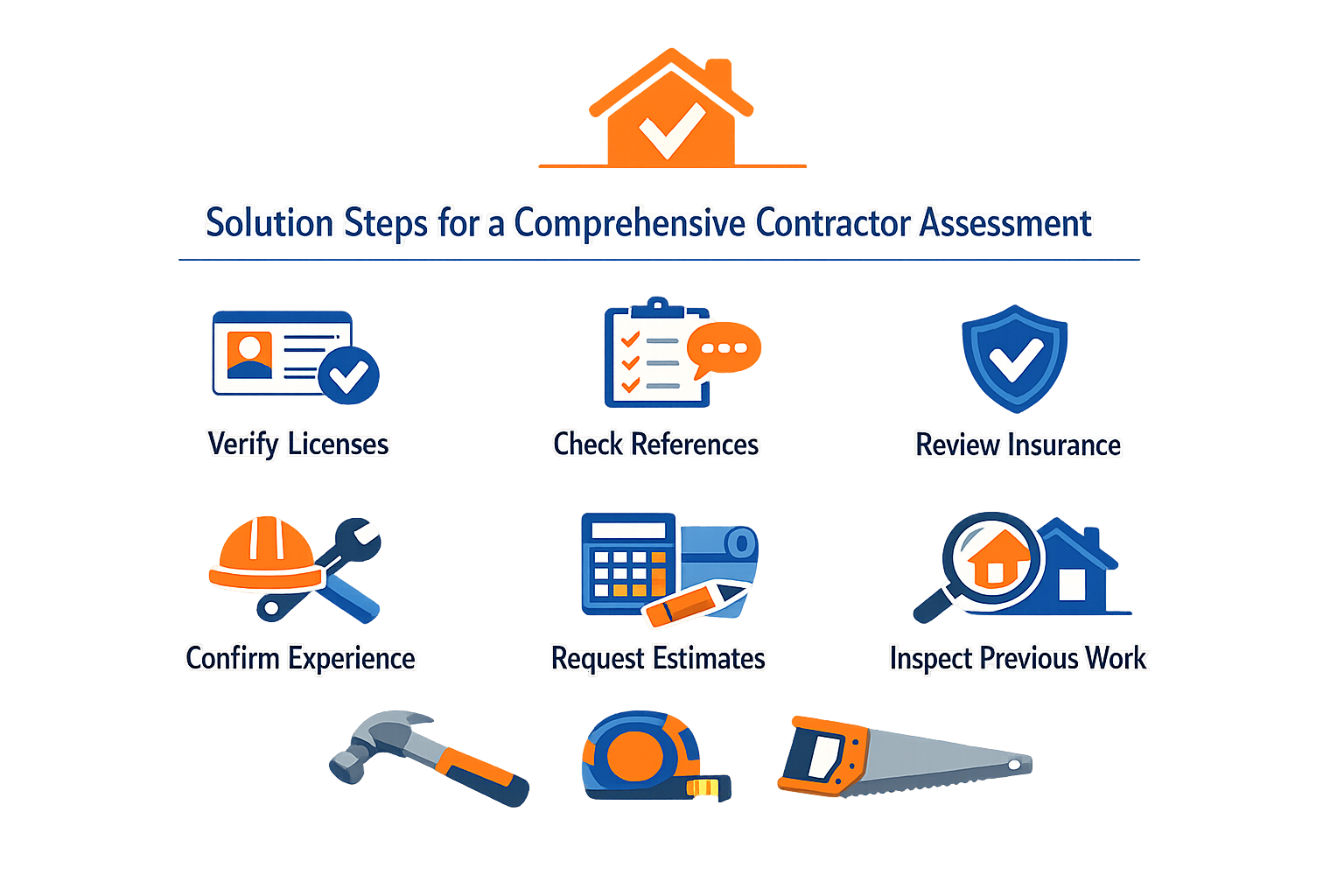
A contractor assessment checklist provides a repeatable framework for verifying credentials, documentation, and contract terms before authorizing work. The steps below follow California statutory requirements for home improvement contracts and preliminary notice disclosures, ensuring the owner retains the records necessary to close code compliance questions and manage lien risk.
Verify License and Entity Information
Before any discussion of scope or price, confirm the contractor's license number, classification, and entity name. The contract must show the contractor's name, business address, and license number exactly as they appear on the state license record. Ask for this information in writing. When the quote arrives on letterhead showing one entity name but the contract signature block names a different entity, stop and clarify which party is the obligated entity. The license holder is the party authorized to perform the work; a mismatch between the license and the signing entity may indicate an unlicensed subcontractor or an improperly delegated agreement.
California Civil Code § 8208 requires a direct contractor to make available the name and address of the owner and the construction lender, if any, to anyone seeking to give preliminary notice. If the contractor cannot or will not provide this basic disclosure, the agreement may not satisfy statutory notice requirements.
Review Preliminary Notice and Price Estimate
California Civil Code § 8202 specifies what a preliminary notice must contain: a general description of the work to be provided and an estimate of the total price of the work provided and to be provided. The notice must also include a statutory warning to the property owner about lien rights. Before authorizing work, verify that the contractor has provided a compliant preliminary notice. If the notice omits the price estimate or describes the work in vague terms, request a corrected version.
The estimate of total price is not the same as a fixed bid. It establishes the ceiling for lien exposure if the contractor or a subcontractor files a mechanics lien. When comparing two contractors, note whether each has provided a preliminary notice that satisfies § 8202. A contractor who skips this step may not be familiar with California lien law, which can complicate dispute resolution later. For a detailed discussion of lien timing and enforcement, see Mechanics Lien California: Mechanics Liens in California: Deadlines.
Step 1
Request the preliminary notice before signing
Ask the contractor to provide the preliminary notice required by Civil Code § 8202. Verify that it includes a general description of the work, an estimate of the total price, and the statutory property owner warning. Retain this notice with the signed contract.
Confirm Insurance Coverage and Retention Periods
Verify that the contractor carries current general liability and workers' compensation insurance. Ask for certificates of insurance naming the policy number, coverage limits, and expiration date. The certificate should name the property owner as an additional insured where the contract requires it. Retain the certificate for the duration of the work and for the period specified in the service agreement's record retention clause.
When a code violation is opened during or after the contractor's work, the authority having jurisdiction may require proof that the work was performed by a licensed and insured contractor. If the contractor's insurance lapsed during the work period, the owner may face difficulty closing the violation. Before you authorize the final payment, confirm that the insurance remained in force through substantial completion.
Examine Contract Terms for Dispute Windows and Default
Service agreements typically include dispute windows, default provisions, and acceleration clauses. The dispute window is the period within which the owner may challenge an invoice or a reported deficiency before the contractor's remedy becomes final. If the contract provides a ten-day window and you miss it, you may forfeit the right to dispute the charge.
Default provisions describe what constitutes a material breach and what notice the non-breaching party must provide before terminating the agreement. Acceleration clauses allow the contractor to demand immediate payment of all future invoices if the owner defaults. Read these sections carefully. If the agreement permits the contractor to suspend work without notice upon any missed payment, and your payment cycle is net-30, the two terms conflict. Ask for the conflict to be resolved in writing before you sign.
| Contract Element | What to Verify | Why It Matters |
|---|---|---|
| Dispute window | Number of days to challenge an invoice | Missing the window forfeits your right to dispute |
| Default notice | Required notice period before termination | Protects both parties from abrupt cancellation |
| Acceleration clause | Conditions that trigger immediate payment of future invoices | Prevents unexpected cash demands |
| Suspension rights | Whether contractor may stop work without notice | Aligns suspension terms with your payment cycle |
Verify Scope Alignment with Adopted Standards
When the contract covers fire protection system inspection or testing, confirm that the scope references the correct edition of the governing standard as adopted locally. NFPA 25, NFPA 72, and NFPA 10 each specify inspection intervals and procedures by edition. California jurisdictions adopt these standards by reference, and the edition matters. A contractor quoting the 2017 edition when the local jurisdiction adopted the 2020 edition may propose a scope that does not satisfy the current requirement.
Before you authorize work, ask the contractor to identify the standard edition and the specific sections that govern the proposed scope. If the quote bundles the annual inspection and the five-year internal assessment into one line item, ask for them to be separately priced. The two are different procedures with different intervals, and treating them as a package obscures what you are actually purchasing. For guidance on fire protection system inspection costs, see Fire Extinguisher Inspection Cost: What to Expect.
Step 2
Confirm the edition and interval
Ask the contractor which edition of NFPA 25, 72, or 10 governs the proposed work and which sections apply. Verify that the edition matches the locally adopted code. If two procedures with different intervals appear on one line, request separate pricing.
Retain Documentation Before Final Payment
Before authorizing the final payment, collect and retain the contractor's completion report, test results, and any certificates of compliance. These records close code violations and demonstrate that the owner performed the required inspections by interval. If an authority having jurisdiction opens a failure after the contractor has left the site, the owner must produce the documentation showing that the work was completed in accordance with the standard.
When an inspection report and an invoice describe two different visits to the same building, the discrepancy may indicate that the contractor performed additional work outside the original scope, or that the invoice consolidates multiple visits into one charge. Ask for clarification in writing. Retain both documents. What the report actually says controls what the authority will accept as proof of compliance.
Tips and Tricks for Evaluating Contractors

Evaluating contractors requires attention to details that are not always visible in a quote or a proposal. The agreement itself contains provisions that matter as much as the price, and the personnel behind the license determine what actually arrives at the building. A contractor assessment checklist that stops at verifying the license number misses the mechanics that govern performance and payment.
Verify the Qualifying Individual's Track Record
The qualifying individual on a contractor's license must have been a member of the personnel of an active and in-good-standing licensee for five of the last seven years. That requirement is not decorative. It establishes that the person supervising the work has recent, continuous experience in the trade. Ask who the qualifying individual is, and confirm that person's tenure with the entity you are contracting with. A newly formed company with a qualifying individual who meets the five-of-seven requirement is not the same as a company where that individual has been on the personnel roster for one month.
Understand the Buyer Rights Notice Requirement
Every service and repair contract must include a notice to the buyer about their rights, including the right to cancel the contract until they receive a signed copy and work begins. The absence of that notice does not void the contract, but it indicates whether the contractor is following the provisions that apply to their agreements. Read the contract for the notice language. If it is missing, ask why. The answer tells you whether the contractor knows what the statute requires, or whether they are working from a template that has not been updated.
Consider Joint Checks for Subcontractor and Supplier Payments
Paying the general contractor does not guarantee that subcontractors and suppliers are paid. One way to reduce that risk is to pay with joint checks, naming both the general contractor and the subcontractor or supplier. The joint check method does not eliminate the possibility of a lien, but it creates a paper trail that shows the funds reached the entity that performed the work or delivered the materials. This is particularly useful when the contract involves multiple tiers of work, or when the general contractor is coordinating services that you would otherwise obtain separately. For more on how liens operate and what triggers the recording, see What Happens When a Mechanics Lien Is Filed?.
The agreement provides the framework, but the personnel determine what that framework delivers.
Ask for Documentation Before Authorizing Payment
Before you authorize final payment, ask for documentation that the work complies with the standard cited in the scope. If the contract references NFPA 25 or NFPA 72, ask for the inspection report, the interval covered, and the edition applied. If the report and the invoice describe two different visits to the same building, or if the interval on the report does not match the interval in the contract, resolve the discrepancy before you pay. The contractor may have performed the work correctly and documented it incorrectly, or they may have performed a different service than the one you authorized. Either way, the documentation closes the record, and you retain that record.
Confirm the Entity Identification on the Agreement
The entity that signs the agreement is the entity that is obligated. If the agreement names a corporation but the qualifying individual signs as an individual, or if the contract names one entity and the invoice comes from another, establish which entity you are contracting with. If a personal guarantee block appears on the agreement, read it. The guarantee identifies who is liable beyond the contracting entity, and under what conditions that liability attaches. Do not assume the guarantee is standard or unenforceable. Ask for clarification in writing if the entity identification is unclear.
Frequently asked questions
What is a contractor assessment checklist?
A contractor assessment checklist is a structured verification tool that confirms a contractor's credentials, insurance coverage, license status, and contract terms before you authorize construction work. The checklist ensures the entity you contract with is legally permitted to perform the work and that the agreement specifies dispute windows, default provisions, and documentation requirements.
How do I verify a contractor's license in California?
Verify a contractor's license by requesting the license number, classification, and entity name in writing, then cross-checking that information against the state license record. The contract must show the contractor's name, business address, and license number exactly as they appear on the official record. A mismatch between the license and the signing entity may indicate an unlicensed subcontractor.
What should a preliminary notice include under California law?
California Civil Code § 8202 requires a preliminary notice to contain a general description of the work, an estimate of the total price of the work provided and to be provided, and a statutory warning to the property owner about lien rights. The estimate establishes the ceiling for lien exposure if a mechanics lien is filed.
Why does the edition of NFPA 25 matter when hiring a contractor?
The edition of NFPA 25 matters because inspection intervals and procedures differ between editions, and the edition adopted locally governs the compliance obligation. A contractor quoting the 2017 edition when the jurisdiction adopted the 2020 edition may propose a scope that does not satisfy the current requirement, leaving the owner with incomplete documentation.
What happens if I sign a contract with an unlicensed contractor?
California Business and Professions Code § 7118 states that entering into a contract with an unlicensed contractor constitutes a cause for disciplinary action. The owner who signs without checking the license forfeits legal remedies that would otherwise be available, and the unlicensed contractor operates outside the regulatory framework that protects both parties.
How can I reduce the risk of mechanics liens when hiring a contractor?
Reduce the risk of mechanics liens by verifying that the contractor provides a compliant preliminary notice, paying with joint checks that name both the general contractor and subcontractors or suppliers, and retaining documentation that shows funds reached the entity that performed the work. For more on lien timing and enforcement, see Mechanics Lien California: Mechanics Liens in California: Deadlines.
Conclusion
A contractor assessment checklist closes the gap between what a quote promises and what the record can prove. The standard requires documentation at every interval — the license, the insurance certificate, the bond if applicable, the agreement terms, and the record of who is obligated. Before you authorize work, establish that the entity on the quote matches the entity on the license and the entity named in the agreement. A mismatch there is not a paperwork error; it determines who you can hold to the contract and who can file against your property.
When comparing two editions of a standard, the interval for inspections might differ, and knowing which edition governs is essential. This can be a local adoption question, impacting how a contractor's compliance is assessed. The contractor who submits a bid under the 2017 edition when your jurisdiction adopted the 2020 edition is not offering what the code requires. Ask for it in writing: which standard, which edition, and what the scope includes. If the proposal does not name the standard, the interval, and the separately priced items, you are comparing prices without comparing scopes.
The checklist is not a one-time gate. Retain the record for every mandated inspection — the report, the invoice, and any correction documentation. Regulators expect serialized chain-of-custody for the full retention period, and an authority having jurisdiction will ask for the file when a violation opens. The contractor who cannot produce a dated, signed report for the work they invoiced is a contractor whose documentation you cannot hand the auditor without flinching. By the time a dispute reaches that stage, the window to cure it has closed.
For guidance on how documentation failures affect insurance claims when fire protection systems are involved, see Understanding Your Denied Fire Insurance Claim: Key Insights. The cheapest vendor is the one whose paper trail you trust enough to produce on demand. The contractor assessment checklist ensures that trust is earned before the agreement is signed, not tested after the failure is recorded.