
Introduction
Contractor audits are systematic examinations that verify whether the person or entity performing work holds the license the law requires, maintains it in good standing, and complies with the terms written into the agreement. The audit is not a courtesy review. It is the mechanism by which an owner confirms that the work was performed by someone the state permits to perform it, that the required notices appeared in the contract, and that the documentation needed to close a code violation or satisfy a lien dispute exists and is complete.
California defines "contractor" broadly. Under Cal. Bus. & Prof. Code § 7026, a contractor is anyone who undertakes to construct, alter, repair, add to, subtract from, improve, move, wreck or demolish any building, structure, project, development or improvement, or to do any part thereof. The definition extends to subcontractors, specialty contractors, and persons who maintain or service fixed air-conditioning, heating, or refrigeration equipment. A consultant who provides or oversees bids, arranges work schedules for contractors and subcontractors, or maintains oversight of a construction project under a home improvement contract also falls within the definition.
The licensing requirement is not negotiable. Cal. Bus. & Prof. Code § 7031 bars any person engaged in the business or acting in the capacity of a contractor from bringing or maintaining any action to collect compensation for work performed without alleging that they were duly licensed at all times during performance, regardless of the merits of the cause. The statute permits an owner who used an unlicensed contractor to recover all compensation paid. A security interest taken to secure payment for work requiring a license is unenforceable if the person performing the work was not duly licensed throughout performance. When licensure is controverted, the burden of proof to establish licensure rests on the licensee, and proof is made by production of a verified certificate of licensure from the Contractors State License Board.
Understanding what happens when a mechanics lien is filed reinforces why contractor audits begin before the first invoice. The statute gives the Registrar of Contractors authority to issue citations containing orders of abatement and civil penalties against persons acting in the capacity of or engaging in the business of a contractor without a license in good standing. Contractor audits confirm that the license existed, that it covered the classification of work performed, and that it remained active through the date of final payment. Audits also confirm that the written contract included the notice required by Cal. Bus. & Prof. Code § 7030, which informs the owner of the Contractors State License Board's jurisdiction, the four-year complaint deadline for patent acts or omissions, and the ten-year deadline for latent acts or omissions pertaining to structural defects.
What Do Contractor Audits Examine?

An unlicensed contractor cannot collect payment through the courts, and an owner who hires one may be forced to pay twice. The California Business and Professions Code establishes that no person acting in the capacity of a contractor may bring or maintain any action for the collection of compensation without alleging they were duly licensed at all times during performance of the work. A security interest taken to secure payment for work requiring a license is unenforceable if the person performing the work was not licensed throughout.
When Licensing Lapses Go Undetected
A contractor whose license lapses mid-project creates immediate exposure. The statute permits an owner who hired an unlicensed contractor to recover all compensation paid, regardless of the work's quality or completion. The Registrar of Contractors is empowered to issue citations containing orders of abatement and civil penalties against persons acting in the capacity of a contractor without a license in good standing. Entering into a contract with a contractor who is not licensed as provided in the chapter constitutes cause for disciplinary action—against the contractor, and in some circumstances against the owner who knowingly proceeded.
The Mechanics Lien Cascade
An owner who pays a licensed prime contractor in full remains exposed to mechanics liens from unpaid subcontractors and suppliers. The required contract warning states the risk plainly: even if you pay your contractor in full, unpaid subcontractors and suppliers who helped improve your property may record mechanics liens and sue to foreclose. If a court finds the lien valid, the owner may be forced to pay twice or face a forced sale to satisfy the lien. Each subcontractor and material supplier must provide a Preliminary Notice to preserve their right to record a lien, and that notice can be sent up to twenty days after work starts or materials are delivered.
The statute directs owners to obtain from the contractor a list of all subcontractors and material suppliers, confirm when work started or materials were delivered, then wait twenty days while monitoring Preliminary Notices. One common failure: the owner authorizes full payment before the notice window closes, leaving no funds to address liens that arrive later. Understanding mechanics lien deadlines becomes essential when the prime contractor's payment does not reach the supply chain.
Documentation Gaps That Survive Contract Signing
Every contract between an owner and a contractor for construction of a single-family dwelling retained by the owner for at least one year must be evidenced in writing and signed by both parties. The writing must contain the contractor's name, address and license number; approximate start and substantial completion dates; a legal description of the work location; the full mechanics lien warning; and a statement on commercial general liability insurance. Failure to comply with the notice requirements is cause for disciplinary action. Service and repair contracts under seven hundred fifty dollars carry reduced notice obligations, but only when the buyer initiated contact, the contractor sells only goods and services reasonably necessary to address the problem, and no payment is due until work is completed.
A contract that omits the required insurance disclosure or the mechanics lien warning does not become void, but it exposes the contractor to board discipline and may shift the burden in later disputes. The owner who signs an incomplete contract cannot later claim ignorance of lien rights or insurance gaps—the statute presumes the required warnings were given, whether or not they appear on the page.
The Hazardous-Substance Subcontractor Trap
Any contractor who knowingly, negligently, or by reason of a failure to inquire enters into a contract with another person required to be certified for removal or remedial action under Section 7058.7—and who is not so certified—faces penalties starting at one thousand dollars for a first offense and possible license revocation or suspension. A subsequent offense is a misdemeanor requiring license revocation or suspension, a fine up to five thousand dollars, or imprisonment up to one year, or both. The statute places the inquiry obligation on the prime contractor; an owner's audit that confirms subcontractor certification protects both parties.
The statute permits recovery of all compensation paid to an unlicensed contractor, and bars the unlicensed contractor from any remedy in court—regardless of the work's merit.
How Are Contractor Audits Conducted?
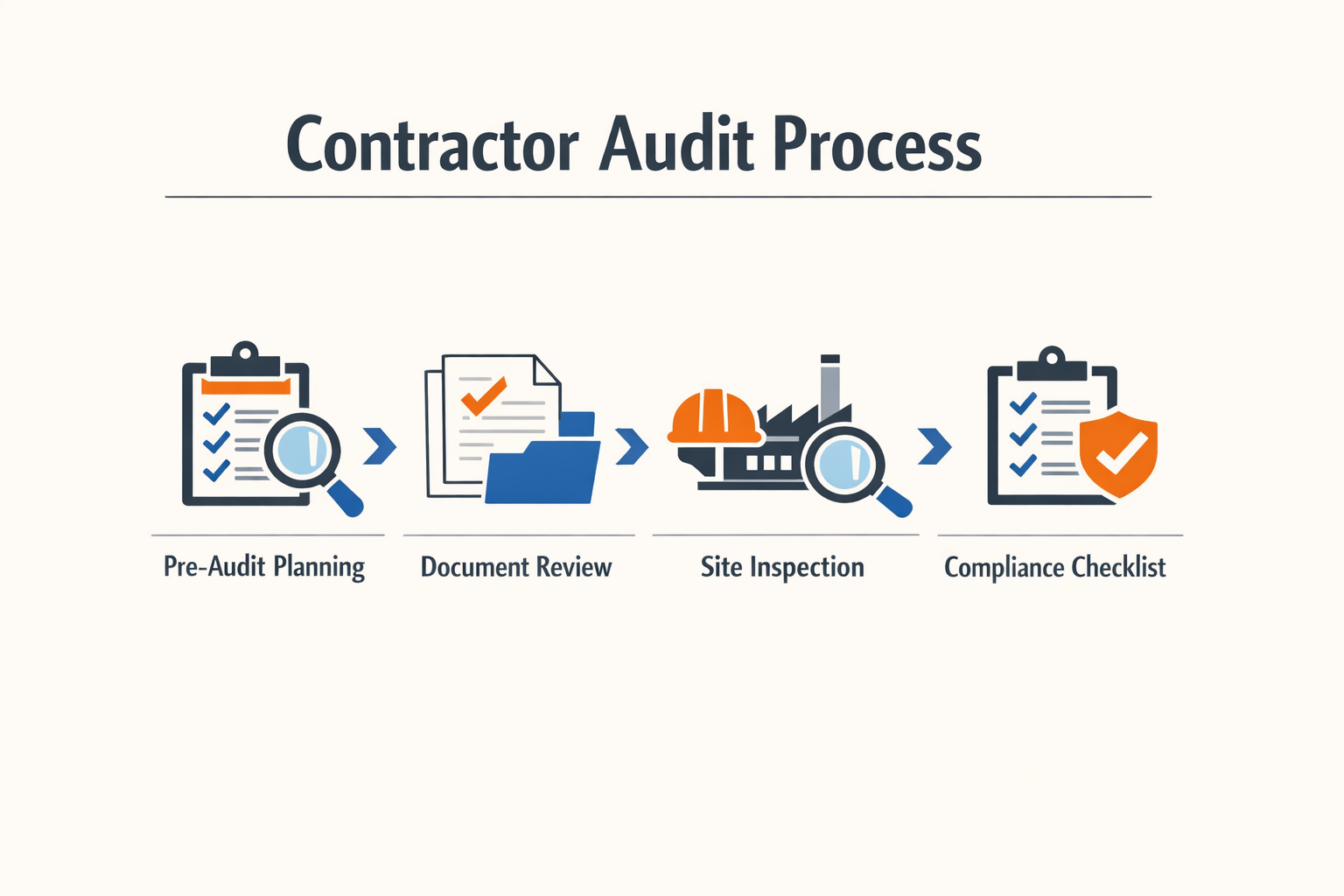
Contractor audits follow a defined sequence. The steps below establish what gets checked, when the check occurs, and what documentation closes each item.
Step 1
Verify the license and classification
Before any work begins, confirm that the contractor holds a current California license in the classification that covers the scope. Cal. Bus. & Prof. Code § 7026 defines "contractor" broadly to include anyone who undertakes to construct, alter, repair, or improve any structure. A contractor who lacks a valid license at the time of performance cannot recover compensation in court under § 7031, and an owner may recover all payments already made. Check the license number against the Contractors State License Board database, verify the expiration date, and confirm that the classification matches the work described in the agreement.
Step 2
Review the written contract for mandatory disclosures
Every written contract must include specific notices. Section 7030 requires a 10-point disclosure that identifies the Contractors State License Board and its complaint jurisdiction. Section 7164 mandates a mechanics lien warning in single-family dwelling contracts. Service and repair contracts under § 7159.10 must state the contractor's license number, business address, and the date the contract was signed, and must include notices regarding commercial general liability insurance and workers' compensation coverage. Audit the contract document itself: confirm that each required notice appears in the specified type size, that the language matches the statutory text, and that the buyer received a signed copy before work started.
Step 3
Confirm insurance coverage and bond status
The contract must disclose whether the contractor carries commercial general liability insurance. If the contract states that coverage exists, obtain the insurer's name and contact number and verify the policy is active. For service and repair contracts, § 7159.10 requires a notice that identifies the insurance company or states that the contractor does not carry coverage. Where a bond is required by the license classification or by local ordinance, request a copy of the bond certificate and confirm that the surety is admitted in California and that the bond amount meets or exceeds the statutory minimum.
Step 4
Audit payment terms and completion milestones
For service and repair contracts, § 7159.10 prohibits any payment until the work is completed—meaning all conditions that caused the buyer to contact the contractor have been fully corrected and, if applicable, the building department has accepted the work. Review the payment schedule in the contract and compare it to the work-completion definition. If the contract calls for a deposit or progress payments before final acceptance, it does not qualify as a service and repair contract, and the home improvement contract requirements under § 7159 apply instead, including any rescission rights under Civil Code §§ 1689.6 and 1689.7.
Step 5
Document retention and complaint windows
Retain the signed contract, all change orders, proof of insurance, the license verification, and any inspection reports for the full complaint period. Section 7030 states that CSLB has jurisdiction to investigate complaints regarding a patent act or omission filed within four years of the alleged violation, and complaints regarding latent structural defects must be filed within ten years. Store these records in a manner that permits production on demand. If a dispute arises, the written agreement and the contemporaneous documentation close the inquiry—what the record shows controls what the authority having jurisdiction can enforce.
Tips and Tricks for Successful Contractor Audits
An audit that finds the record complete is faster and cheaper than one that does not. Before the auditor arrives, confirm that every required notice appears on every written contract, that the license number matches the Contractors State License Board database, and that the personnel of record named on the application have not changed without filing an amendment. The statute requires specific language in at least 10-point type on most contracts and 12-point type on home improvement and service contracts — the auditor will measure it.
Ask for It in Writing Before You Authorize
When a contractor proposes work that requires a specialty classification, verify that classification on the CSLB website before signing. A contractor who holds a general building license but not the required specialty license cannot lawfully perform that work, and the owner who hires that contractor may face enforcement action. Cal. Bus. & Prof. Code § 7118 states that entering into a contract with an unlicensed contractor constitutes cause for disciplinary action. If the contractor claims an exemption under Section 7053, ask for documentation supporting that claim — exemptions are narrow, and misapplication is common.
Retain the Record
The CSLB may investigate a complaint regarding a patent act or omission filed within four years of the alleged violation, or a latent act pertaining to structural defects filed within ten years. Every contract must include this notice, and every owner must retain the signed contract for the full limitation period. If the contractor fails to include the required notice, that failure is cause for disciplinary action under Section 7030(c), but the limitation period does not change. Retain invoices, change orders, and correspondence separately; if a dispute arises, the auditor or investigator will ask for the complete file, not a summary.
Contractors are required by law to be licensed and regulated by the Contractors State License Board which has jurisdiction to investigate complaints against contractors if a complaint regarding a patent act or omission is filed within four years of the date of the alleged violation.
What the Personnel of Record Shows
Every officer, member, responsible manager, or director of a corporation or limited liability company seeking licensure must be listed on the application as a member of the personnel of record. When a qualifying individual leaves or a new officer joins, the licensee must file an amendment. An audit that reveals an unlisted officer or a departed qualifier who remains on the application will pause until the record is corrected. If the only qualifier has left and no replacement has been designated, the license is no longer valid for new contracts, and work in progress may be subject to suspension.
A qualifying individual who passed the written examination for the same classification within the preceding five years, or who served as the qualifier for a license in good standing during that period, is exempt from re-examination when applying for a new license in the same classification. This exemption does not apply if the individual's prior license was suspended or revoked, or if the five-year window has closed. Verify the examination date and the prior license status before relying on the exemption.
Separately Priced, Not the Whole Provision
When a contractor bundles multiple classifications of work into one line item, the audit cannot confirm that each classification was performed by a properly licensed entity. If the contract includes fire alarm testing, backflow certification, and structural repair, price each separately and verify that the entity performing each task holds the required classification. A general contractor may subcontract specialty work, but the prime contractor remains responsible for ensuring that every subcontractor is licensed. For guidance on managing service agreements that span multiple compliance intervals, see Annual Fire Alarm Inspection Costs: What to Expect.
Conclusion
Contractor audits verify that the entity performing work holds the license the law requires, that the agreement identifies the obligated party, and that the record closes the interval. The standard names the interval, the provision permits the alternative remedy, and the audit confirms which one was performed. When the documentation supports the claim, the audit passes; when it does not, the audit identifies the gap before the authority having jurisdiction does.
An audit does not evaluate whether the price was competitive or whether the work met a subjective standard of quality. It asks whether the contractor was licensed at all times during performance, whether the agreement contains the disclosure the statute requires, and whether the record demonstrates compliance with the mandated interval. Those three questions—licensure, disclosure, and interval—anchor every audit, and the answers either satisfy the requirement or they do not.
The building owner retains the burden of producing the record when the authority requests it. The contractor produces the license, the insurance certificate, and the service report; the owner produces the agreement, the payment record, and the retained copy of each mandated inspection. Where the owner cannot produce a record, the authority treats the interval as missed, regardless of whether the work was actually performed. The audit closes when the record is complete, current, and matches the standard's requirement.
Ongoing compliance checks prevent the accumulation of gaps that contractor audits or an AHJ inspection would expose all at once. Understanding mechanics lien procedures reinforces the importance of verifying contractor credentials before authorizing work. Each interval creates a new documentation obligation, and each agreement adds a retention requirement. Contractor audits are not an event that happens once; they are the discipline of maintaining a complete record at every interval, so that when the record is requested, it is ready to produce.
Frequently asked questions
What is checked during contractor audits?
Contractor audits verify that the contractor held a valid California license in the correct classification throughout the work period, that all mandatory disclosures appeared in the written contract, that required insurance and bond coverage was active, and that payment terms complied with statutory requirements.
How often should contractor audits be performed?
Contractor audits should begin before work starts with license and insurance verification, continue with contract review at signing, and conclude with documentation retention after final payment. Owners should verify license status before each new contract and maintain audit records for the full statutory complaint period.
Why are contractor audits important for building owners?
Contractor audits protect owners from paying twice for the same work, shield them from mechanics liens filed by unpaid subcontractors, ensure compliance with California licensing law, and provide the documentation needed to resolve disputes or satisfy code enforcement inquiries.