
Introduction
The agreement names a party. The license names a holder. Contractor identification is the process that confirms those two are the same entity, and that the credential permits the work you are authorizing. Without it, you cannot know whether the party signing your agreement is permitted to perform the service, whether the work will satisfy the standard, or whether a failure documented in that party's name will close the violation.
Contractor license lookup starts with the right jurisdiction and credential family, then requires identity resolution before a record becomes a company target. A license number alone does not establish that the holder is the entity on your agreement. The name on the license must match the obligated party exactly, or you must obtain documentation — a doing-business-as filing, a certificate of good standing, or an entity formation record — that ties the two together. Where the match is unclear, ask for it in writing before you authorize the work.
Many owners discover the mismatch only after a compliance failure, when the authority having jurisdiction asks who performed the service and the name on the report does not match the name on the license. At that point, the documentation you should have requested up front becomes the documentation you must produce to avoid a citation. Understanding mechanics lien disputes illustrates how entity identification gaps create enforcement exposure — the same principle applies to service agreements.
The standard requires specific work at specific intervals, and many standards require that work be performed by a licensed agency or a certified technician. The provision does not permit substitution. If the party you hire is not licensed to perform the service, the work does not satisfy the standard, and the violation remains open regardless of what the report says. Contractor identification closes that gap before you sign, not after the inspection fails.
Problem Statement
A service agreement names a licensed contractor. The invoice arrives from a different entity. The crew on site carries no identification, and the truck displays no contractor license number. When the work fails inspection, establishing who performed it — and who is obligated to correct it — becomes the owner's problem.
The scale of unverified contractor activity is substantial. Approximately 30% of contractors operating in the United States are unlicensed, making verification a necessary step rather than an optional precaution. The FTC received 81,925 reports of home improvement fraud in 2024, with storm-damaged properties and older homeowners being the most common targets. These figures reflect residential incidents, but the same identification failures appear in commercial service: an unlicensed subcontractor performing mandated fire-system work, a dissolved corporation still bidding under its old name, or a technician whose certification lapsed two years before the visit.
What Breaks When Contractor Identification Contractor Identification Fails
When a building owner cannot establish the performing entity, several consequences follow. The authority having jurisdiction may reject the inspection report if the signatory lacks the required license or certification for that system type. A mechanics lien filed by an unlicensed contractor is unenforceable in California, but defending against it still consumes time and legal fees. Insurance carriers deny claims when the loss originated from work performed by an unverified or unlicensed party, leaving the owner to fund the repair.
Service agreements frequently name one entity in the signature block and a different entity in the payment instructions. When a dispute arises — over scope, over defects, over timing — the question of which entity is obligated determines where the owner must file, what remedies are available, and whether a personal guarantee applies. An agreement signed by an individual doing business as a sole proprietorship creates different obligations than one signed by a corporate officer. The owner who does not verify the obligated party at signing discovers the gap only when enforcement is needed.
The report says the system failed. Before you approve the remedy, establish who is permitted to close that failure.
The interval matters. NFPA 25 requires certain inspections annually and others every five years. An unlicensed entity cannot satisfy the five-year internal assessment even if the work was performed correctly, because the standard specifies who may sign the report. The owner who relies on an unverified contractor's assurance that "we do this all the time" learns the distinction only when the authority having jurisdiction rejects the documentation and the interval clock resets.
Fraud is one risk; incompetence covered by a fraudulent license claim is another. A contractor who misrepresents licensure or certification may also misrepresent the work performed, the parts installed, or the defects observed. The building owner has no documentation trail to an accountable party, no bond to claim against, and no license board to petition. The work must be redone, the cost absorbed, and the compliance interval often restarted from the date of proper completion.
Solution Steps to Verify Contractor Credentials
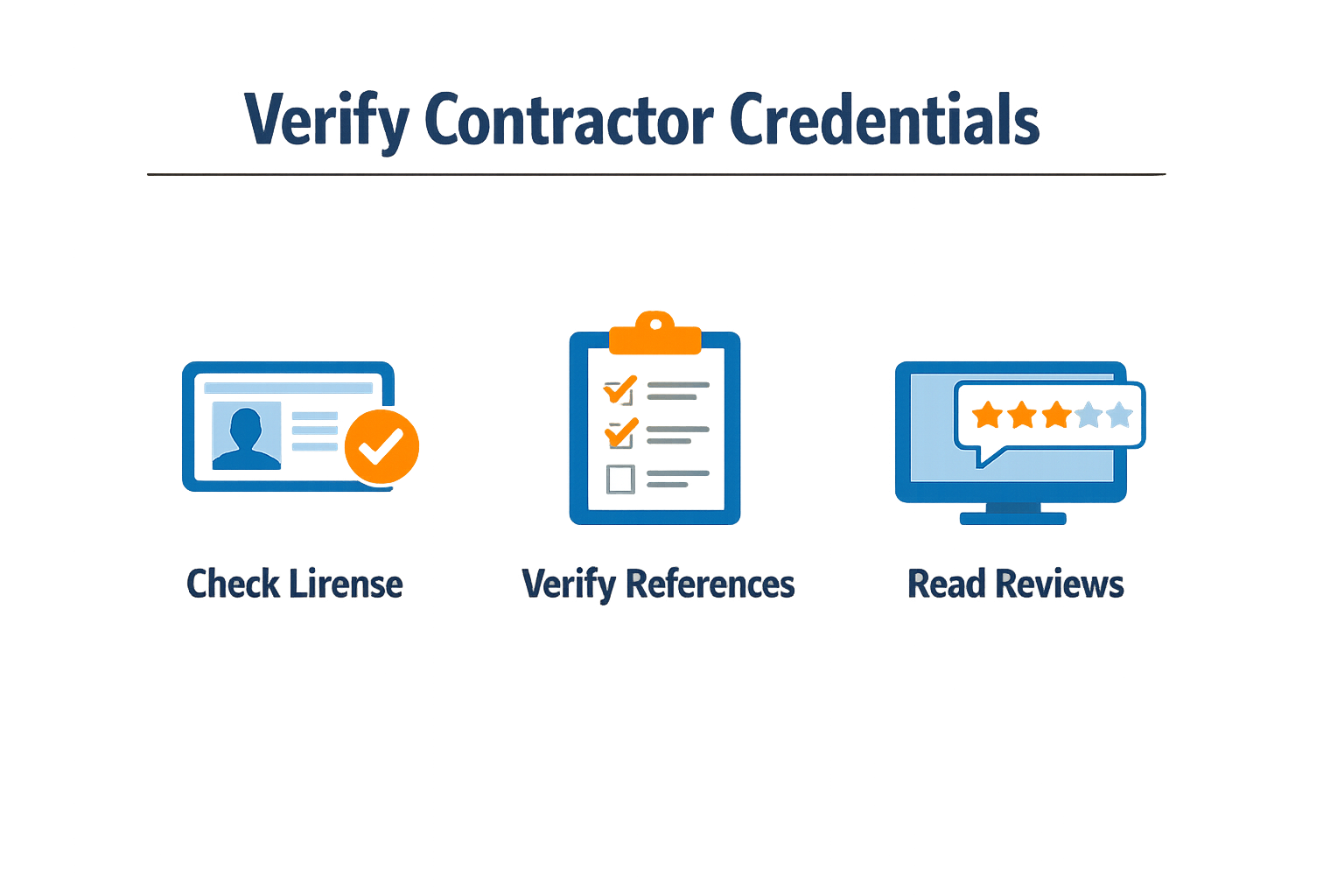
The standard requires verification before the contractor arrives. What follows is not a recommendation — it is the minimum documentation an owner must obtain and retain before authorizing work.
Step 1: Obtain the License Number in Writing
Ask the contractor to provide their license number in writing before you receive a quote. Do not accept a business card, a letterhead, or a photograph of a card. The number must appear on the written proposal or in a separate email from the contractor.
The license number identifies the entity that holds the license. If the contractor operates under a trade name, the license record shows which legal entity is obligated. Retain that proposal or email — it establishes what the contractor represented at the time you authorized the work.
Step 1
Request the license number before quoting
Before you receive a bid, ask the contractor to include their license number in the written proposal. If they quote verbally or send a price without the number, ask for it in a separate email. The license number must be in writing before you compare bids.
Step 2: Verify the License Through the State Database
Verify the contractor's license through your state's licensing board database, rather than relying on a card or PDF they provide. Most states publish an online search tool that shows the license status, the issue date, the expiration date, and any disciplinary actions.
Check that the license is active and in good standing. Check that the license classification matches the work you are authorizing. Check that the name on the license matches the name on the proposal. If the contractor is an individual, the license shows their legal name. If the contractor is a company, the license shows the entity name and the responsible managing employee or officer.
Step 3: Request the Certificate of Insurance Directly From the Insurer
Ask the contractor to have their insurer email the Certificate of Insurance directly to you to ensure authenticity. A COI that the contractor forwards as a PDF attachment is not verified. The insurer must send it.
The COI shows the policy number, the coverage limits, the effective dates, and the certificate holder. Confirm that the policy is current and that the coverage limits meet the requirements in your lease, your service agreement, or the local code. Confirm that the named insured on the COI matches the entity name on the license record.
If the contractor cannot produce a COI sent directly by the insurer, they are either uninsured or unwilling to verify their coverage. Either condition disqualifies them.
Step 2
Verify insurance before the first visit
Before the contractor enters the building, confirm that the COI arrived from the insurer's email domain and that the policy has not expired. Retain the COI with the proposal and the license verification. If the policy expires during a multi-visit project, request an updated COI before the next visit.
Step 4: Confirm Identity on the Day of Service
On the day of service, confirm the contractor's identity by asking for ID and comparing it to the name given when booking the appointment. The person who arrives must be the person the contractor identified in advance, or an employee whose presence the contractor disclosed in writing.
If the contractor sends a substitute without notice, or if the person at the door cannot produce ID that matches the name the contractor provided, do not permit entry. Contact the contractor in writing and ask them to confirm the identity of the person they sent. Retain that confirmation.
For more on managing contractor obligations after a claim, see How to Deal with an Insurance Claims Adjuster for Commercial Buildings.
Tips and Tricks for Contractor Identification
The agreement names the entity performing the work. Before you authorize a deposit or sign the contract, verify that the named entity holds the license, not a related company or an individual who left the firm. The state licensing agency confirms who holds the credential, and that record supersedes what the proposal says.
Ask for Documentation in Writing
Request proof of insurance before work begins. A licensed agency carries liability coverage and worker's compensation; a reputable contractor provides the certificate without delay. The certificate names the insured entity, the policy period, and the coverage limits. Match the entity name on the certificate to the entity name on the agreement — if they differ, ask why in writing and retain the answer.
When a contractor states that insurance is included or that the company is insured, ask for the declaration page or the certificate of insurance. The statement alone does not close the question; the document does.
Compare Information Across Platforms
Reviews on one platform do not tell the whole story. A contractor may hold high ratings on a single directory while complaints accumulate elsewhere. Compare what appears on the state licensing board, the Better Business Bureau directory, and any industry-specific complaint database the authority having jurisdiction publishes. The licensing board shows disciplinary actions and license status; the BBB directory shows complaint history and resolution patterns; the local building department may track permit violations or failed inspections tied to that contractor's license number.
The cheapest bid is not the compliant bid when the entity submitting it does not hold the credential the standard requires.
When reviews conflict, weight the source. A finding by the licensing board outweighs an anonymous review; a closed complaint with documented resolution outweighs a single positive testimonial. If the research reveals a pattern — multiple complaints about the same failure, or repeated license suspensions — that pattern is the fact, not the rating average.
Verify the License Holder, Not the Salesperson
The individual who quotes the work may not be the license holder. The proposal should name the licensed entity and provide the license number. Verify that number with the state agency before you sign; confirm that the license is active, that it covers the scope of work in the agreement, and that no disciplinary action is pending. Some agreements include a personal guarantee block signed by an individual; that signature does not make the individual the license holder, and it does not transfer the license obligation to a person when the entity defaults.
If the agreement names a doing-business-as designation or a trade name, ask for the legal entity name and verify the license under that legal name. A DBA is not a separate entity; it is a name under which an entity operates. The license belongs to the entity, not the trade name, and the state agency searches by legal entity name or license number, not by DBA.
Retain the Documentation
Keep the license verification, the insurance certificate, the signed agreement, and any written responses to your questions. If a dispute arises or if the authority having jurisdiction opens a violation, those records show that you performed due diligence at the time of hire. The record does not prevent a failure, but it establishes what you verified and when. That distinction matters when the question is whether the owner exercised reasonable care in selecting the contractor.
For mandated inspections under NFPA 25 or NFPA 72, the standard requires that you retain the inspection report for a specified period. Retain the contractor's license verification and insurance certificate for the same period; if an auditor or an AHJ asks how you determined the contractor was qualified, the verification record is the answer. The contractor's statement that they were licensed is not documentation; the state agency's confirmation that they were licensed on the date of hire is documentation.
For additional guidance on verifying service agreements and understanding contractor obligations in commercial property contexts, see How to Deal with an Insurance Claims Adjuster for Commercial Buildings.
Conclusion
Verifying contractor identification is not a courtesy check—it is the documented step that separates a compliant service agreement from a liability. When a licensed agency performs mandated inspections, the owner retains the obligation to confirm that the entity on the agreement matches the entity on the license, that the license covers the scope of work, and that the license remains active through the service interval. A mismatch between the contracting party and the performing party opens exposure that no indemnity clause closes cleanly.
The record you retain matters as much as the verification itself. A screenshot of a license lookup, dated and saved, establishes what you confirmed on the date you authorized the work. An invoice from an unlicensed entity, or from an entity whose license expired mid-term, does not satisfy a code authority's request for documentation, and it will not support a later claim that you performed due diligence. The standard does not permit you to delegate verification to the contractor; it expects you to ask for the license number, check it yourself, and document what you found.
Contractor identification is not a one-time gate at bid stage. Licenses expire, scopes change, and entities dissolve or reorganize. The interval-based inspections required by NFPA 25, NFPA 72, and NFPA 10 create recurring obligations, and each interval restarts the verification clock. A contractor whose license was valid at contract signing may not hold that license when the annual visit is due. Check the license status again before each service event, retain the dated confirmation, and treat a lapsed or suspended license as a material breach that suspends your obligation to perform under the agreement until the contractor cures the defect or you terminate.
The cost of verification is measured in minutes. The cost of accepting an unverified contractor is measured in the expense of re-performing the work under a valid license, the fines an authority having jurisdiction may assess for non-compliant service, and the legal fees required to recover from an entity that may not exist by the time you discover the problem. Verify the license, name the edition, retain the record, and understand what happens when a mechanics lien is filed if a contractor's claim reaches that stage. The documentation you keep today is the evidence you produce when the authority asks.