
Tenant Improvement Allowance Repayment: What You Need to Know
A tenant improvement allowance repayment obligation exists only when the lease agreement creates one. Whether you must repay depends entirely on the written terms in your lease — not on custom, verbal assurances, or assumptions. Early termination clauses frequently trigger repayment, typically calculated on a pro-rata basis over the remaining lease term. Before you authorize any improvement work, confirm what your lease says about clawback provisions, default triggers, and the amortization schedule.
What a Tenant Improvement Allowance Repayment Obligation Looks Like
A tenant improvement allowance is a sum the landlord provides to offset the cost of modifying leased space to suit the tenant's operations. The provision may appear as a dollar-per-square-foot figure, a lump sum, or a reimbursement cap. What the lease says about repayment — or what it omits — determines whether that allowance becomes a liability when the tenant vacates early or defaults.
Repayment clauses tie the allowance to occupancy duration. If the lease requires a five-year term and the tenant terminates in year three, a typical repayment provision recovers two-fifths of the original allowance. The lease may label this a "recapture," "clawback," or "unamortized balance." The calculation method, the trigger events, and the payment deadline must all appear in writing. When they do not, the landlord and tenant each interpret the silence differently, and the cost of resolving that interpretation often exceeds the allowance itself.
Commercial lease practice treats the allowance as an inducement, not a gift. The tenant receives capital to perform work the landlord would otherwise fund or forgo. In exchange, the landlord expects occupancy long enough to recover that outlay through rent. The repayment clause enforces that expectation. It does not penalize the tenant; it restores the landlord's position when the expected occupancy does not occur.
Why the Agreement Must Specify the Obligation
Agreements regarding payment terms should be documented in writing to avoid disputes over repayment obligations. A lease that states "Landlord provides $50,000 TI allowance" and nothing further leaves the repayment question open. One party may believe the allowance is conditional; the other may believe it vests on execution. Neither position is provably wrong without additional language, and neither is provably right.
The written agreement should name the triggering events: voluntary termination, default, assignment without consent, or failure to open for business by a stated date. It should state the formula: straight-line amortization over the lease term, or another method tied to occupancy or revenue. It should identify the obligated party — the tenant entity that signed, or any successor or assignee. It should set a payment deadline and specify whether the landlord may offset the amount against the security deposit, retain tenant property, or accelerate future rent. When these elements appear in the lease, both parties know the repayment rule before the first dollar is spent. When they do not, the first dispute reveals the gap, and the cost of closing it is high.
For a broader view of how tenant improvement allowances are structured and applied in commercial leases, see Tenant Improvement Allowance for Commercial Spaces.
When Must You Repay a Tenant Improvement Allowance?
The agreement says the landlord will provide a tenant improvement allowance, but it does not say whether the tenant keeps the money or must return it. That silence creates risk. The lease may include a clawback provision that triggers on early termination, or it may define the allowance as a credit against rent rather than a payment. Without reading the provision to the end, a tenant may authorize work assuming the allowance is a grant, only to discover later that the lease treats it as an advance subject to repayment conditions.
A common misunderstanding arises when the lease permits two remedies at different prices. One remedy allows the tenant to manage the work and receive the allowance as a reimbursement; the other requires the landlord to perform the work and deduct the cost from the allowance. If the tenant selects the first remedy but terminates the lease before a stated minimum term, the lease may require repayment of the full allowance, not just the unused portion. The provision matters because the interval between lease signing and the clawback trigger determines whether the tenant retains the funds or must return them.
Another concern centers on good faith disputes regarding progress payments. If the landlord withholds a portion of the allowance pending completion of the work, the tenant may proceed with construction assuming the full allowance will be released upon final inspection. However, if a dispute arises over whether the work satisfies the lease's specifications, the landlord may withhold up to 150 percent of the disputed amount. That withholding can delay the tenant's ability to pay subcontractors and suppliers, and if the tenant pays the contractor in full before the dispute is resolved, unpaid subcontractors may record mechanics liens against the property. The tenant then faces the risk of double payment: once to the contractor and again to satisfy the lien.
The lease may also define the allowance as a credit applied to future rent rather than a cash disbursement. In that structure, the tenant performs the work using its own capital, then offsets the cost against monthly rent payments over a stated period. If the tenant terminates the lease before the offset period concludes, the lease may require the tenant to repay the unamortized balance of the allowance. The tenant's obligation depends on whether the lease characterizes the allowance as a landlord contribution, a tenant advance, or a rent credit subject to recapture.
Finally, the lease may require the tenant to retain records of all improvement costs and produce them upon request. If the tenant cannot document that the allowance was spent on qualifying improvements, the landlord may treat the shortfall as a debt due immediately. The record retention expectation is not limited to invoices; it includes contracts, change orders, lien releases, and certificates of completion. A tenant who fails to retain the record may lose the ability to prove that the allowance was used as permitted, exposing the tenant to a repayment demand even when the work was completed in good faith.
How to Determine If You Owe Tenant Improvement Allowance Repayment
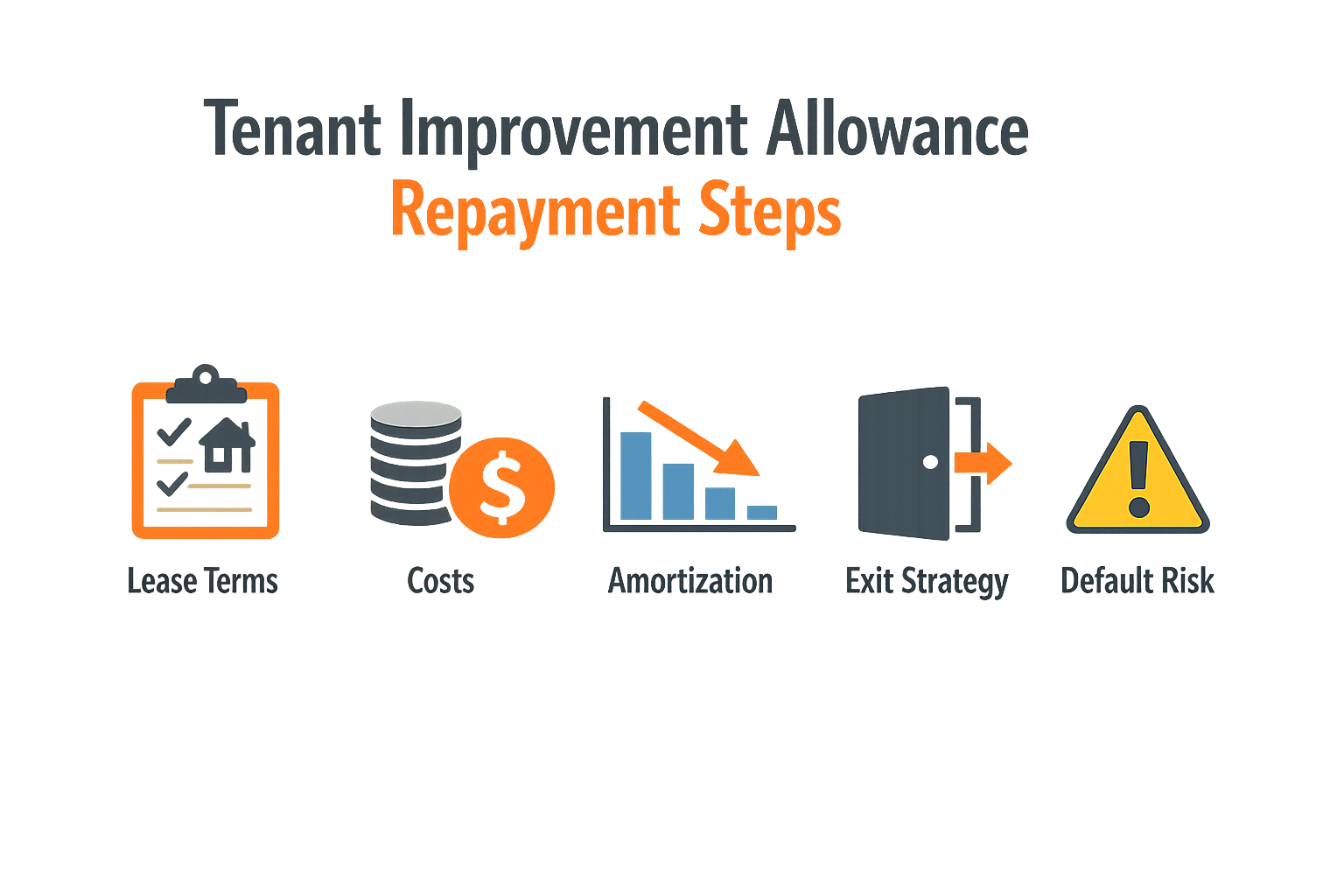
Determining whether a tenant improvement allowance repayment obligation exists requires a methodical review of the lease agreement and the circumstances under which the tenancy ends. The lease itself is the authoritative document; no external standard or regulation establishes a universal repayment rule. Follow these steps to assess your position.
Step 1
Locate the tenant improvement clause
Find the section of the lease that describes the tenant improvement allowance. It may appear under headings such as "Tenant Improvements," "Leasehold Improvements," "Allowance," or "Build-Out." Read the entire provision — not just the dollar amount. The repayment obligation, if any, is typically stated in the same clause or immediately following it.
Step 2
Identify the triggering event
Look for language that ties repayment to a specific event. Common triggers include early termination by the tenant, breach of lease, or failure to occupy for a minimum period. If the lease is silent on repayment, no obligation exists absent a separate written agreement. The absence of a repayment clause means the allowance was a landlord concession, not a loan.
Step 3
Calculate the amortization or proration schedule
When a repayment provision exists, it often includes an amortization schedule. The landlord recoups the allowance over the lease term; early departure triggers repayment of the unamortized balance. For example, a sixty-month lease with a $60,000 allowance amortizes at $1,000 per month. Termination at month twenty-four leaves forty months unamortized, yielding a $40,000 repayment obligation. Confirm whether the lease specifies straight-line amortization or another method.
Step 4
Review the default and acceleration language
Examine the lease's default provisions. Some agreements accelerate the full unamortized balance upon tenant default, while others limit repayment to specific breach scenarios. The lease may also distinguish between tenant-initiated termination and landlord-initiated termination for cause. These distinctions determine whether repayment applies and in what amount.
Step 5
Determine the obligated party
Confirm which entity signed the lease. If the tenant is a corporation or LLC, the entity is the obligated party unless a personal guarantee block appears in the lease. A guarantee makes an individual jointly liable for the tenant's obligations, including tenant improvement allowance repayment. Check the signature page and any attached guarantee rider to identify who must perform if repayment is owed.
Factors That Influence Repayment
Several lease-specific factors determine whether and how much repayment is required. The length of the initial term matters: longer leases often carry lower per-month amortization, reducing the repayment risk if the tenant remains through a substantial portion of the term. Renewal option exercise can also affect the calculation; some leases treat the initial term and the first renewal as a combined amortization period, while others reset the allowance at renewal.
The lease may permit the landlord to offset the repayment amount against the security deposit. If the deposit is insufficient, the tenant remains liable for the shortfall. Separately, some agreements allow the tenant to cure a default and avoid repayment by resuming occupancy within a specified window. That window is not negotiable after the fact — it is either in the lease or it is not.
The cheapest concession is the one whose repayment terms you read before the first invoice arrives.
For additional context on how tenant improvement allowances are structured in commercial leases, see Tenant Improvement Allowance for Commercial Spaces and What is a Reasonable Tenant Improvement Allowance.
Tips and Tricks
The agreement provides what the tenant improvement allowance covers and what triggers repayment. Before you authorize any improvement work, establish what the lease actually says about early termination, default, and the interval during which the allowance remains the landlord's obligation. Many commercial leases include a clawback provision that activates within a specified window — typically the first three to five years — if the tenant vacates before the term ends.
Review the Agreement Before Work Begins
Read the entire tenant improvement provision, not just the dollar figure. The lease may permit two remedies for the same improvement category at different prices, or it may separately price design work and construction. Confirm which entity is obligated on the agreement: if the lease names a parent company but the improvement work is contracted by a subsidiary, the personal guarantee block may not cover the improvement allowance repayment. Ask for the repayment terms in writing, including the calculation method, the window during which repayment applies, and whether repayment accelerates if the lease defaults for reasons other than non-payment.
Understand the Repayment Calculation
When a repayment clause exists, the lease typically provides a formula: a pro-rata reduction for each month the tenant remains in occupancy, or a fixed schedule that steps down the repayment obligation by interval. Check the date on the lease commencement and the date on the improvement completion certificate; some leases measure the repayment window from the certificate date rather than the lease start date. If the lease permits early termination without cause, confirm whether that provision suspends the repayment obligation or whether the two clauses operate independently.
The cheapest improvement allowance is the one whose repayment terms you understand before the first invoice arrives.
Document Everything
The owner performs routine lease administration, but a licensed agency performs any improvement work that requires a permit. Retain copies of the improvement allowance approval, the contractor's proposal, the signed change orders, the final invoice, and the completion certificate. If the lease includes a dispute window — often thirty to sixty days from the landlord's notice of repayment — you must respond within that window or the repayment amount becomes non-negotiable. What closes a repayment dispute is documentation that the improvement was authorized, completed as specified, and paid within the allowance cap. For more details on how tenant improvement allowances are structured and allocated, see How Does Tenant Improvement Allowance Work and How to Calculate Tenant Improvement Allowance.
Negotiate Before You Sign
If the lease draft includes a repayment provision, ask the landlord to specify the exact conditions under which repayment is required and whether any exceptions apply. Some landlords waive repayment if the tenant subleases the space to an approved subtenant who assumes the remaining lease term. Others permit the tenant to buy out the repayment obligation at a discount if the tenant provides advance notice of termination. Either remedy satisfies the landlord's interest in recovering the improvement cost, and both are negotiable before the lease is executed — rarely after.
Conclusion
Tenant improvement allowance repayment obligations exist only where the lease agreement creates them. The standard permits two paths: a fixed-dollar allowance with no repayment clause, or a conditional allowance that accelerates on early termination or default. Either structure satisfies commercial lease practice; the edition matters when the agreement references a specific code or standard for the work itself.
The provision permits repayment only when the lease explicitly defines the trigger event, the calculation method, and the party obligated to repay. Without those three elements in writing, no repayment obligation exists. Before you authorize an improvement, ask for the repayment clause in writing — including the exact interval, the amortization schedule if any, and what closes the obligation. What the lease actually says controls; verbal assurances and prior practice do not override the written terms.
Retain the lease, the improvement invoices, and any amendment or acceleration notice for the full term plus the statute of limitations period. In California, that means six years from the date of the last payment or the date the lease terminated, whichever is later. The agreement provides the dispute window; if a landlord asserts a repayment claim outside that window, the claim fails unless the lease separately extends it.
Understanding tenant improvement allowance repayment terms protects both parties from unplanned acceleration and ensures that the obligated party knows the full cost of early exit. For more on how tenant improvement allowances function in commercial leases, see our guide on Tenant Improvement Allowance Tax Treatment. The interval for compliance checks on the completed work — fire protection, HVAC, electrical — runs separately from the lease term and does not reset when a tenant improvement allowance is repaid or forgiven.
Frequently asked questions
Do you always have to repay a tenant improvement allowance?
No. Tenant improvement allowance repayment is required only when the lease agreement includes a specific repayment clause. If the lease is silent on repayment, the allowance is a landlord concession and no repayment obligation exists.
What triggers tenant improvement allowance repayment?
Common triggers include early lease termination by the tenant, tenant default, failure to occupy for a minimum period, or assignment of the lease without landlord consent. The lease must specify these triggers in writing.
How is tenant improvement allowance repayment calculated?
Most leases use straight-line amortization over the lease term. If a sixty-month lease includes a $60,000 allowance and the tenant terminates at month twenty-four, the unamortized balance is $40,000 (40 months × $1,000 per month).
Can a landlord offset tenant improvement allowance repayment against the security deposit?
Yes, if the lease permits it. Many commercial leases allow the landlord to apply the security deposit to any outstanding tenant obligations, including unamortized tenant improvement allowance balances.
What happens if you cannot document how the tenant improvement allowance was spent?
If the lease requires documentation and you cannot produce invoices, contracts, and completion certificates, the landlord may treat the shortfall as an immediate debt. Retain all improvement records for the full lease term plus any dispute window.