
Introduction
Commercial fire alarm systems operate under published inspection requirements that specify intervals, procedures, and the party responsible for each task. NFPA 72, the National Fire Alarm and Signaling Code, sets those intervals and defines the scope of each inspection type. Local adoption determines which edition applies, and the edition matters—requirements for semi-annual, annual, and five-year inspections have shifted across revisions.
The standard divides work between owner-performed checks and licensed-agency service. Monthly and quarterly tasks typically fall to the building owner or designated staff, while annual and comprehensive inspections require a qualified technician. Quotes often present these as a single line item, but the two are separately priced and separately mandated. When a quote does not itemize the interval or the party performing the work, the owner cannot verify that the agreement satisfies the provision.
Service agreements govern who performs each task, at what interval, and what happens when a deficiency is found. The agreement must identify the obligated entity, not merely a trade name, and must state the dispute window before suspension or acceleration takes effect. A guarantee block, if present, shows whether an individual is personally liable beyond the corporate entity. Before you authorize any multi-year agreement, confirm that the contract language matches the intervals the standard requires and that the entity signing is the one you intend to hold accountable.
Understanding filing a complaint with the California Department of Insurance can clarify your rights when a contractor's performance falls short of the agreement or when an insurer disputes coverage for a code violation. The record you retain—test reports, deficiency notices, and completion certificates—determines what documentation closes a failure when the authority having jurisdiction opens one.
Problem Statement
Building owners encounter recurring obstacles when attempting to satisfy fire alarm inspection requirements. The standard specifies intervals, but the quote often combines multiple provisions into a single line — and that single line may include work the owner is permitted to perform alongside work that requires a licensed agency. When the quote arrives without separation, the owner cannot verify whether each component is priced correctly or even required at that interval.
The second obstacle is entity identification. A service agreement names a company, but the entity obligated on the agreement may differ from the entity that holds the alarm company operator's license. If a dispute arises, the owner must establish who is bound by the contract and who is regulated by the Contractors State License Board. That board has jurisdiction to investigate complaints against contractors if a complaint regarding a patent act or omission is filed within four years of the date of the alleged violation — but only when the complaint names the correct entity and the work in question falls within the board's scope.
Common Gaps in Quotes
A typical quote lists "annual fire alarm inspection" without distinguishing between the monthly owner check, the quarterly device test, and the annual licensed inspection. Each of those carries a different requirement under the adopted edition of NFPA 72, and only the annual licensed inspection must be performed by a holder of an alarm company operator's license. When all three appear on one line, the owner cannot determine whether the price reflects only the licensed work or includes items the owner is permitted to perform in-house.
Another frequent gap is the absence of edition citation. The requirement changed between the 2010 and 2013 editions of NFPA 72, and it changed again in 2016. The authority having jurisdiction adopts a specific edition, and that edition governs what the inspection must include. A quote that omits the edition reference leaves the owner unable to verify that the scope matches the locally adopted provision.
Licensing and Compliance Uncertainty
Compliance with fire alarm inspection requirements may be influenced by the licensing of personnel involved in alarm system work. The owner receives a report stating that the system failed, but the report does not specify who is permitted to close that failure. In California, installation of a fire protection system must be performed by a contractor holding a fire protection contractor classification or, in limited cases, by an alarm company operator licensed under the Alarm Company Act. The inspection report rarely clarifies which license the remedial work requires, and the quote rarely states which license the performing entity holds.
When a code violation is opened by the authority having jurisdiction, the owner must produce documentation that closes it. That documentation includes the inspection report, the remedial work order, and proof that the performing entity held the appropriate license on the date of the work. If any of those elements is missing or inconsistent, the violation remains open — and the owner's obligation to retain the record begins on the date of the inspection, not the date of the violation notice.
For further guidance on regulatory timelines and complaint procedures in California, see Filing a Complaint With the California Department of Insurance.
Solution Steps for Fire Alarm Inspections
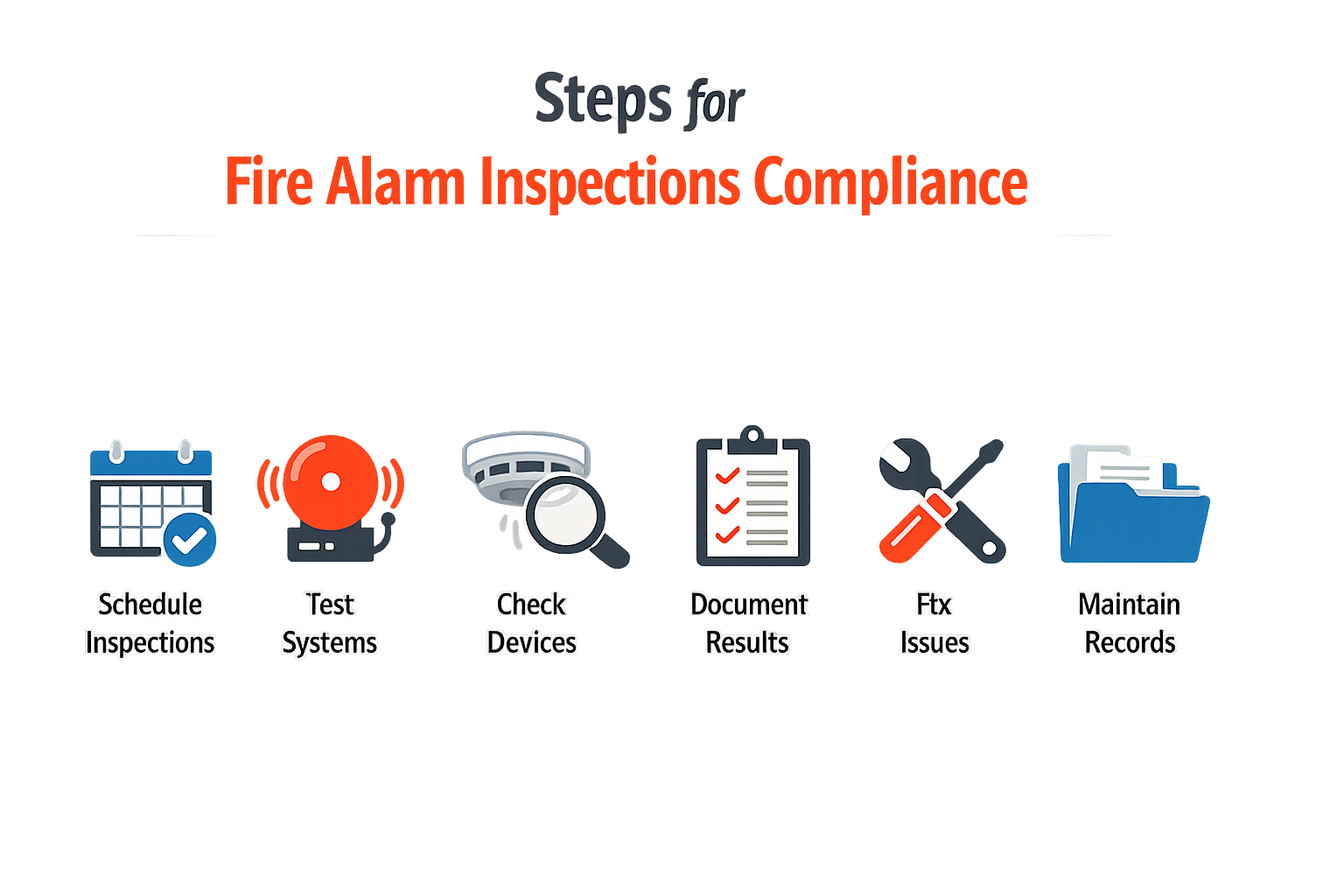
Compliance begins with understanding what the standard requires and what the licensee must provide. The interval matters, the edition matters, and the documentation trail matters. When a building owner receives a quote for fire alarm inspection work, the steps below separate a compliant engagement from one that leaves gaps in the record.
Step 1: Verify the Licensee's Documentation Requirements
Before authorizing any fire alarm work, confirm that the licensee will comply with contract requirements. The licensee must execute a certification statement and provide documentation including the physical address and contractor details. Ask for it in writing. The agreement should identify the obligated party clearly, and if a personal guarantee block appears, verify who signed it and what entity they represent.
Step 1
Request contract compliance confirmation
Ask the contractor to confirm in writing that the agreement will meet statutory contract requirements, include the certification statement, and list the physical address and license details. Retain this confirmation with the signed agreement.
Step 2: Establish What the Inspection Covers by Interval
Fire alarm inspection requirements are interval-specific. The annual visit does not include every test, and the multi-year items are frequently quoted as one line. Before you approve a quote, establish which interval the work addresses. The standard requires certain tests annually, others at longer intervals. A quote that bundles them without naming the interval may omit the separately priced multi-year work.
Step 3: Confirm Who Performs Each Task
Some checks are owner-performed; others require a licensed agency. The standard permits the owner to perform certain visual inspections and functional tests, while other work must be performed by a licensed entity. The quote should distinguish between tasks the owner can complete and tasks that require the licensed agency. If the quote prices owner-performed checks as licensed-agency service, you are paying for work the standard does not require a licensee to perform.
Step 4: Retain the Record and Close the Violation
Once the inspection is complete, the licensee must provide a written report. Retain the record. If the report identifies a deficiency, establish who is permitted to close that failure before you authorize remedial work. The authority having jurisdiction expects documentation that shows the deficiency was corrected by a qualified party. What the report actually says determines what documentation closes the violation. If the report says the system failed, the remedy must address the specific failure the report names.
For guidance on regulatory timelines and documentation expectations in other compliance contexts, see Insurance Adjuster Contact Timeline: California Regulations.
Step 4
Document the closure
When remedial work is complete, obtain a written statement from the licensee confirming that the deficiency identified in the inspection report has been corrected. Retain this statement with the original inspection report and the signed agreement.
Step 5: Understand the Agreement's Dispute and Default Provisions
Service agreements include dispute windows, default terms, and acceleration clauses. Read them. If the agreement provides for suspension of service upon non-payment, confirm the notice period and the procedure for reinstatement. If the agreement includes an acceleration clause, understand what triggers it and what the owner's obligations become upon default. The agreement provides the framework; the owner performs or the licensee performs, and the record shows who did what.
| Provision | Owner's Obligation | Licensee's Obligation |
|---|---|---|
| Dispute window | Raise objection within the window | Respond within the agreement's notice period |
| Default | Cure within the cure period or face acceleration | Provide written notice before suspension |
| Record retention | Retain inspection reports and remedial work documentation | Provide written reports and certifications |
Tips and Tricks for Ensuring Compliance

Compliance with fire alarm inspection requirements depends on documentation discipline and contractor selection. The record you retain determines what an authority having jurisdiction can verify. The license status of the entity performing the work determines whether the work closes a violation or creates a new one.
Verify the License Before You Authorize
Use only licensed contractors. If you file a complaint against a licensed contractor within the legal deadline — usually four years — the Contractors State License Board has authority to investigate the complaint. A contractor holding the appropriate fire protection or alarm classification is permitted to perform the inspection and to certify the result. An unlicensed entity cannot close a code violation, regardless of the technical quality of the work performed.
Ask for the license number in writing and verify it against the CSLB database before you sign. The classification on the license must match the scope of work in the contract. A general contractor classification does not authorize fire alarm system work; a fire protection contractor classification does.
Retain the Record for the Full Interval
All documents required must be retained by the licensee for five years and made available to the board within thirty days of a written request. As the building owner, you are not the licensee, but you are the party who must produce the record when the authority having jurisdiction opens an inspection. Retain the signed report, the invoice showing the date of service, and the contractor's license verification for the full interval between inspections.
The standard specifies the interval; the record proves you met it. If the report is dated outside the interval, the record does not close the requirement. If the contractor's license was not active on the date of service, the work does not satisfy the provision.
Understand What the Agreement Obligates
Service agreements for fire alarm inspection requirements often include annual visits and multi-year items priced as a single line. Read the scope section to establish which tasks occur at which interval. The annual visit does not include the five-year internal inspection, and the two are frequently quoted as one total. If the agreement does not separately price each interval, ask for it in writing before you sign.
The entity identification block shows who is obligated. If the contractor is a corporation, the corporation is the obligated party, not the individual who signed. A personal guarantee block, if present, makes an individual liable for the corporation's default. If the agreement permits suspension of service for nonpayment, establish the notice window and whether the contractor must resume service when payment is current. For guidance on managing disputes with insurance-related service providers, see Filing a Complaint With the California Department of Insurance.
The agreement provides the remedy; the record proves you performed it.
Separate the Interval from the Remedy
The provision permits two compliant remedies at different prices: replace the component, or test it against a calibrated instrument. Only one of those reaches most quotes. If the contractor proposes replacement, ask whether testing satisfies the same provision. If testing is permitted, ask for the separately priced alternative. The standard does not require the more expensive remedy when the less expensive one closes the same interval.
What closes the failure is the documentation that the work was performed by a licensed entity, on the required interval, using a method the standard permits. The report must state which method was used. If it says "tested," the contractor must produce the calibration record for the test instrument. If it says "replaced," the invoice must show the part installed.
Conclusion
Fire alarm inspection requirements exist to close the gap between a system installed and a system that remains functional when called upon. The standard specifies the interval, names the party who performs the check, and defines what documentation closes the record. A quote that bundles unrelated intervals or omits the edition reference introduces ambiguity that an authority having jurisdiction will not resolve in the owner's favor.
Compliance is not a single event. The owner performs weekly and monthly checks; a licensed agency performs the annual, the semi-annual where required, and any testing the standard reserves to qualified personnel. Each interval stands alone. A service agreement that defaults on one does not excuse performance on another, and the obligated party remains the entity named in the signature block regardless of which technician arrives. Retain the inspection report, the deficiency notice, and the correction certificate in a form the AHJ will accept — digital or paper, depending on what the adopting jurisdiction permits.
The standard does not negotiate. It states the requirement, permits an alternative where one exists, and stops. When a quote omits the interval or conflates two separate provisions, ask for it in writing with the edition cited and the line item separately priced. What the report actually says determines what must be done, and the date on the standard determines which provision applies. For guidance on regulatory timelines and complaint procedures when disputes arise, refer to resources on filing a complaint with the California Department of Insurance.
Compliance protects occupants, satisfies the authority, and preserves the record an owner must produce on demand. The interval is published, the licensed agency is identifiable, and the documentation either exists or it does not. Read the standard to the end, retain the report, and ensure the agreement names the party who will answer when the next inspection opens a deficiency.
Related reading
Understanding Your Denied Fire Insurance Claim: Key Insights