Introduction
Fire extinguisher inspection requirements operate on two distinct intervals, and commercial property owners frequently discover the split only when an authority having jurisdiction opens a violation. The monthly check is an owner-performed visual verification. The annual service is a licensed-agency procedure that includes internal examination and pressure testing where the standard requires it. Neither interval replaces the other, and a compliant building maintains documentation for both.
The provision permits the owner to delegate the monthly check, but delegation does not convert it into a licensed-agency obligation. The person performing the monthly walk retains the record on a tag or in a log, and that record must show the date and the result. If the tag is blank or the log stops six months back, the building is out of compliance regardless of whether the annual service is current.
Regulations governing fire extinguisher inspections evolve through amendments, and the edition matters. What closed a violation under an earlier standard may not satisfy the current adopted code. For guidance on regulatory timelines and compliance documentation in California, see Insurance Adjuster Contact Timeline: California Regulations. Before you authorize a remedy, establish which edition the authority having jurisdiction adopted locally, and ask for it in writing.
What the report actually says determines whether the inspection closed a prior failure or opened a new one. If the licensed agency marks a unit as failed and recommends replacement, that recommendation does not itself close the violation—only the completed remedy and a follow-up inspection showing the unit back in service will satisfy the authority having jurisdiction. The obligated party on the service agreement is the entity named in the signature block, and a personal guarantee block extends liability beyond the corporate shield. Read both before you authorize the work.
Problem Statement

The standard requires monthly checks and annual service, but the interval alone does not tell you who performs each task or what documentation closes a failure. A missed monthly check is not the same violation as a skipped annual service, and the remedy for one does not satisfy the other. When a building receives a notice of violation, the owner must establish what the citation actually requires and which entity is permitted to close it.
When the Interval and the Performer Are Confused
Many service agreements bundle monthly checks and annual service into a single line item. The provision permits the owner to perform the monthly inspection, while a licensed agency performs the annual service. When the agreement does not separate these tasks, the owner may authorize payment for work they are permitted to perform themselves. The agreement should state which party performs the monthly check, which party performs the annual service, and what the obligated party must retain.
Before you authorize a remedy, ask for the documentation in writing. The report should identify the specific deficiency, the standard section that governs it, and the entity that performed the inspection. If the citation references a monthly check that the owner performs, a licensed agency's proposal to close it may exceed what the provision requires. If the citation references annual service, confirm that the proposing entity holds the license the standard requires.
What the Record Must Show
Retain the record of each monthly check and each annual service separately. The authority having jurisdiction expects serialized documentation, not a summary statement. When an inspector asks for proof of compliance, the owner must produce the date, the findings, and the signature for each interval. A gap in the monthly record is a separate compliance issue from a gap in the annual record, and filing a complaint with the California Department of Insurance does not substitute for the documentation the standard requires.
The edition matters. NFPA 10 has been amended multiple times, and the locally adopted edition determines what the monthly check must include and what the annual service must cover. An agreement that references "NFPA 10" without naming the edition leaves the owner uncertain which requirements apply. Ask for the edition in writing, and verify that it matches the edition adopted by the authority having jurisdiction.
The cheapest proposal is the one that states the edition, separates the monthly check from the annual service, and names the entity that signs the record.
Solution Steps for Fire Extinguisher Inspections
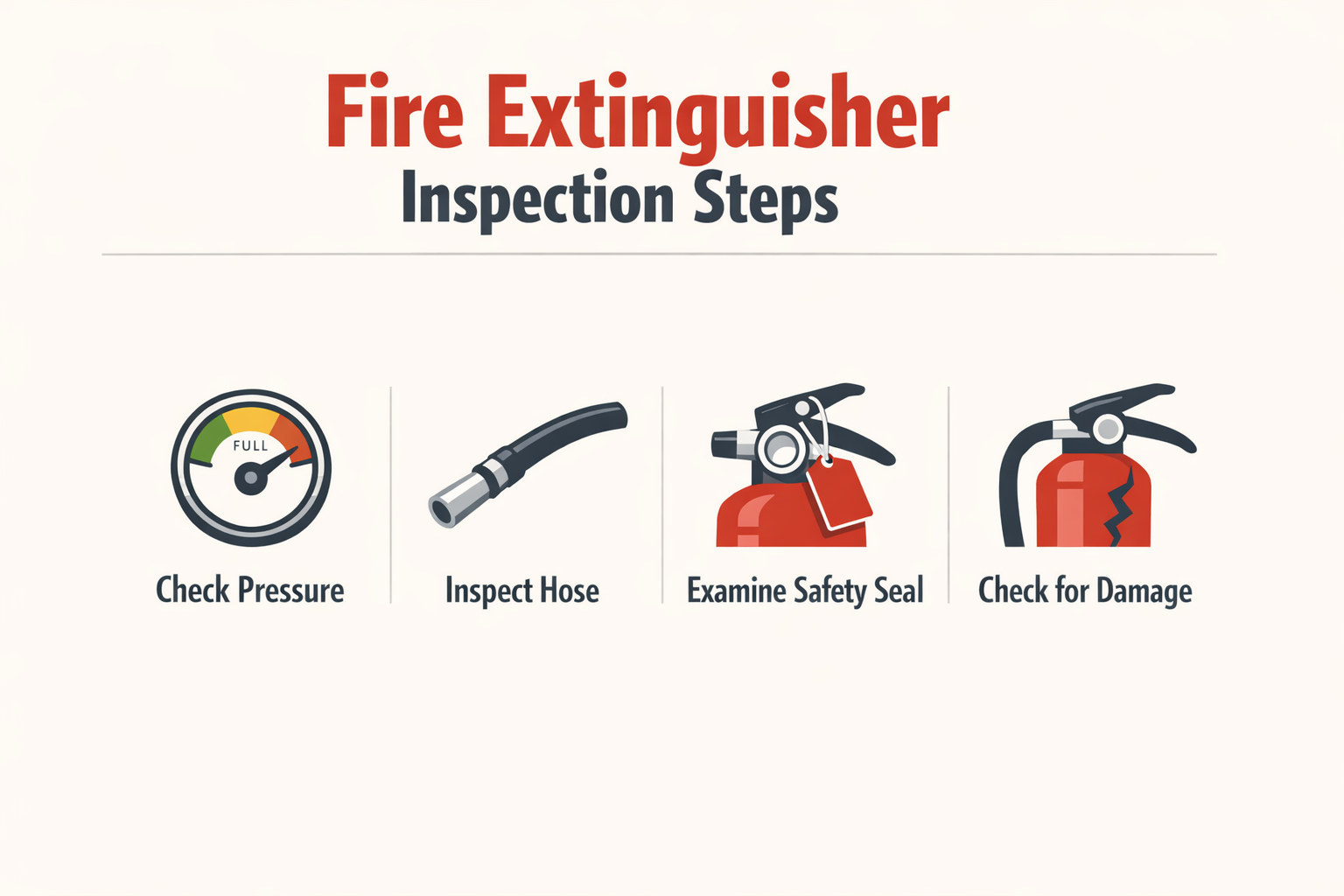
The monthly check is an owner-performed item. The annual inspection is not. Separating these two intervals prevents the common error of treating both as a single obligation.
Monthly Owner-Performed Checks
Step 1
Verify physical presence and accessibility
Confirm the extinguisher is in its designated location, unobstructed, and visible. The standard requires that the unit be immediately accessible — storage behind equipment or locked doors closes accessibility.
Step 2
Inspect the pressure gauge
Check that the needle rests in the operable range. A gauge reading outside the green zone indicates either over-pressurization or discharge, both of which require service by a licensed agency.
Step 3
Examine the tamper seal and pull pin
The tamper seal must be intact and the pull pin must be present. A broken seal or missing pin means the unit may have been discharged or tampered with, triggering immediate service.
Step 4
Check the inspection tag and record the check
Verify the most recent annual service date on the tag. Record the monthly check with the date and the initials of the person who performed it. Retain this record — the authority having jurisdiction can request it during an inspection.
When to Engage a Licensed Agency
The annual inspection, internal examination, hydrostatic testing, and any recharge or repair must be performed by a licensed fire protection service agency. The owner does not perform these.
A licensed agency is required when:
- The annual inspection interval arrives (twelve months from the last service date on the tag)
- The pressure gauge shows a reading outside the operable range
- The tamper seal is broken or the pull pin is missing
- The unit shows visible damage, corrosion, or leakage
- The extinguisher has been discharged, even partially
- The six-year internal examination or twelve-year hydrostatic test interval arrives
When you authorize service, confirm that the agreement identifies the obligated party by legal name and address. If the agreement includes a personal guarantee block, that individual becomes jointly liable for payment. Ask for the service report in writing before you approve payment — what the report actually says determines whether the work satisfies the standard.
For guidance on timelines and documentation in other compliance contexts, see Insurance Adjuster Contact Timeline: California Regulations.
Retain the Documentation
The monthly check record, the annual service report, and the multi-year test documentation must be retained for the period specified by the locally adopted edition of the standard. The authority having jurisdiction can request these records during an inspection, and their absence can open a violation even when the physical equipment is compliant.
Store the records in a location accessible to the person responsible for producing them. Electronic copies satisfy the requirement if they are complete, legible, and retrievable on demand.
Tips and Tricks for Effective Inspections
The standard requires the monthly check. The annual service requires a licensed agency. Between those two intervals, the owner performs the work that closes the monthly obligation, and the agency performs the work that closes the annual one. Separating those duties on paper before you authorize either prevents the confusion that emerges when one quote bundles both and you cannot tell which interval you are buying.
Check the Date on the Tag
The inspection tag shows the month and year of the last annual service. If the tag is missing, faded, or older than twelve months, the system is out of compliance for the annual interval. The monthly check does not replace that tag — only a licensed agency performing the annual service replaces it. Ask for the tag date in writing before you approve a quote, and verify that the quote explicitly states which interval it covers.
Separately Priced Items Close Separately
The six-year maintenance and the twelve-year hydrostatic test are not part of the annual service. If a quote lists all three on one line, ask for it in writing as three separate line items with three separate prices. The standard permits the owner to defer the six-year work or the twelve-year work without deferring the annual work, but only if the agreement shows them as independent obligations. A single bundled price forfeits that flexibility.
What the Report Actually Says
The annual report identifies deficiencies by extinguisher serial number and by deficiency type. If the report says the gauge failed, the remedy is gauge replacement or gauge testing against a calibrated instrument — either remedy satisfies the provision, and the two are frequently priced differently. Before you authorize the work, establish which remedy the quote provides. If the report says the extinguisher failed for multiple reasons, ask which deficiencies the quote closes and which remain open. Not the whole provision — the specific deficiencies listed on your report.
The cheapest vendor is the one whose paper trail you trust enough to hand the authority having jurisdiction without flinching.
The Obligated Party
The service agreement names the entity that owes the work. If the agreement names a dissolved corporation, a retired individual, or an entity that no longer holds the property, the obligation is unenforceable and the record is incomplete. Before you sign, verify that the named party matches the current owner of record. If the agreement includes a personal guarantee block, verify that the guarantor is authorized to bind themselves — a property manager cannot personally guarantee the owner's obligation without written authority from the owner.
Monitor Regulatory Updates
Fire extinguisher inspection requirements are subject to updates as standards evolve and local jurisdictions adopt new editions. The edition matters — what closed a deficiency under the 2017 edition may not close the same deficiency under the 2020 edition if the provision changed between those years. When the authority having jurisdiction adopts a new edition, ask your licensed agency in writing which edition governs your next annual service and retain that confirmation with your other compliance records.
For additional guidance on managing regulatory timelines and documentation requirements in California, see Insurance Adjuster Contact Timeline: California Regulations.
Conclusion
The standard requires what it requires, by interval. Monthly owner-performed checks and annual licensed-agency service are separate obligations, not interchangeable steps. The provision permits both, and the record must show both, or the failure remains open.
What closes a violation is documentation that the obligated party performed the required action within the mandated window. The agreement provides the interval, the licensed agency performs the work, and the owner retains the record. When an authority having jurisdiction asks for it in writing, produce the dated report—not a description of what happened, but the document that proves compliance at the moment it was due.
The edition matters. NFPA 10 as adopted locally sets the annual and five-year items, and quoting one without the other leaves the owner exposed. Before you authorize a remedy, establish which standard applies and what the full scope of work includes. A licensed agency that quotes only the annual visit is not hiding anything—it is quoting what it was asked to quote. Ask for the five-year items separately, ask for them in writing, and retain both records in a form you can hand an inspector without searching.
Compliance is not expensive when the scope is clear and the documentation is complete. Non-compliance is expensive when the failure is discovered during an unrelated inspection and the owner cannot produce proof that the work was done. The report says what was performed, when, and by whom. That is what the authority having jurisdiction will ask for, and that is what the owner must produce. For additional guidance on regulatory timelines and documentation requirements in California, see our article on Insurance Adjuster Contact Timeline: California Regulations.
The interval does not negotiate. The standard does not care whether the building is occupied, whether the extinguishers have been used, or whether the last inspection found no deficiencies. The clock runs, the obligation accrues, and the record closes it or it remains open.
Explore fire extinguisher inspection requirements, including monthly checks and when to involve a licensed agency.