
Introduction
Hiring a contractor without a structured checklist exposes a building owner to statutory traps that are simple to avoid but expensive to fix. California Business and Professions Code sections 7026, 7030, 7150.1, 7159.10, and 7164 impose specific written-contract requirements on contractors and create corresponding obligations for owners who engage them. The statutes do not distinguish between owners who knew the rules and owners who did not — the requirements apply equally to both.
A Hiring a Contractor Checklist begins with the items the statute makes mandatory: license number, insurance disclosure, and the mechanics lien warning. These are not suggestions. Cal. Bus. & Prof. Code § 7164 requires that every contract for construction of a single-family dwelling contain the contractor's name, address, and license number, along with approximate start and completion dates, a legal description of the property, and a full mechanics lien warning in the exact statutory form. Service and repair contracts under $750 carry a shorter list of mandatory terms under § 7159.10, but the license number, insurance notice, and signed acknowledgment remain non-negotiable.
The definition of "contractor" is broader than many owners assume. Under § 7026, a contractor is any person who undertakes to construct, alter, repair, add to, subtract from, improve, move, wreck, or demolish any building, highway, road, or other structure — or to do any part of that work. The definition includes subcontractors, specialty contractors, and anyone who submits a bid or purports to have the capacity to undertake the work. It extends to scaffolding, traffic control, underground storage tank monitoring equipment, and tree removal over 15 feet in height. If the work falls within that definition, the person performing it is subject to licensure, and the owner is subject to the statutory contract requirements.
When a mechanics lien is recorded after payment, or when a code violation remains open months after the contractor said it was closed, the first document an authority or a court will ask for is the signed contract. If it is missing the statutory disclosures, the owner's remedies narrow sharply. Section 7030 makes failure to include the required CSLB notice on a written contract cause for disciplinary action against the contractor, but that disciplinary action does not undo the lien or reopen the owner's limitations period. The checklist exists to prevent that outcome.
For owners managing properties subject to interval inspections — fire alarm, sprinkler, extinguisher, and emergency lighting systems under NFPA 72, 25, and 10 — the contract must also identify which entity is obligated to perform the work and whether a personal guarantee binds an individual. Service agreements frequently name a corporation but include a guarantee block signed by an officer; that signature makes the individual jointly liable if the corporation defaults. Before you authorize work, confirm that the license number on the contract matches the license held by the entity that will invoice you, and retain a copy of the insurance certificate the contractor provides. These are the records you produce when an inspector asks who closed the deficiency.
The checklist is not a substitute for reading the standard or for knowing what your jurisdiction adopted, but it ensures that the baseline statutory items appear in writing before any work begins. The next section addresses the risks that emerge when these items are missing.
Problem Statement
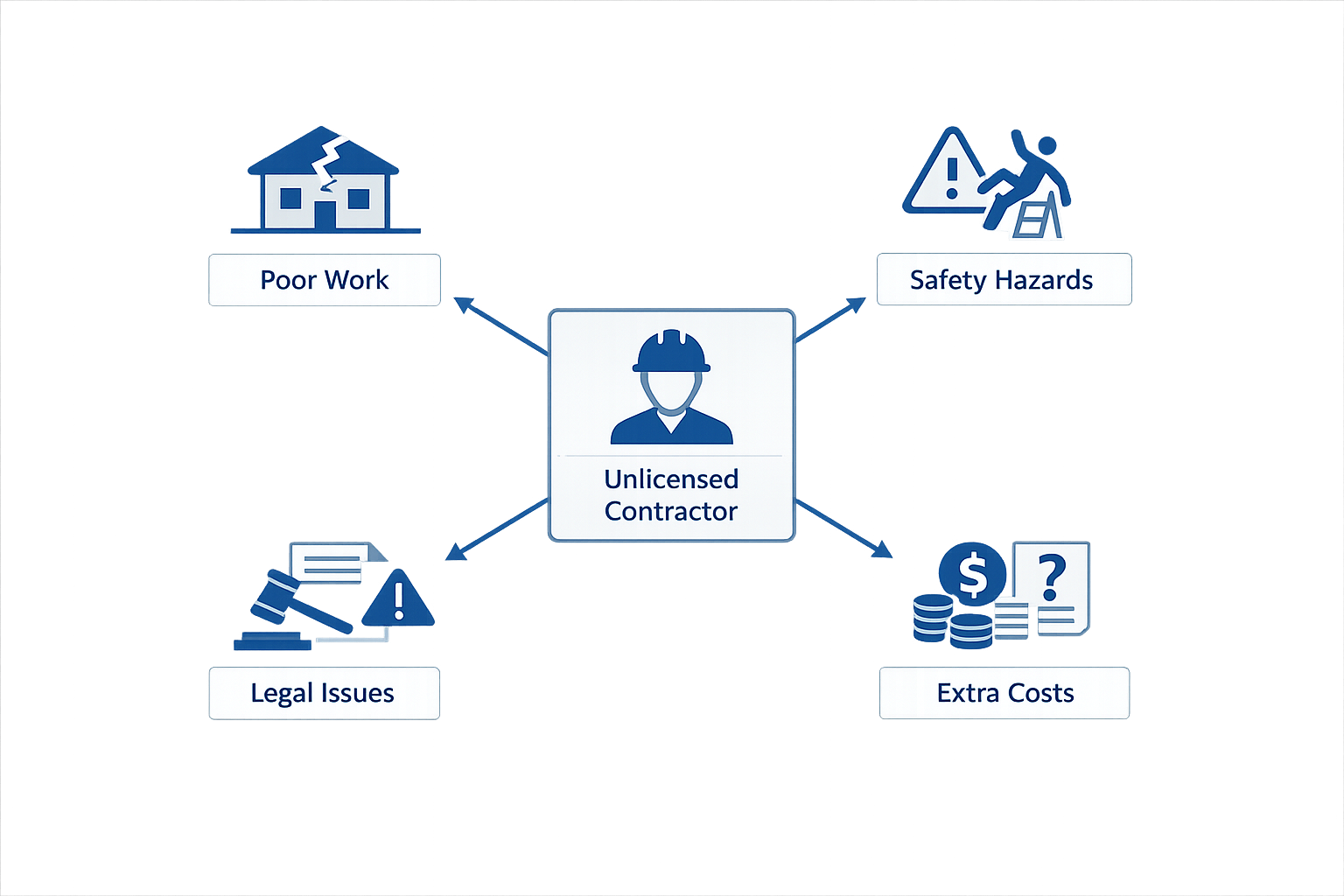
Entering into a contract with an unlicensed contractor creates immediate compliance exposure. California Business and Professions Code § 7118 states that contracting with an unlicensed individual is itself cause for disciplinary action against any licensed party involved. The statute does not distinguish between knowing and negligent failures to verify — the act of signing with an unlicensed person triggers the provision.
The Four-Year Window and What It Closes
The Contractors State License Board holds jurisdiction to investigate complaints filed within four years of a patent act or omission, and within ten years for latent structural defects. An unlicensed contractor falls outside that jurisdiction entirely. If the work fails, the property owner's only remedy is civil court, and the owner may become liable for injuries to the unlicensed contractor or the contractor's employees. The statute places that liability squarely on the hiring party.
What Unlicensed Means in Practice
California Business and Professions Code § 7026 defines a contractor as any person who undertakes to construct, alter, repair, add to, subtract from, improve, move, wreck, or demolish any building, structure, or improvement, or to do any part of that work. The definition extends to scaffolding, site preparation, traffic control for construction zones, and the installation or maintenance of underground storage tank monitoring equipment. A person performing that work without a valid license issued by the Contractors State License Board is unlicensed, regardless of experience, insurance, or business registration.
The Permit Presumption
Business and Professions Code § 7090 establishes a rebuttable presumption that construction performed without a permit is a willful and deliberate violation. When the registrar finds that a licensed contractor has violated state or local building permit law, disciplinary action follows. The statute carves out an exception for repair, maintenance, and adjustment of equipment valued under five hundred dollars, or for replacing an identical part or component of mechanical equipment. Outside those narrow categories, the absence of a permit shifts the burden: the contractor must rebut willfulness, and the property owner who hired without verifying permit compliance shares the exposure.
Cross-Contracting Without Certification
Business and Professions Code § 7118.6 addresses a contractor who enters into a contract with another person required to hold hazardous substance removal or remedial action certification under § 7058.7, when that person is not certified. A first offense is an infraction carrying a fine between one thousand and three thousand dollars, plus possible license revocation or suspension. A subsequent offense is a misdemeanor requiring license revocation or suspension, a fine between three thousand and five thousand dollars, imprisonment up to one year, or both. The statute applies whether the violation was knowing, negligent, or the result of a failure to inquire. If you are comparing mechanics lien risks, the same verification principle applies: the hiring decision creates the liability, and the absence of documentation does not excuse it.
Solution Steps for Hiring a Contractor
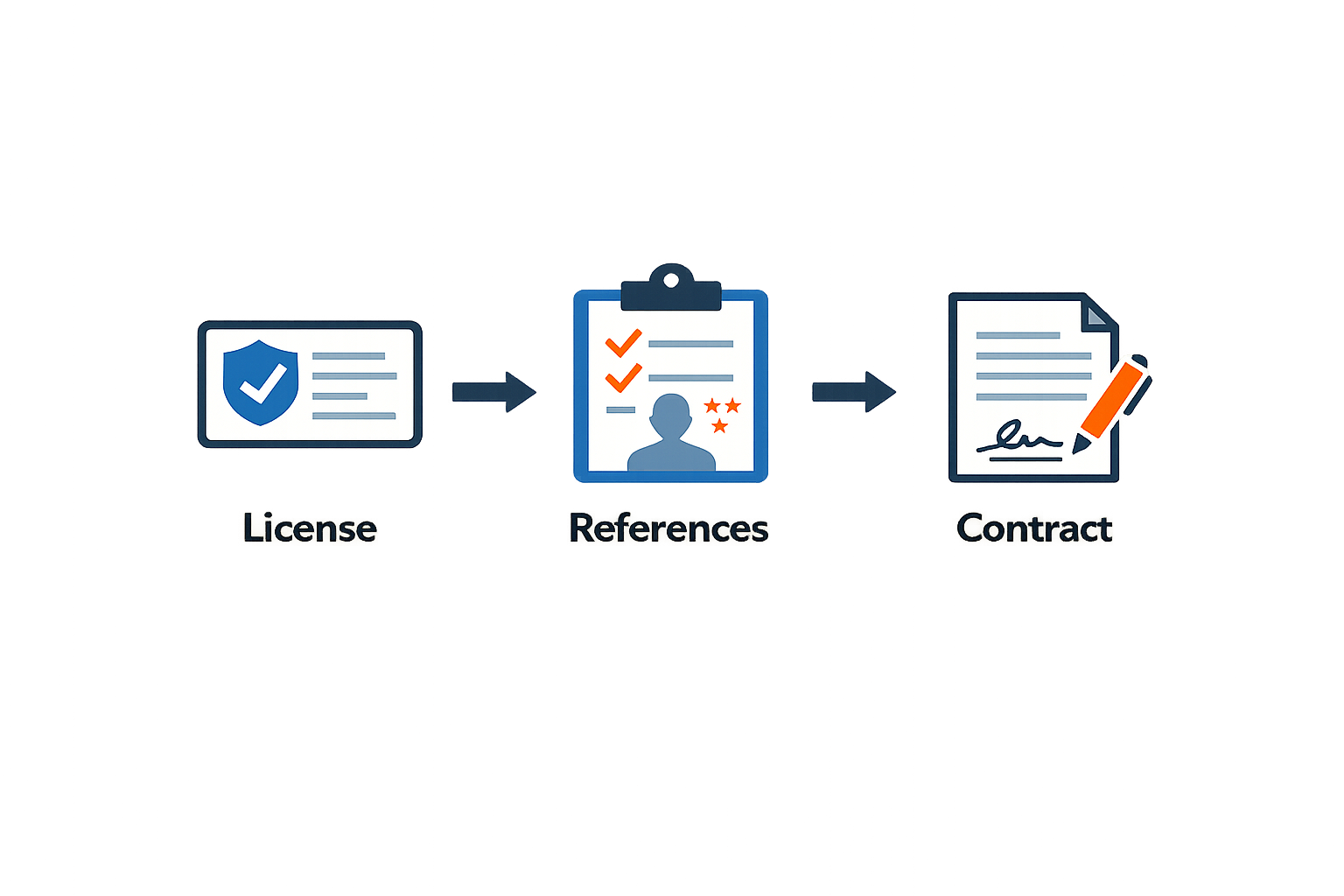
The Hiring a Contractor Checklist begins with verifying the contractor holds a valid license. Cal. Bus. & Prof. Code § 7026 defines a contractor as any person who undertakes to construct, alter, repair, or improve any structure or project, and the license requirement applies whether the contractor is a general contractor or a specialty contractor. The statute makes no exception for small jobs or established relationships — the license is required.
Step 1: Verify the Contractor's License Status
Confirm the contractor's license number and classification before any contract is signed. Cal. Bus. & Prof. Code § 7065 requires contractors to qualify by written examination, and licenses are issued to individual owners, partnerships, corporations, limited liability companies, and participating tribes. The Contractors State License Board maintains a public database where you can verify the license number, classification, expiration date, and disciplinary history. A contractor who qualifies by means of a responsible managing employee must file a statement at renewal verifying that individual's capacity, and the qualifying individual must be actively engaged in the classification of work for which they are the qualifying person.
For a contractor adding an additional classification, Cal. Bus. & Prof. Code § 7065.3 permits the addition without further examination if the qualifying individual has been listed as a member of the personnel of any licensee whose license was active and in good standing for five of the seven years immediately preceding the application, and has had not less than four years of experience as a journeyman, foreman, supervising employee, or contractor in that classification within the last ten years. The registrar must determine the new classification is closely related to the existing one, or that it is a significant component of the contractor's construction business.
Step 2: Confirm Insurance Coverage
The contract must include a notice concerning commercial general liability insurance. Cal. Bus. & Prof. Code § 7164 requires every contract for the construction of a single-family dwelling to contain a check box indicating whether or not the contractor carries commercial general liability insurance, and if so, the name and telephone number of the insurer. The statute directs the board to prepare a statement emphasizing the value of commercial general liability insurance and encouraging the owner to verify the contractor's insurance coverage and status. The same requirement applies to service and repair contracts under Cal. Bus. & Prof. Code § 7159.10: the contract must include a notice stating whether the contractor carries commercial general liability insurance, is self-insured, or does not carry coverage.
Verify the coverage directly with the insurer before you authorize any work. The notice must also address workers' compensation insurance, and the contractor must provide the name and telephone number of the carrier or state that the contractor is self-insured or does not carry coverage.
Step 3: Review the Written Contract
Every contract between an owner and a contractor for the construction of a single-family dwelling must be in writing and signed by both parties, per Cal. Bus. & Prof. Code § 7164. The writing must be legible and must contain the contractor's name, address, and license number; the approximate dates when the work will begin and be substantially completed; and a legal description of the location where the work will be done. The contract must include a mechanics lien warning with the heading "MECHANICS LIEN WARNING" followed by the full statutory text, which explains that unpaid subcontractors, suppliers, and laborers may record liens even if the owner pays the contractor in full.
The contract must also include the notice required by Cal. Bus. & Prof. Code § 7030, which states that contractors are required by law to be licensed and regulated by the Contractors State License Board, and that the board has jurisdiction to investigate complaints filed within four years of the date of the alleged violation (or within ten years for latent acts or omissions pertaining to structural defects). For home improvement contracts and service and repair contracts, the statute requires a longer notice in at least 12-point type, directing the owner to the board's website and contact information.
Step 1
Obtain the Preliminary Notice Information
Before the contractor begins work, obtain the name and address of the owner and the construction lender, if any. Cal. Civ. Code § 8208 requires a direct contractor to make this information available to any person seeking to give preliminary notice. The preliminary notice must comply with Cal. Civ. Code § 8202 and include a general description of the work to be provided, an estimate of the total price, and the statutory notice to the property owner that a lien may be placed on the property if subcontractors or suppliers are not paid in full.
Step 2
Verify the Qualifying Individual's Experience
If the contractor qualifies by means of a responsible managing employee, confirm that individual's experience meets the statutory requirements. Cal. Bus. & Prof. Code § 7068 defines a responsible managing employee as an individual who is a bona fide employee of the applicant and is actively engaged in the classification of work for which that responsible managing employee is the qualifying person. "Bona fide employee" means an employee who is permanently employed by the applicant, and "actively engaged" means working 32 hours per week, or 80 percent of the total hours per week that the applicant's business is in operation, whichever is less.
Step 4: Understand the Contract Terms and Payment Schedule
The contract must state when payment is due and what conditions constitute completion. Cal. Bus. & Prof. Code § 7159.10 defines a service and repair contract as an agreement where no payment is due, or accepted by the contractor, until the work is completed — meaning all of the conditions that caused the buyer to contact the contractor for service and repairs have been fully corrected and, if applicable, the building department has accepted and approved the corrective work. If the contract does not meet all the requirements for a service and repair contract, the full home improvement contract requirements apply, including any rights to rescind the contract.
Retain the signed contract and all attachments. The contractor must give the buyer a copy of the contract signed and dated by both parties before any work is started. The writing must be in the same language as principally used in the oral sales presentation, and any printed form must be readable in at least 10-point typeface with headings in at least 10-point boldface type.
For additional guidance on contract compliance and documentation requirements, see How Does a Mechanics Lien Work: Mechanics Lien for Building Owners.
Tips and Tricks for Hiring a Contractor

Once you have verified a contractor's license and reviewed the written agreement, additional practices can reduce risk and clarify expectations. The California Business and Professions Code sets requirements for what must appear in writing, but it does not prevent you from asking for more before work begins.
Use the Online License Verification Tool
The Contractors State License Board maintains a current contractor license check search function on its website. Cal. Bus. & Prof. Code § 7018 requires the board to permit consumers to search for a licensed contractor by either ZIP Code or geographic location. Use this tool every time, even when a contractor provides a license number in a quote. License status changes — suspensions, expirations, and disciplinary actions appear in the public record. Verify the license before you sign, and verify it again if the project start date moves.
Confirm Insurance Coverage in Writing
Cal. Bus. & Prof. Code § 7164 requires the written contract to include a check box indicating whether the contractor carries commercial general liability insurance and, if so, the name and telephone number of the insurer. The provision also requires a statement prepared by the board that emphasizes the value of commercial general liability insurance and encourages the owner to verify the contractor's insurance coverage and status. Do not stop at the check box. Call the insurer at the number provided and confirm that the policy is active, that it covers the type of work described in your contract, and that it will remain in force through the completion date.
Consider Joint-Check Payment for Subcontractors
When a contractor tells you it is time to pay for the work of a subcontractor or supplier who has provided you with a Preliminary Notice, one way to reduce lien risk is to pay with a joint check. Cal. Bus. & Prof. Code § 7164 describes this practice: write a joint check payable to both the contractor and the subcontractor or material supplier. The joint check ensures that the subcontractor or supplier receives payment directly, reducing the chance that an unpaid party will record a lien even after you have paid the prime contractor in full. This practice does not eliminate all lien risk, but it addresses the most common scenario — a contractor who collects payment and does not distribute it downstream.
The joint check ensures that the subcontractor or supplier receives payment directly, reducing the chance that an unpaid party will record a lien even after you have paid the prime contractor in full.
Understand the Consequences of Hiring an Unlicensed Contractor
Cal. Bus. & Prof. Code § 7118 states that entering into a contract with a contractor while such contractor is not licensed as provided in the chapter constitutes a cause for disciplinary action. The provision does not specify who faces the disciplinary action, but the context makes clear that the unlicensed contractor is the target. The practical consequence for the property owner is different: an unlicensed contractor cannot use the courts to collect payment, and the owner cannot enforce contract terms through the Contractors State License Board's complaint process. If a dispute arises, the absence of a valid license removes the most straightforward enforcement paths. For more on lien risks and enforcement, see Mechanics Lien California: Mechanics Liens in California: Deadlines.
Verify That All Contract Requirements Are Met
Cal. Bus. & Prof. Code § 7150.1 defines a home improvement contractor as a contractor who is engaged in the business of home improvement either full time or part time and states that a home improvement contractor shall satisfy all requirements imposed by the relevant article. Before you sign, confirm that the contract includes every element the statute requires: the contractor's name, address, and license number; the approximate dates when the work will begin and be substantially completed; a legal description of the location where the work will be done; the mechanics lien warning; and the insurance and workers' compensation notices. If an element is missing, ask for it in writing. The contractor's willingness to add the missing provision tells you something about how the contractor approaches compliance.
Conclusion
A Hiring a Contractor Checklist that begins with license verification and extends to contract terms, insurance requirements, and record retention expectations establishes a defensible position before work starts. The standard requires documentation; the agreement provides dispute windows; and the obligated party is the entity whose license number appears on the contract. Where a contractor's license status is unclear, the Contractors State License Board maintains a public database that closes the question.
The checklist does not eliminate risk, but it shifts the burden of proof. A written contract that names the licensed entity, specifies the scope, and includes the statutorily required CSLB disclosure produces a record an owner can retain and produce. Where a dispute arises within the complaint window, that record determines whether the Board has jurisdiction and what remedy the owner may pursue. Entering into a contract with an unlicensed contractor is cause for disciplinary action under Cal. Bus. & Prof. Code § 7118, and using an unlicensed contractor may leave the owner with no administrative remedy—only civil court.
Thorough preparation means asking for it in writing, checking the date on the license, and confirming that the agreement identifies the obligated party. The edition matters, the interval matters, and the record you retain determines what you can produce when the authority having jurisdiction asks. For guidance on managing contractor relationships in the context of insurance claims and compliance obligations, see How to Deal with an Insurance Claims Adjuster for Commercial Buildings.