
Introduction
Washington L&I Contractor Verification is the state-maintained tool for checking whether a contractor holds a current license, carries required insurance, and has no open compliance failures. The standard requires certain building services to be performed by licensed contractors, and many jurisdictions condition permit issuance or inspection sign-off on proof of licensure. The system returns a snapshot of the contractor's standing at the moment you search it.
A verification record does not tell you what the job should cost, whether the contractor is competent, or whether the proposed scope matches the license classification. It tells you whether the state has issued a license, whether that license is active, and whether the contractor has met baseline insurance and bonding requirements. When a contractor quotes work that falls under a licensing requirement, ask for the license number and run it through the system before you authorize anything. If the record shows an expired license, a suspended status, or missing insurance, the contractor is not permitted to perform the work, and any agreement you sign may be unenforceable.
The verification system does not replace due diligence on the service agreement itself. Read the agreement, confirm the entity name matches the license holder, check the insurance certificate dates, and retain the verification printout with your contract file. If a dispute arises later, the fact that you verified the license at the time of contracting does not cure a defect in the agreement or prove the work was performed correctly, but it does show you took the required step to confirm the contractor was authorized to bid. For guidance on reviewing service agreements and understanding what closes a compliance failure, see How Does a Mechanics Lien Work: Mechanics Lien for Building Owners.
The system is not a substitute for asking the contractor for documentation in writing. If the verification record shows the license is valid but the insurance expiration date is approaching, ask the contractor to provide an updated certificate before work begins. If the record shows a complaint history or a prior stop-work order, ask the contractor to explain it in writing and provide evidence that the issue was resolved. The verification system gives you the state's record; the contractor's written response gives you a document you can produce if the issue resurfaces.
Why Washington L&I Contractor Verification Matters
The agreement arrives with a contractor name, a business address, and a signature block. The owner signs, the work begins, and the invoice follows. Months later, a lien is recorded, or the authority having jurisdiction issues a stop-work order, and the owner learns that the contractor was never licensed or that coverage lapsed before the job started. The signed agreement does not protect the owner from that failure.
California Business and Professions Code section 7031 bars an unlicensed contractor from recovering payment in any court, regardless of the work performed. The statute permits the owner to recover all compensation already paid to an unlicensed contractor. A contract signed with an unlicensed entity is unenforceable, and any security interest taken to secure payment is void. The burden of proving licensure falls on the contractor when licensure is disputed, and proof requires a verified certificate from the licensing board showing that the contractor held the proper classification at all times during performance.
The Gap Between the Agreement and the Record
The service agreement states that the contractor is licensed. The proposal lists an address and a registration number. The owner has no practical means to verify those representations before signing, and most owners do not attempt verification until a problem surfaces. By that time, the work is complete, the invoice is paid, and the window to challenge the agreement has closed. The owner who paid an unlicensed contractor has a statutory remedy, but recovering the payment requires litigation, and the unlicensed contractor may lack attachable assets.
The compliance interval does not wait for the owner to discover the licensing failure. The authority having jurisdiction inspects on its own schedule, and a violation opened during that inspection must be closed by a licensed agency. If the original contractor cannot close the violation, the owner must retain a second contractor to perform corrective work, and the cost of that work is not recoverable from the first contractor through the unenforceable agreement.
What the Owner Cannot Verify from the Document Alone
The proposal shows a license number. It does not show the classification under which that number was issued, the expiration date of the license, or whether the license was active on the date the agreement was signed. The agreement may reference insurance, but it does not attach a certificate of insurance showing the policy period, the coverage limits, or the named insured. The owner who signs without independent verification accepts the contractor's representation as true, and that representation is not binding on the licensing board, the insurer, or the authority having jurisdiction.
The contractor's business address, as printed on the agreement, may differ from the address on file with the licensing board. The entity name on the agreement may differ from the legal name under which the license was issued. The signature block may show an individual's name, but the license may be held by a corporation or a partnership, and the individual may lack authority to bind the licensed entity. None of those discrepancies appears on the face of the agreement, and the owner has no duty under most service agreements to investigate them before signing.
The agreement states that the contractor is licensed, but the agreement does not prove it — and the authority having jurisdiction does not accept the agreement as proof.
The problem is not that the information does not exist. Licensing boards maintain current records, and those records are public. The problem is that the owner, at the moment of signing, does not retrieve the record, does not compare it to the agreement, and does not condition the signature on a match. The verification step is omitted, and the omission transfers the risk of licensing failure from the contractor to the owner.
How to Use Washington L&I Contractor Verification
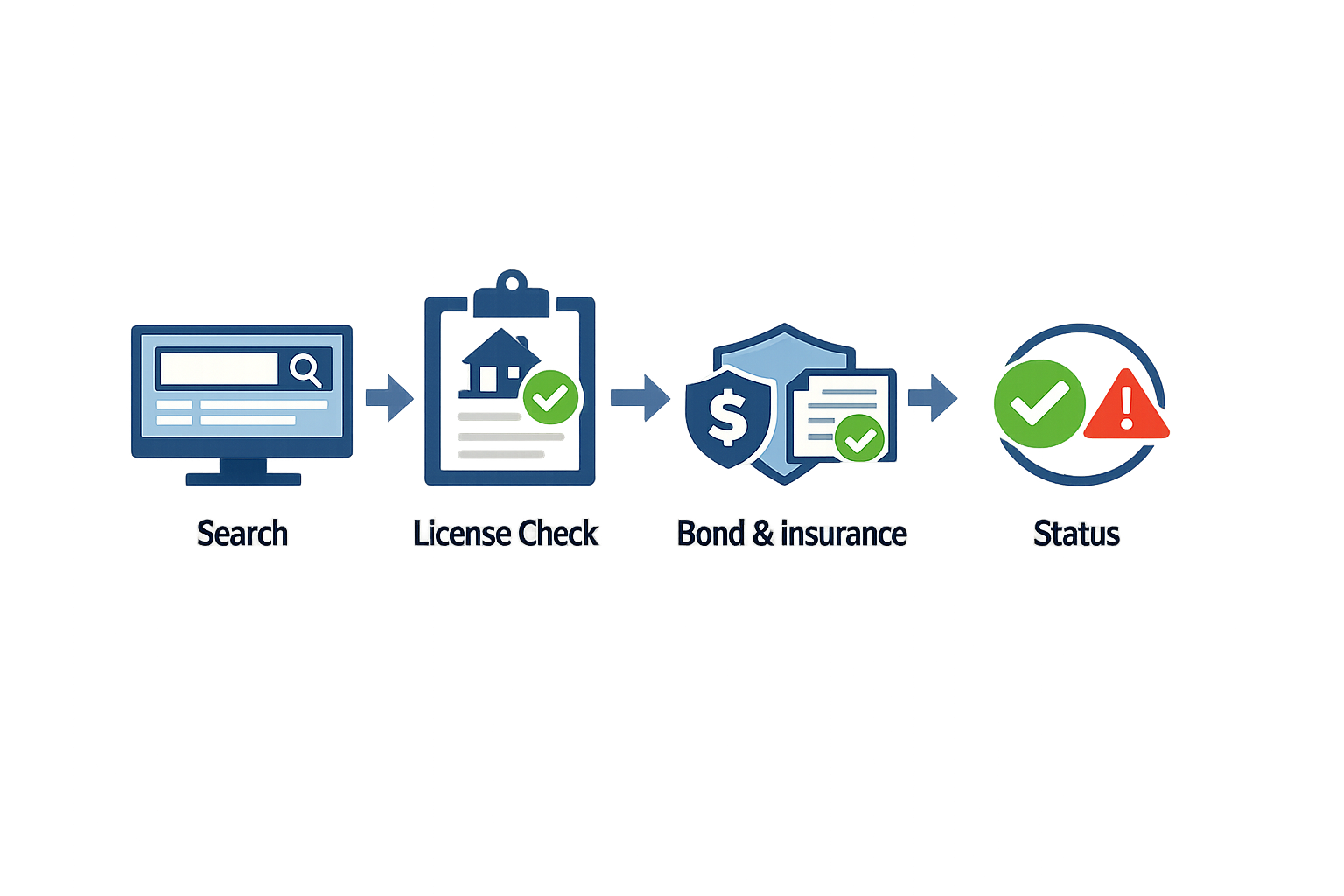
The verification process requires a methodical approach. Start with the information you already have — the contractor's name, the entity type, and the license number if it was provided to you. The system will not accept partial queries, so gather the complete legal name before you begin.
Locate the Contractor Search Portal
The board maintains a contractor license check search function on their internet website. This function permits searches by either ZIP Code or geographic location. Navigate to the official portal; do not rely on third-party aggregators or cached results. The board updates the database continuously, and only the official portal reflects current standing.
Step 1
Identify the entity type
Determine whether the contractor is an individual owner, a partnership, a corporation, a limited liability company, or a participating tribe. Each entity type qualifies for licensure differently: an individual owner may qualify by personal appearance or by a responsible managing employee; a partnership qualifies by a general partner or a responsible managing employee; a corporation qualifies by a responsible managing officer or employee; a limited liability company qualifies by a responsible managing officer, manager, member, or employee. The entity type determines which personnel appear on the license record.
Step 2
Enter the contractor's legal name
Use the exact legal name as it appears on the license application. A corporation or limited liability company must provide its identification number issued by the Secretary of State; if you have that number, include it in the search field. A tribal business must provide verification of its status as a tribal business, which may include enacted resolutions, articles of incorporation, or a current list of federally recognized tribes published under the Federally Recognized Indian Tribe List Act of 1994. The search will not match nicknames, assumed names, or partial strings.
Step 3
Verify the classification
The license record displays the classification for which the contractor qualified. The applicant must show the degree of knowledge and experience in the classification applied for, and the general knowledge of the building, safety, health, and lien laws of the state. If the work you are authorizing falls outside the listed classification, the license does not cover it. Ask for the classification in writing before you sign the agreement.
Step 4
Confirm the qualifying individual
The license record names the qualifying individual — the person who passed the written examination or who served as the qualifying individual for a licensee whose license was in good standing within the five-year period immediately preceding the application. A responsible managing employee means an individual who is a bona fide employee of the applicant and is actively engaged in the classification of work for which that responsible managing employee is the qualifying person. "Bona fide employee" means permanently employed by the applicant; "actively engaged" means working 32 hours per week, or 80 percent of the total hours per week that the applicant's business is in operation, whichever is less. At the time of application for renewal, the current qualifying individual must file a statement with the registrar verifying their capacity as a qualifying individual to the licensee.
Step 5
Check workers' compensation status
The record should confirm the obligation to secure the payment of valid and current workers' compensation insurance in accordance with Section 3700.5 of the Labor Code. The enforcement division rigorously enforces this chapter prohibiting all forms of unlicensed activity and enforces the workers' compensation requirement. If the record does not show current coverage, do not proceed. The contractor must provide proof of insurance separately; the verification system confirms only that the requirement is on file.
Review the License Expiration Date
The license record displays the expiration date. A license that expired more than five years before the current application date may require the qualifying individual to retake the written examination. If the license is within 90 days of expiration, confirm that the contractor has initiated the renewal process. The board does not grant extensions; an expired license is an invalid license, and work performed under an expired license is unlicensed work.
Document the Verification
Print or save a PDF of the search result page. The record includes the license number, the entity name, the classification, the qualifying individual, the issue date, and the expiration date. Retain this document with the service agreement. If the contractor later disputes the scope of the license or the identity of the qualifying individual, the verification record establishes what the board published on the date you checked it. For more guidance on documentation requirements in service agreements, see How Does a Mechanics Lien Work: Mechanics Lien for Building Owners.
The verification record establishes what the board published on the date you checked it — retain it with the agreement.
Best Practices for Washington L&I Contractor Verification
Verification is not a one-time event. The standard requires you to check before you authorize work, and again at intervals if the relationship continues. A contractor whose license was current when you first hired them may not remain current; a workers' compensation policy that satisfied the requirement in January may lapse in March. The record you retain must reflect the date you checked, not the date the contractor says they complied.
Verify Before Every Authorization
Each time you approve a scope or authorize a payment, confirm that the license remains active and the insurance remains in force. The enforcement division has the authority to issue notices to appear in court for unlicensed activities — a failure that can close your building until you remedy it. The interval between checks depends on the work: a monthly service agreement invites a quarterly verification; a one-time repair invites a check immediately before you sign. When a contractor submits an invoice, ask for the current insurance certificate in writing before you authorize payment. The certificate must show coverage that includes the work period, not coverage that expired before the work began.
Retain the Record with the Date You Checked
The record that closes a compliance question is the record that shows when you verified, not when the contractor claims they held the credential. Print the verification page, note the date you accessed it, and file it with the service agreement or work order. If the system permits, download a PDF; if it does not, a dated screenshot satisfies the requirement. When an authority having jurisdiction asks to see your documentation, produce the verification record and the invoice together. The two documents together establish that you checked before you authorized, which is what the provision requires.
Understand What the Verification System Does Not Show
The system shows license status and, where integrated, workers' compensation coverage. It does not show whether the contractor performed work to the standard, whether prior clients were satisfied, or whether the contractor's pricing is competitive. A valid license establishes that the contractor is permitted to bid and to perform; it does not establish that the contractor's quote is reasonable or that the work will satisfy your tenant's expectations. Separately priced items — the internal assessment, the gauge replacement, the calibration test — require you to verify that the quoted remedy is the one the standard actually requires, not merely that the contractor holds a license to perform either remedy. For guidance on managing contractor relationships and ensuring compliance, see How to Deal with an Insurance Claims Adjuster for Commercial Buildings.
The cheapest bid from a licensed contractor is not the compliant bid if the scope omits half the required interval items.
Check the Qualifying Individual's Status
A corporation or limited liability company qualifies by the appearance of a responsible managing officer or responsible managing employee. When you verify the entity's license, confirm that the qualifying individual named in the verification matches the individual who signed the quote or the service agreement. If the qualifying individual changes mid-term, the license remains valid, but the obligated party may have changed — ask for the updated qualifying individual's name in writing and verify that the board's record reflects the change. The agreement provides for notice of changes to the personnel of record; if the contractor does not provide that notice within the window the agreement specifies, you may have grounds to suspend payment until the documentation is current.
Conclusion
Verifying a contractor's standing before work begins is not optional — it is the record you produce when a dispute reaches an authority or a courtroom. The standard requires documentation at intervals, and a service agreement obligates a specific entity. When that entity lacks current coverage or a valid license, the agreement may not bind anyone, and the owner retains the obligation to close any open violation.
The verification step takes minutes. The absence of that record can suspend operations, accelerate payment disputes, or leave an owner without recourse when a contractor walks off a job. Ask for the license number, the coverage expiration date, and the name on the policy in writing. Retain the printout with the date you pulled it, and check it again if the job crosses a renewal window. Either remedy satisfies the provision — verify before you authorize, or defend the failure after it closes.
When a contractor states that coverage is current, that statement may be accurate on the day it is made and expired the day work begins. What Happens When a Mechanics Lien Is Filed? examines the documentation an owner must produce to establish that the obligated party performed under a valid agreement. The verification is not a courtesy — it is the first line in the record that determines who bears the cost when the standard was not met.
The system exists to answer one question: was this contractor permitted to perform this work on this date? The answer determines whether the owner performed the required check, whether the agreement binds the named entity, and what documentation closes a violation. Verification is not the whole provision — it is the part that determines whether the rest of the provision applies.
FAQ
What is Washington L&I Contractor Verification?Washington L&I Contractor Verification is the state's official online system for checking a contractor's license status, insurance coverage, and compliance standing before hiring.
How often should I use Washington L&I Contractor Verification?Verify before signing any agreement, before each payment authorization, and at quarterly intervals for ongoing service contracts.
Does Washington L&I Contractor Verification show insurance details?The system confirms whether required workers' compensation insurance is on file but does not display policy limits or expiration dates — request a certificate directly from the contractor.
Can I rely on a contractor's word instead of using Washington L&I Contractor Verification?No. An agreement with an unlicensed contractor may be unenforceable, and verbal assurances do not satisfy documentation requirements when an authority inspects.
What should I do if Washington L&I Contractor Verification shows an expired license?Do not authorize work. Ask the contractor to renew the license and provide proof of current standing before proceeding.