
Introduction
Verifying a contractor before you hire is not about distrust—it is about documentation. When you authorize work on a commercial building, you become responsible for closing code violations, retaining inspection records, and defending against mechanics liens filed by parties you never contracted with. The contractor you select determines whether those obligations are straightforward or expensive.
An experience that stands out involves an owner who submitted an inspection report and an invoice that described two different visits to the same building. The discrepancy was not evidence of dishonesty; it was evidence that the owner had not cross-referenced the documents before paying. That failure cost the owner a second inspection to close a violation the first visit never addressed.
California law mandates specific contract terms, including the contractor's license number, business address, and a statement about commercial general liability insurance. The statute does not require you to verify those terms—it requires the contractor to provide them in writing. When a contractor resists putting those terms on paper, or when the paper describes work in general language that does not match the standard cited, you have identified a problem before it becomes your problem. For guidance on managing disputes once work begins, see How to Deal with an Insurance Claims Adjuster for Commercial Buildings.
This guide walks through what verification means in practice: what to ask for in writing, which documents close which failures, and where the standard permits two compliant remedies at different prices. It does not tell you what any specific job should cost, and it does not provide legal advice for disputes already underway. It reads the provisions to the end and stops where the record stops.
What is Contractor Verification?
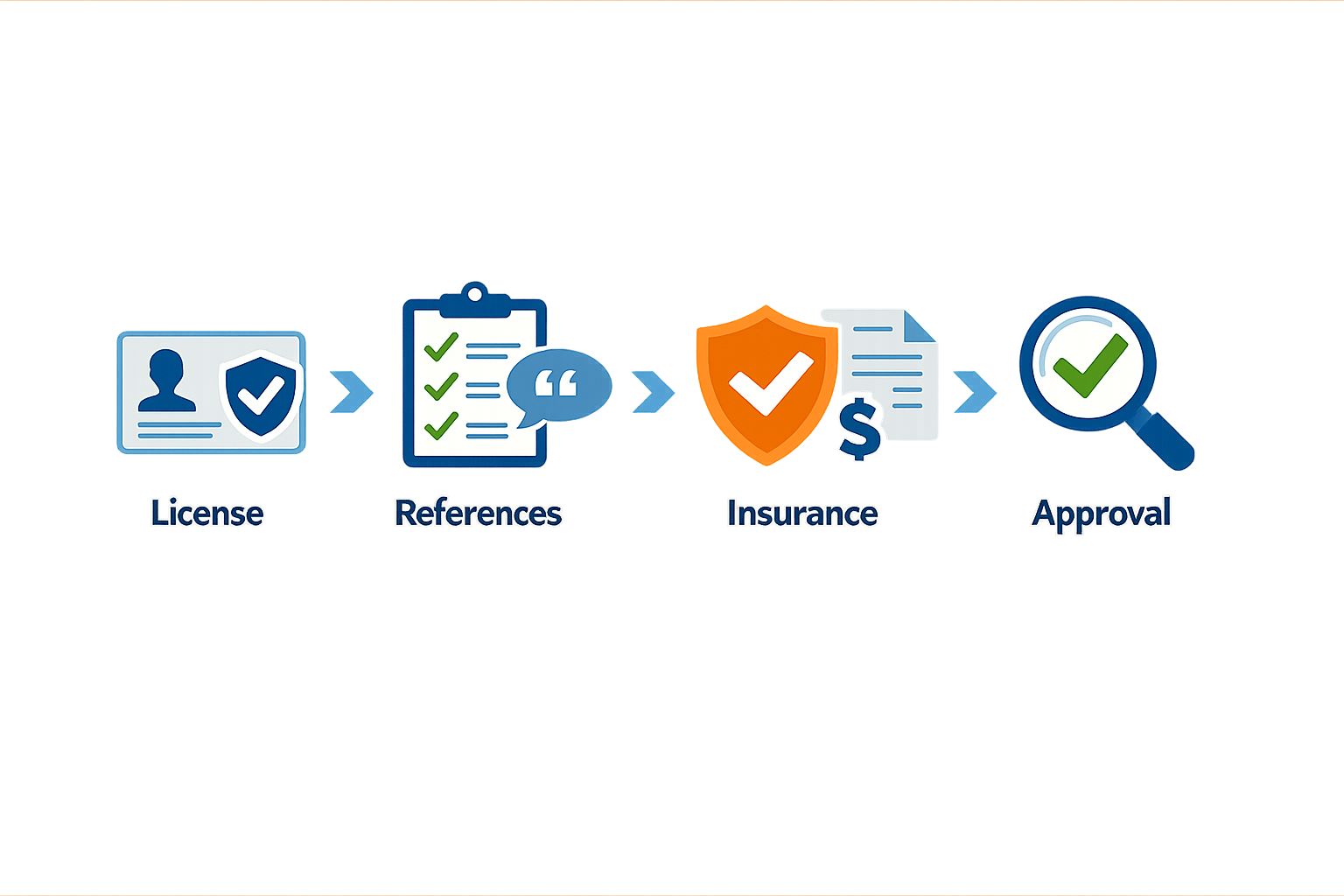
Contractor verification is the process of confirming that an individual or entity undertaking construction work holds a valid, active license issued by the state licensing authority and meets the legal requirements to perform the work. In California, the Contractors State License Board (CSLB) regulates contractors and maintains public records of licensure status, disciplinary actions, and bond information. Verification establishes that the contractor is legally permitted to enter into a contract and perform the work described.
The Legal Definition of a Contractor
California law defines a contractor broadly. The term includes any person or entity that undertakes or offers to undertake construction projects, maintains or services fixed air-conditioning, heating, or refrigeration equipment, or performs tree removal and similar specialized work (Cal. Bus. & Prof. Code § 7026.1). The definition extends to consultants who oversee bids, arrange work schedules, and maintain oversight of construction projects under home improvement contracts. A contractor must hold a license in the appropriate classification for the work performed.
What Verification Confirms
Verification confirms three elements: the contractor's license number, the license status at the time work is performed, and the classification of work the license permits. The CSLB maintains a public search function on its website that allows owners to search by license number, business name, or geographic location (Cal. Bus. & Prof. Code § 7018). The search returns the license status, expiration date, and any disclosable complaints or disciplinary actions. Verification does not assess the contractor's skill, pricing, or reputation — it establishes only that the contractor is legally permitted to contract for the work.
Why the License Number Matters
Every written contract must include the contractor's name, business address, and license number (Cal. Bus. & Prof. Code § 7030). The license number is the primary identifier used in verification. Without it, an owner cannot confirm licensure through the CSLB database. Contracts that omit the license number, or that include an expired or invalid number, signal a compliance failure before work begins. The license number also appears on preliminary notices and payment demands — cross-referencing these documents against the CSLB record confirms that the entity performing work matches the entity on the license.
For more information on what happens when a mechanics lien is filed, including how licensure affects lien enforceability, see our detailed guide.
Why Contractor Verification Matters
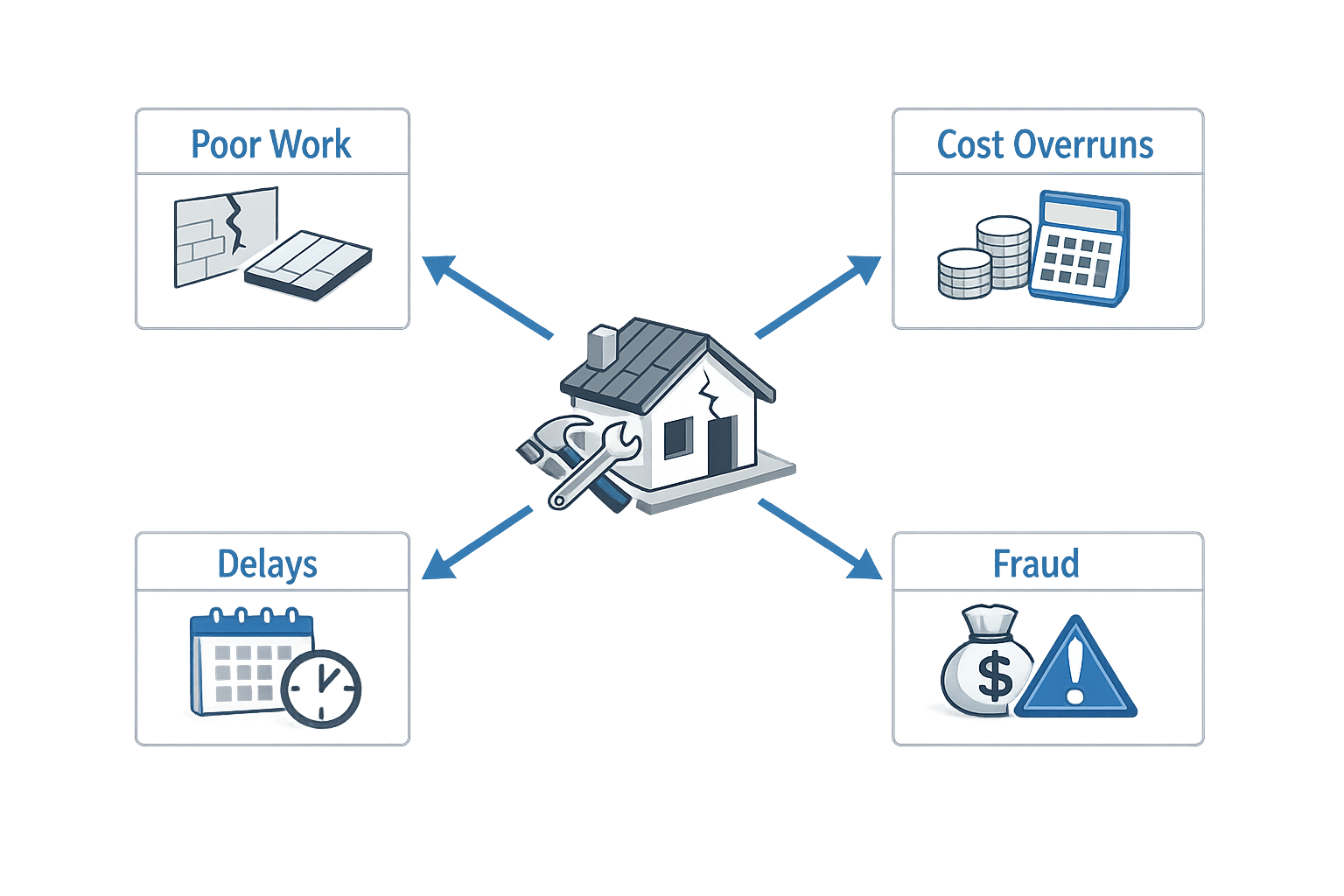
Hiring an unverified contractor exposes a building owner to statutory penalties, unrecoverable payments, and compliance failures that can close a project or open enforcement action. The California Business and Professions Code establishes that an unlicensed contractor cannot collect payment through the courts and that an owner who paid an unlicensed contractor may recover all compensation through legal action. That recovery right exists regardless of the quality of the work performed. The statute removes the usual defenses; the contractor's lack of licensure during performance bars enforcement of the contract.
Legal and Financial Consequences
Cal. Bus. & Prof. Code § 7031 provides that a person who uses an unlicensed contractor may bring an action to recover all compensation paid to that contractor. The provision does not limit recovery to defective work or breach; it applies to the entire contract price. A security interest taken to secure payment for work requiring a license is unenforceable if the contractor was not licensed at all times during performance. When licensure is disputed, the burden of proof to establish licensure rests on the contractor, and proof must be made by production of a verified certificate of licensure from the Contractors State License Board.
Entering into a contract with an unlicensed contractor also constitutes cause for disciplinary action against a licensed contractor who subcontracts to that unlicensed party, per Cal. Bus. & Prof. Code § 7118. The registrar may deny licensure, cite, suspend, or revoke a license when a contractor enters into a contract with another person required to be certified for hazardous substance work under § 7058.7 but who is not certified. A first offense is an infraction punishable by a fine of one thousand to three thousand dollars and possible license suspension; a subsequent offense is a misdemeanor requiring license revocation or suspension, a fine of three thousand to five thousand dollars, or imprisonment, or both.
Compliance and Enforcement Risks
An unverified contractor may perform work that fails to meet the standard adopted locally, leaving the owner with an open code violation and no enforceable remedy against the contractor. The Contractors State License Board has jurisdiction to investigate complaints against licensed contractors if a complaint regarding a patent act or omission is filed within four years of the alleged violation; complaints regarding latent acts or omissions pertaining to structural defects must be filed within ten years. When the contractor is unlicensed, the Board has no jurisdiction, and the owner's only remedy is civil court—where the owner may also be liable for damages arising from injuries to the unlicensed contractor or the contractor's employees.
A conviction of a crime substantially related to the qualifications, functions, and duties of a contractor constitutes cause for disciplinary action, with the record of conviction serving as conclusive evidence. Willful and deliberate violation of state or local laws relating to building permits triggers mandatory disciplinary action, except for repairs valued under five hundred dollars or replacement of identical parts in mechanical equipment. These provisions mean that an owner who hires a contractor with an undisclosed disciplinary history or unresolved permit violations may inherit the contractor's compliance failures and face enforcement action from the authority having jurisdiction.
A person who utilizes the services of an unlicensed contractor may bring an action in any court of competent jurisdiction to recover all compensation paid to the unlicensed contractor.
Benefits of Thorough Verification
Verifying a contractor before signing a contract confirms that the contractor holds a current license in the correct classification, that the license has not been suspended or revoked, and that the contractor is authorized to perform the work described in the proposal. Verification also establishes the contractor's legal capacity to enforce the contract and the owner's ability to file a complaint with the Contractors State License Board if a dispute arises within the statutory window. When the contractor is properly licensed, the owner retains the statutory protections and remedies that the licensing scheme provides.
Thorough verification reduces the risk of paying twice for the same work—once to the unlicensed contractor and again to a licensed contractor to correct or complete the work to code. It also reduces the risk that the authority having jurisdiction will issue a stop-work order or refuse to issue a certificate of occupancy because the work was performed by an unlicensed or improperly classified contractor. For projects subject to NFPA inspection intervals or other mandated compliance schedules, verification ensures that the contractor performing annual, five-year, or internal assessments is qualified to close a code violation and that the inspection report will satisfy the standard adopted locally. Understanding how to deal with an insurance claims adjuster for commercial buildings can also help owners manage disputes that arise when unverified contractors create compliance gaps.
How to Verify a Contractor
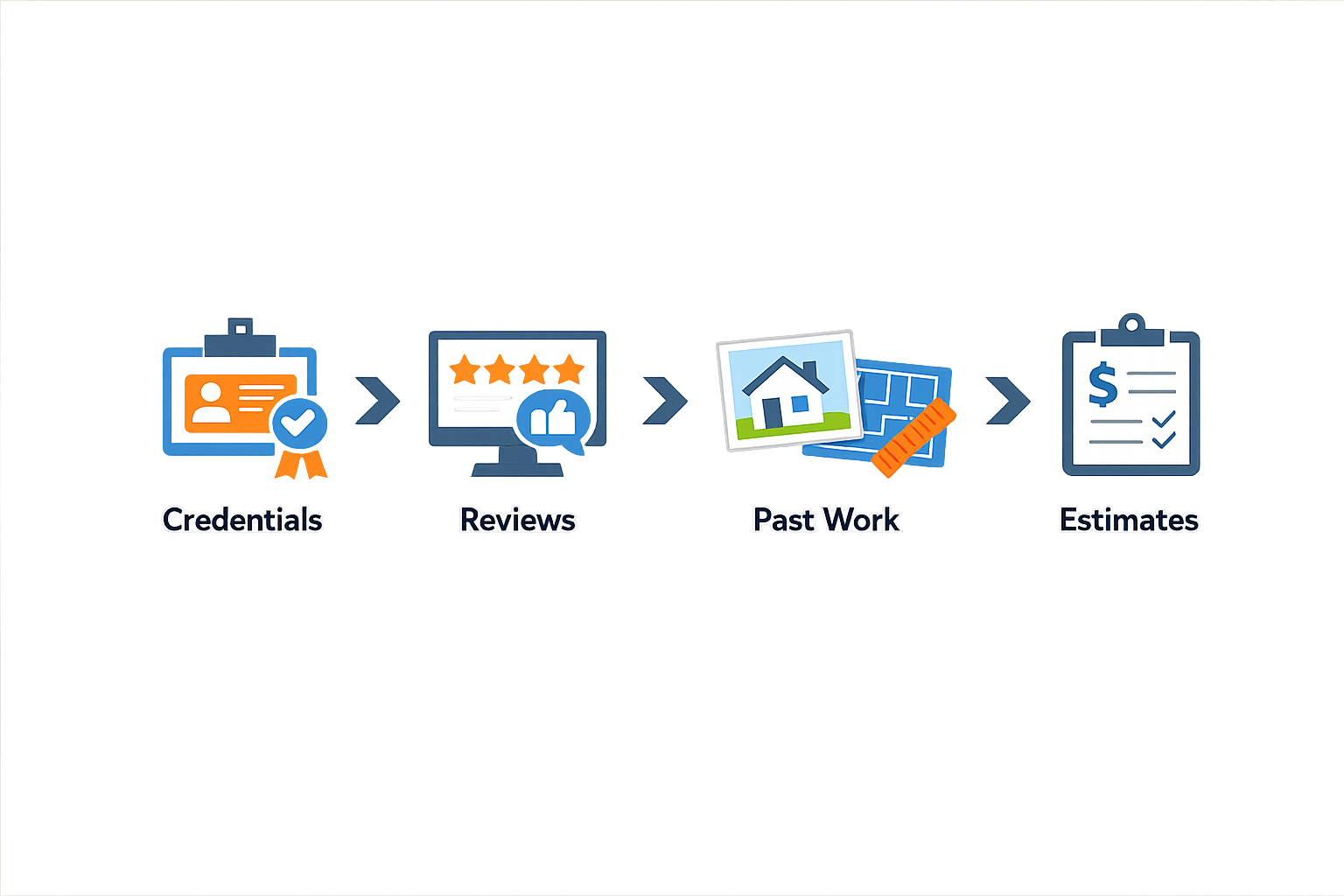
Verifying a contractor before you hire them requires a methodical approach to documentation and licensing. The process begins with confirming that the contractor holds a current license in the classification that matches the work you need done. California Business and Professions Code § 7031 makes this verification essential: an unlicensed contractor cannot enforce a contract or recover payment, and an owner who hires an unlicensed contractor may recover all compensation paid.
Check the License Status and Classification
The Contractors State License Board maintains a contractor license check search function on its website that permits consumers to search for a licensed contractor by ZIP Code or geographic location (Cal. Bus. & Prof. Code § 7018). When you search, confirm that the license is active and in good standing, and verify that the classification matches the scope of work. A contractor licensed for general building work is not necessarily qualified for specialized fire protection system service, and the classification on the license determines what work the contractor may lawfully perform.
The license record shows the qualifying individual — the person who passed the examination and demonstrated the required knowledge of building, safety, health, and lien laws, as well as administrative principles of the contracting business (Cal. Bus. & Prof. Code § 7068). That qualifying individual must be actively engaged in the work, meaning they work at least 32 hours per week or 80 percent of the total hours per week that the business is in operation, whichever is less. If the qualifying individual listed on the license is not the person you are speaking with, ask how that individual will be involved in your project.
Review the Contract and Required Disclosures
Every written contract from a licensed contractor must include specific statutory notices. For most contracts, the contractor must include a statement in at least 10-point type directing you to the Contractors State License Board and explaining that complaints regarding patent acts or omissions must be filed within four years, and complaints regarding latent acts or omissions pertaining to structural defects must be filed within ten years (Cal. Bus. & Prof. Code § 7030). Home improvement contracts and service and repair contracts require a different, more detailed notice in at least 12-point type, including contact information for the CSLB and a warning that using an unlicensed contractor may leave you without recourse if problems arise.
If the contract does not include these notices, that omission is cause for disciplinary action against the contractor. The absence of the required notice does not void the contract, but it signals that the contractor is not following statutory requirements.
Verify Experience and Qualifying Credentials
A contractor may hold multiple classifications, and some classifications may have been added without further examination if the contractor demonstrated satisfactory experience. Under Cal. Bus. & Prof. Code § 7065.3, a contractor may add a classification without examination if the qualifying individual was listed on an active license for five of the seven years immediately preceding the application, had at least four years of experience as a journeyman, foreman, supervising employee, or contractor in the new classification, and is applying for a classification closely related to the existing one or a significant component of the contractor's business.
When a contractor claims experience in a particular type of work, ask how that experience was verified. The registrar requires statements of experience to be verified by a qualified and responsible person, and the registrar randomly reviews a percentage of those statements for accuracy (Cal. Bus. & Prof. Code § 7068). If the contractor gained experience in another state, the registrar reviews that experience to determine whether it was gained lawfully in that state.
Understand Who Is Qualifying the License
A contractor may be an individual owner, a partnership, a corporation, a limited liability company, or a participating tribe. The license must be qualified by a specific individual: for an individual owner, the owner or a responsible managing employee; for a partnership, a general partner or a responsible managing employee; for a corporation or tribe, a responsible managing officer or responsible managing employee; for a limited liability company, a responsible managing officer, manager, member, or employee (Cal. Bus. & Prof. Code § 7065).
The qualifying individual may not hold any other active contractor's license while acting in that capacity, except in limited circumstances. At the time of renewal, the qualifying individual must file a statement verifying their capacity as the qualifying individual to the licensee. If the qualifying individual has left the company or is no longer actively engaged, the license may no longer be valid for new work.
Step 1
Confirm the license is active and in the correct classification
Use the CSLB website to search by the contractor's license number, business name, or ZIP Code. Verify that the license status is active, the classification matches your project, and the expiration date has not passed.
Step 2
Identify the qualifying individual
The license record shows the qualifying individual's name. Ask the contractor how that individual will be involved in your project, and confirm that they meet the statutory definition of actively engaged.
Step 3
Review the written contract for required notices
Before you sign, check that the contract includes the statutory notice required by Cal. Bus. & Prof. Code § 7030. The absence of this notice is a red flag.
Step 4
Ask for documentation of experience and qualifications
If the contractor claims specialized experience, ask how that experience was verified when the classification was added to the license. The registrar's random review process means that some applications are scrutinized more closely than others.
For work involving fire protection systems or other mandated inspections, cross-reference the contractor's license classification with the standard that governs the work. What Happens When a Mechanics Lien Is Filed? explains the consequences of hiring a contractor who does not complete the work or does not pay subcontractors — verification at the outset reduces the risk of those outcomes.
Best Practices for Contractor Verification
Verifying a contractor requires more than checking a single credential. The standard requires you to confirm that the individual or entity appearing on the license is the one you are actually hiring, and that the qualifying individual listed on the license is actively engaged in the work. A best practice is to request the license number, confirm it against the Contractors State License Board online lookup, and then ask for written documentation showing who qualifies the license and in what classification. Many contracts list a company name without identifying the qualifying individual, which leaves you unable to verify whether the person managing your project is the one who passed the examination.
Verify the Qualifying Individual
Cal. Bus. & Prof. Code § 7068 defines a responsible managing employee as an individual who is a bona fide employee of the applicant and is actively engaged in the classification of work for which that responsible managing employee is the qualifying person on behalf of the applicant. "Actively engaged" means working 32 hours per week, or 80 percent of the total hours per week that the applicant's business is in operation, whichever is less. Before you authorize work, confirm in writing who the qualifying individual is and whether that person will be actively engaged in your project. If the contractor cannot or will not provide this information, that is a signal to pause.
Confirm the Classification Matches the Scope
Licenses are issued by classification, and a contractor may hold multiple classifications or may qualify for an additional classification without further examination if they meet the experience and good-standing requirements set out in Cal. Bus. & Prof. Code § 7065.3. The provision permits an additional classification to be added without further examination if the qualifying individual has been listed as a member of the personnel of any licensee whose license was active and in good standing for five of the seven years immediately preceding the application, and has had not less than four years of experience as a journeyman, foreman, supervising employee, or contractor in the classification within which the licensee intends to engage. Verify that the classification on the license matches the work described in your contract. A contractor licensed only in one classification cannot perform work that requires a different classification, and doing so is a violation.
Request and Retain Written Documentation
Every person licensed pursuant to this chapter must include a specific notice in at least 10-point type on all written contracts, as required by Cal. Bus. & Prof. Code § 7030. The notice must state that contractors are required by law to be licensed and regulated by the Contractors State License Board, which has jurisdiction to investigate complaints against contractors if a complaint regarding a patent act or omission is filed within four years of the date of the alleged violation. A complaint regarding a latent act or omission pertaining to structural defects must be filed within 10 years of the date of the alleged violation. If the contract you receive does not include this notice, that is a red flag. Retain the contract, the license verification, and any correspondence that identifies the qualifying individual and the scope of work. These records are what you will need if a dispute arises or if you must produce documentation to an authority having jurisdiction.
Contractors are required by law to include a notice on all written contracts that the Contractors State License Board has jurisdiction to investigate complaints if filed within the legal deadline.
Understand the Consequences of Hiring an Unlicensed Contractor
Cal. Bus. & Prof. Code § 7031 provides that a person who utilizes the services of an unlicensed contractor may bring an action in any court of competent jurisdiction in this state to recover all compensation paid to the unlicensed contractor for performance of any act or contract. This provision exists to protect you, but it also means you must verify licensure before you pay. If you hire someone who was never licensed, or whose license was not active and in good standing at all times during the performance of the work, you may be able to recover what you paid, but you will have spent time and money on a dispute that could have been avoided. The statute also provides that the judicial doctrine of substantial compliance shall not apply where the person who engaged in the business or acted in the capacity of a contractor has never been a duly licensed contractor in this state.
For more on how documentation gaps can complicate disputes, see Fire Extinguisher Inspection Cost: What to Expect.
Cross-Reference the Contract and the License
A best practice is to cross-reference the contract and the license before you sign. Confirm that the entity named on the contract is the same entity that holds the license, and that the qualifying individual identified on the license is the person who will oversee the work. If the contract names a corporation or limited liability company, verify that the corporation or limited liability company is the licensee, not an individual doing business under a company name. Cal. Bus. & Prof. Code § 7065 requires that a corporation or limited liability company seeking licensure provide its identification number issued by the Secretary of State, and that every person who is an officer, member, responsible manager, or director of a corporation or limited liability company seeking licensure be listed on the application as a member of the personnel of record. If the contract does not match the license, ask for clarification in writing before you proceed.
Common Mistakes in Contractor Verification
The verification process is where many owners introduce risk they could have avoided. Small errors compound: a missed license check becomes an unenforceable contract, and a failure to cross-reference documents turns into a payment dispute with no clear record. The mistakes described below recur because they feel minor at the time.
Accepting a License Number Without Checking Its Status
A contractor states a license number on a quote or proposal. The owner writes it down and assumes the number is current. That assumption is not verification. License numbers remain assigned even after suspension, expiration, or disciplinary action. The Contractors State License Board maintains a public database that shows current status, classification, and any disclosable complaints or actions. If you do not check the database yourself, you have not verified the license — you have copied a number.
An expired license is not a valid license. A suspended license is not a valid license. A license in the wrong classification for the work you need is not a valid license for that work. Each of these conditions appears in the database record; none appears on a business card or a proposal header.
Confusing a Business Entity Name With Licensure
A contractor operates under a business name — "ABC Fire Protection Services" or "Reliable Sprinkler, Inc." The owner assumes that because the business is incorporated or registered, it is licensed to perform the work. Business registration and contractor licensure are separate systems. A corporation can be validly formed and entirely unlicensed to contract for construction work.
Cal. Bus. & Prof. Code § 7026.1 defines "contractor" to include any person or entity that undertakes or offers to undertake construction work, including maintenance of fixed fire and life-safety equipment. The definition does not hinge on business structure; it hinges on the activity. If the work requires a license, the entity performing it must hold that license or employ a qualifying individual who does. Verify the license tied to the business name, not the business name alone.
Failing to Cross-Reference the Contract, the Invoice, and the Inspection Report
An owner receives three documents: a service agreement describing annual and five-year intervals, an invoice listing work performed, and an inspection report showing findings and remedies. The owner assumes all three describe the same visit and the same scope. That assumption invites error. One owner submitted an inspection report and an invoice that described two different visits to the same building — different dates, different findings, different line items. The mismatch surfaced only when the authority having jurisdiction asked which visit closed the cited deficiency.
Before you authorize payment, confirm that the contract provision, the invoice line items, and the report findings align. If the contract called for an internal obstruction assessment under NFPA 25 and the invoice shows only an external visual check, one document is incomplete or one document is wrong. Do not pay until you know which.
Ignoring the Edition of the Standard Cited
A contractor states that the work complies with NFPA 25. The owner accepts the statement without asking which edition governs locally. Different editions set different compliance thresholds, different intervals, and different alternative remedies. What satisfies the 2017 edition may fall short under the 2020 edition, and what the 2020 edition requires may exceed what earlier editions demanded. The edition adopted by your authority having jurisdiction is the edition that controls.
If a contractor cites a standard without naming the edition, ask for it in writing. If the contractor names an edition that your jurisdiction has not adopted, the work may comply with that edition and still fail your local code. Verify which edition your jurisdiction enforces, then verify that the proposed work satisfies that edition.
Relying on Summaries Instead of Reading the Full Provision
A contractor quotes a code provision and describes the remedy it requires. The owner relies on that summary without reading the provision. Summaries omit details, and details determine cost. A full reading of NFPA 25 reveals that some provisions permit two compliant remedies at different price points: replace a component, or test it against a calibrated instrument and retain the record. A summary that states only "replace every five years" is accurate but incomplete; it describes one remedy and omits the alternative.
Before you approve a scope based on a cited standard, read the cited section to the end. If the standard permits an alternative remedy, you are entitled to a quote for both. If the contractor quotes only the higher-priced option, ask why the alternative does not satisfy the provision. The answer will clarify whether the contractor read the standard or summarized it from habit.
For additional context on ensuring contractors meet necessary compliance standards, see Fire Extinguisher Inspection Cost: What to Expect.
Assuming That Disciplinary History Does Not Matter if the License Is Active
A contractor holds an active license. The owner checks the status, sees "active," and stops. The database record also shows disclosable complaints, citations, or prior suspensions. Those entries remain visible even after the license is reinstated. Cal. Bus. & Prof. Code § 7090 authorizes the registrar to investigate and take disciplinary action for violations, and Cal. Bus. & Prof. Code § 7123 establishes that a conviction substantially related to contractor duties constitutes cause for discipline. The record of conviction serves as conclusive evidence.
An active license with a disciplinary history is not the same as an active license with a clean record. Review the full database entry, not just the status line. If the record shows multiple complaints in the same category, ask the contractor to explain them before you sign.
Entering Into a Contract Before Verification Is Complete
An owner signs a service agreement, then checks the license. If the license is invalid, the agreement may be unenforceable from the start. Cal. Bus. & Prof. Code § 7118 states that entering into a contract with an unlicensed contractor constitutes cause for disciplinary action against a licensed contractor who does so, and Cal. Bus. & Prof. Code § 7031 bars the unlicensed contractor from recovering payment. The financial risk falls on the owner, but the risk is entirely avoidable: verify first, then sign.
Do not authorize work, issue a purchase order, or sign an agreement until you have confirmed that the contractor holds a current license in the correct classification. Once you sign, the verification window has closed.
Frequently asked questions
What information must a contractor include in a written contract?
California law requires every licensed contractor to include a specific disclosure statement in at least 10-point type on all written contracts where the contractor is the prime contractor. The statement must inform the owner that the Contractors State License Board has jurisdiction to investigate complaints filed within four years of the alleged violation (or within 10 years for latent structural defects). Home improvement contracts and service and repair contracts carry a different, longer disclosure in at least 12-point type, directing owners to contact the Board for information about complaints, disciplinary actions, and civil judgments. Failure to include the required notice is cause for disciplinary action. (Cal. Bus. & Prof. Code § 7030)
Can I recover money paid to an unlicensed contractor?
Yes. A person who uses the services of an unlicensed contractor may bring an action in any court of competent jurisdiction to recover all compensation paid to the unlicensed contractor for performance of any act or contract. An unlicensed contractor cannot bring or maintain any action to collect compensation for work performed, regardless of the quality of that work. If licensure is disputed, the burden of proof to establish licensure rests on the contractor, who must produce a verified certificate of licensure from the Contractors State License Board showing that the individual or entity was duly licensed in the proper classification at all times during the performance of the work. (Cal. Bus. & Prof. Code § 7031)
What is a preliminary notice, and why does it matter?
A preliminary notice is a document that subcontractors, material suppliers, and laborers send to property owners to preserve their right to file a mechanics lien if they are not paid. The notice must include a general description of the work, an estimate of the total price, and a bold statement warning the owner that a lien may be placed on the property even if the owner has paid the contractor in full. The notice also advises the owner to require signed releases before making payments to the contractor. If you record a notice of cessation or completion, you must send a copy to your contractor and to anyone who gave you a preliminary notice within 10 days after recording (unless you are a residential homeowner of a dwelling containing four or fewer units). (Cal. Civ. Code § 8202, § 8208)
Does a consultant need a contractor's license?
It depends on what the consultant does. A consultant who provides or oversees a bid for a construction project, or who arranges work schedules for contractors and subcontractors and maintains oversight of a construction project, is considered a contractor under California law and must hold a valid contractor's license. The term does not include a common interest development manager performing management services. If the person's activities fall within the statutory definition of a contractor, licensure is required. (Cal. Bus. & Prof. Code § 7026.1)
How do I verify that a contractor holds the correct classification?
Request a verified certificate of licensure from the Contractors State License Board. The certificate establishes that the individual or entity was duly licensed in the proper classification at all times during the performance of the work. When licensure or proper licensure is disputed, the burden of proof rests on the contractor to produce this certificate. Do not rely on a contractor's verbal assurance or on an unverified document—ask for the Board's certificate and confirm that the classification matches the work you are contracting for. (Cal. Bus. & Prof. Code § 7031)
What happens if a contractor fails to include the required disclosure statement?
Failure to comply with the notice requirements is cause for disciplinary action by the Contractors State License Board. The omission does not void the contract, but it exposes the contractor to potential discipline. If you receive a contract without the required disclosure, ask the contractor to provide a corrected version before you sign. The absence of the statement may also indicate that the contractor is not familiar with basic statutory obligations. (Cal. Bus. & Prof. Code § 7030)
Conclusion
Verifying a contractor before you hire protects your project, your budget, and your compliance standing. The steps outlined in this guide — confirming the license is active and in the correct classification, reading the contract in full, cross-referencing the invoice against the scope, and retaining every signed document — are not optional courtesies. They are the documented practices that close a code violation, survive an audit, and prevent a mechanics lien from landing on your property.
One lesson that stands out: an owner submitted an inspection report and an invoice that described two different visits to the same building. The dates did not align, the scope of work differed, and the contractor could not explain the discrepancy when asked. Cross-referencing documents is not skepticism — it is the standard of care. When a contractor provides a report, an invoice, and a service agreement, those three records must describe the same work, performed on the same date, by the same licensed entity. If they do not, ask for it in writing before you authorize payment.
The California Business and Professions Code establishes clear requirements for contractor qualification, contract content, and documentation. Cal. Bus. & Prof. Code § 7068 requires every contractor to demonstrate knowledge of building, safety, health, and lien laws, and to qualify through examination or documented experience in the classification applied for. Cal. Bus. & Prof. Code § 7164 mandates that every contract include the contractor's name, address, and license number, along with specific notices regarding mechanics liens and insurance coverage. These provisions are not administrative formalities — they are the record that an authority having jurisdiction expects to see when a compliance question arises.
Before you sign, read the full contract. Verify the license number against the Contractors State License Board database. Confirm that the named entity on the contract matches the entity on the license. Retain the signed agreement, the completed report, and the final invoice in a single file. If a dispute arises, the documentation you retain today is the documentation that determines your position tomorrow.
For additional guidance on managing compliance documentation and understanding what records close a code violation, see Understanding Your Denied Fire Insurance Claim: Key Insights. The contractor you hire is the contractor whose paper trail you trust enough to hand the auditor without flinching.