
Introduction
The contractor arrives with a quote, a business card, and a schedule. Before you authorize the work, establish that the entity on the agreement holds the license the work requires. Washington State mandates that contractors performing regulated work carry an active license issued by the state board. An unlicensed contractor cannot collect payment through legal action, and the building owner may recover all compensation paid if the contractor was never licensed during performance.
Verification is not a courtesy check—it is a compliance step. The standard requires that certain inspections and installations be performed by licensed agencies or individuals. When a code violation is opened, the authority having jurisdiction expects documentation that the remedy was performed by a properly credentialed party. If that documentation is absent, the violation remains open regardless of whether the physical work was completed. Retain the contractor's license number, the date you verified it, and the agency's confirmation in the same file as the inspection report.
The mechanics are straightforward: before you sign, confirm the license is active, confirm the bond is current, and confirm the named entity on the agreement matches the licensed entity on the state record. If those three items do not align, the agreement is defective before the first invoice. For building owners managing fire extinguisher service cost or other mandated intervals, the verification step precedes the price negotiation—because a cheaper bid from an unlicensed contractor is not a bid at all.
The introduction of a service agreement should identify the obligated party by legal name and license number. If the agreement shows a trade name or DBA without the underlying licensed entity, ask for the correction in writing before you authorize work. The same principle applies to personal guarantee blocks: the individual signing the guarantee must be identifiable, and their relationship to the licensed entity must be clear. When an agreement lists multiple entities or leaves the obligated party ambiguous, the dispute window opens the moment the first invoice is questioned.
Verification closes the gap between the quote and the record. It does not prevent all disputes, but it establishes that the party you hired was permitted to perform the work and permitted to seek payment if the work satisfies the standard. The steps that follow—license lookup, bond confirmation, and compliance checks—are mechanical. Perform them in order, document the results, and retain the documentation with the agreement.
Understanding the Importance of Contractor Verification
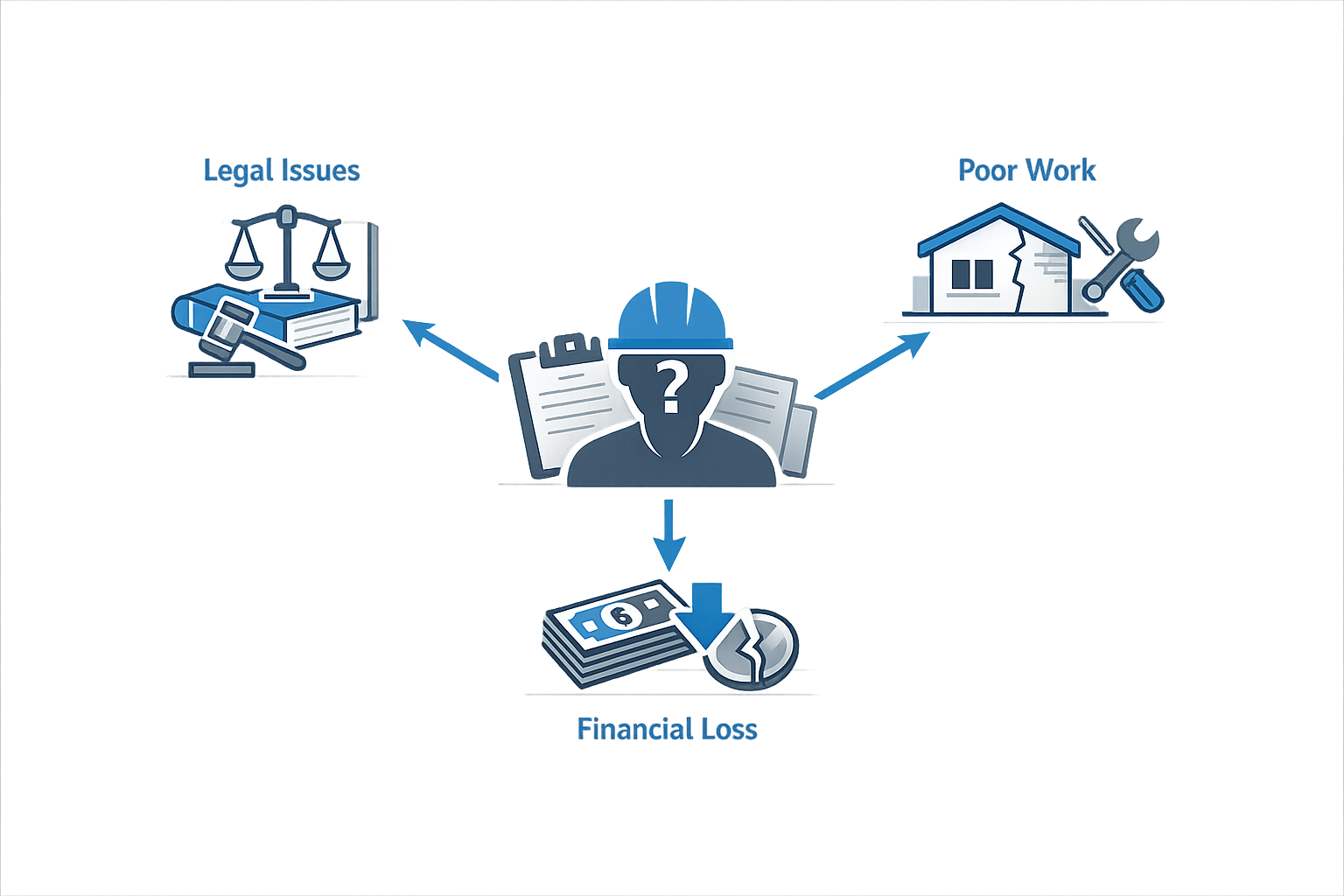
Hiring an unlicensed or unverified contractor exposes the property owner to legal consequences, financial liability, and enforcement gaps that no contract clause can close. The statute strips an unlicensed contractor of standing to sue for payment, but it also permits the owner to recover all compensation already paid—a double exposure when the work is incomplete or defective. Where verification is skipped, the owner assumes risks the law was written to prevent.
Legal Consequences of Hiring Unlicensed Contractors
California Business and Professions Code section 7031 bars an unlicensed contractor from bringing or maintaining any action to collect compensation for work performed. The prohibition applies regardless of the merits of the contractor's claim. If the contractor was never licensed in California, the judicial doctrine of substantial compliance does not apply, and the owner may bring an action to recover all compensation paid. A security interest taken to secure payment for unlicensed work is unenforceable.
The statute places the burden of proof on the contractor to establish licensure when it is controverted. Proof requires production of a verified certificate of licensure from the Contractors State License Board showing the contractor was duly licensed in the proper classification at all times during performance. No other evidence satisfies the requirement.
Financial and Performance Risks
A mechanics lien is a claim recorded against the property when subcontractors, suppliers, or laborers who improved the property are not paid. Even if the owner pays the prime contractor in full, unpaid parties may record liens and sue to foreclose. A valid lien can force the owner to pay twice or result in a court-ordered sale of the property to satisfy the debt. Liens also affect the owner's credit and complicate refinancing or sale.
Each subcontractor and material supplier must provide a Preliminary Notice to preserve the right to record a lien. The notice is not itself a lien; it informs the owner that the sender has lien rights if unpaid. The Preliminary Notice can be sent up to 20 days after the subcontractor starts work or the supplier provides material. An owner who pays the prime contractor before receiving all Preliminary Notices risks paying twice when liens are recorded later.
The prime contractor and persons the owner contracts with directly do not send Preliminary Notices—the law presumes the owner already knows they are improving the property. Laborers working on the project also do not send notices. The owner must obtain a list of all subcontractors and material suppliers from the contractor, confirm when each started work or delivered material, and wait 20 days while monitoring incoming notices. For more on what happens after a lien is recorded, see What Happens When a Mechanics Lien Is Filed?.
Enforcement Gaps and Complaint Limitations
The Contractors State License Board has jurisdiction to investigate complaints against licensed contractors if a complaint regarding a patent act or omission is filed within four years of the alleged violation. A complaint regarding a latent act or omission pertaining to structural defects must be filed within ten years. If the owner uses an unlicensed contractor, the Board may not be able to help resolve the complaint. The owner's only remedy may be in civil court, and the owner may be liable for damages arising out of injuries to the unlicensed contractor or the contractor's employees.
Every licensed contractor must include a disclosure statement in at least 10-point type on all written contracts, informing the owner of the Board's jurisdiction, complaint deadlines, and contact information. Home improvement contracts and service and repair contracts require a longer disclosure in 12-point type, including instructions to visit the Board's website, call 800-321-CSLB, or write to the Board's Sacramento address. Failure to include the required disclosure is cause for disciplinary action, but the disclosure itself confirms that enforcement tools apply only when the contractor is licensed.
The statute permits the owner to recover all compensation paid to an unlicensed contractor, but it does not erase the mechanics lien rights of unpaid subcontractors who performed the work.
Verification closes the enforcement gap before the contract is signed. It confirms that the contractor holds an active license in the proper classification, that the Board has jurisdiction over complaints, and that the owner can rely on the complaint process rather than civil litigation when disputes arise. The alternative is a contract the contractor cannot enforce, liens the owner cannot prevent, and a complaint the Board cannot investigate.
Steps to Verify a Contractor in Washington State
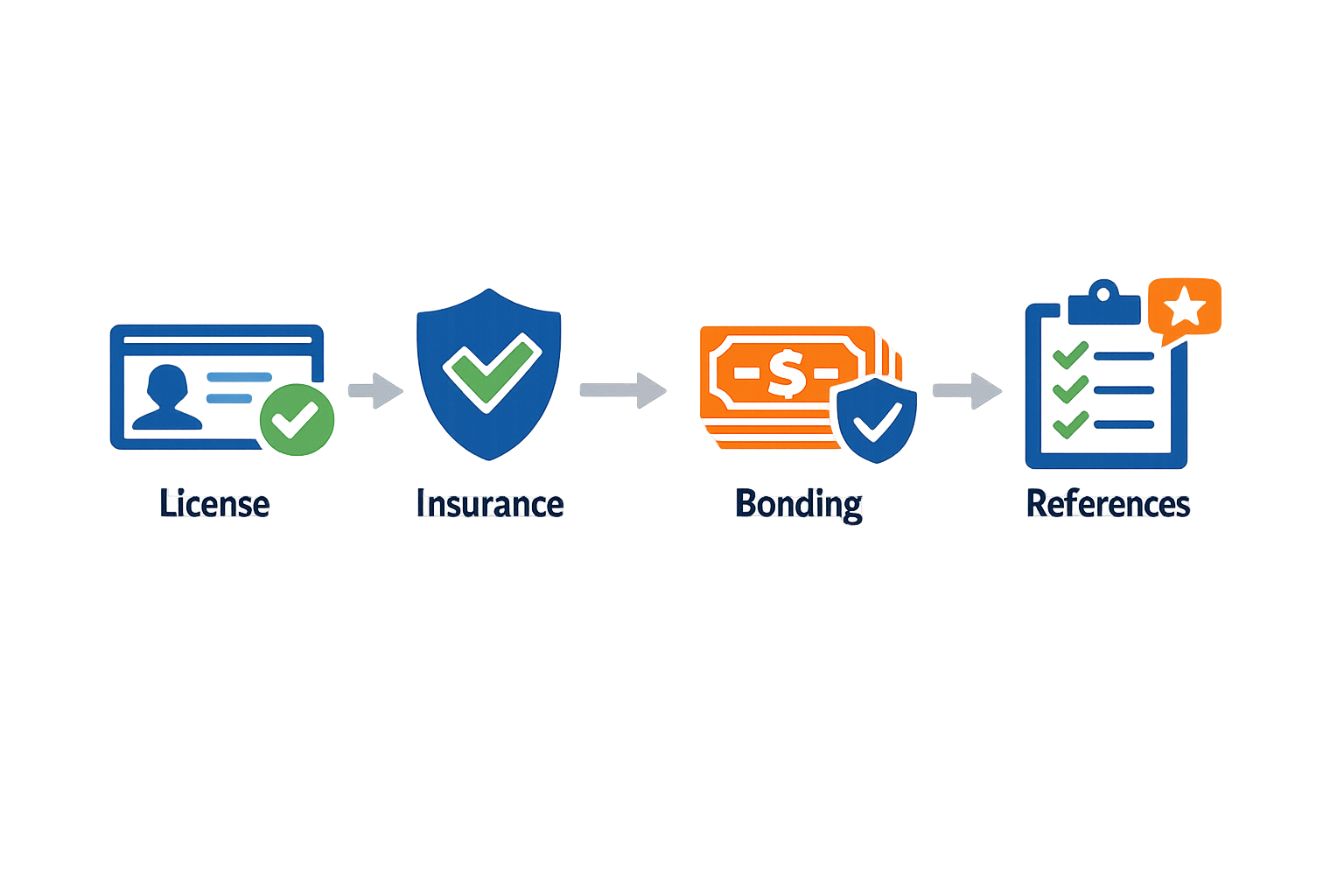
Verifying a contractor before signing an agreement is not optional — it is a mandatory step to protect your property and your compliance obligations. The verification process follows a fixed sequence, and each step produces a record you retain. Skip a step, and you may authorize work by an entity that cannot close a code violation or enforce its own contract.
Step 1: Confirm Active Licensure Through the State Database
Step 1
Run the online license check
The state maintains a contractor license check search function on its internet website. Enter the contractor's license number, or search by ZIP Code or geographic location. The result shows whether the license is active, suspended, or revoked, and displays the classification and expiration date. Print or save the result with a date stamp — that record establishes what the database showed on the day you checked.
The license status you see today may not match the status on the day work begins. A license that is active when you sign the contract but expires or is suspended before work starts leaves you with an unlicensed contractor. Ask for the expiration date in writing, and verify that it extends beyond the scheduled completion date.
Step 2: Verify Vehicle Identification and Display Requirements
Certain contractor classifications must display their name, permanent business address, and contractor's license number on each side of each motor vehicle used in the business. The letters and numerals must be at least 1½ inches high. This requirement applies to C-36 plumbing contractors, C-45 sign contractors, and C-57 well-drilling contractors, and extends to any drill rig used for water well drilling.
When the contractor arrives on site, check the vehicle markings against the license number you verified online. A mismatch — or the absence of markings where the classification requires them — is a compliance failure and grounds for disciplinary action. Do not authorize work until the discrepancy is resolved in writing.
Step 3: Request Owner and Lender Information in Writing
A direct contractor must make available the name and address of the owner and the name and address of the construction lender, if any, to any person seeking to give preliminary notice. Ask for this information before the contract is signed. If the contractor cannot or will not provide it, that silence is a signal — either the contractor does not understand the statutory obligation, or the contractor is not structured as a direct contractor on this project.
Retain the written response. It becomes part of the project record and may be required if a lien is filed or if a dispute reaches litigation.
Step 4: Check for Out-of-State Disciplinary Actions
Step 4
Verify disciplinary history across state lines
A contractor licensed in your state may have been subject to revocation, suspension, or other disciplinary action in another state. That out-of-state action constitutes grounds for disciplinary action in your state if the individual is a licensee or applies for a license here. A certified copy of the action by the other state is conclusive evidence of that action.
If the contractor or any qualifying individual on the license has worked in another state, ask in writing whether any license held in that state has ever been revoked, suspended, or subjected to disciplinary action. If the answer is yes, request a certified copy of the order. If the answer is no, retain the written denial — it becomes evidence of misrepresentation if a prior action later surfaces.
For guidance on handling disputes that arise after a contractor is hired, see How to Deal with an Insurance Claims Adjuster for Commercial Buildings.
Step 5: Confirm the Contract Includes the Required Notice Language
Every licensed contractor must include specific statutory notice language in all written contracts. The notice informs the owner of the state board's jurisdiction to investigate complaints, the deadlines for filing complaints, and the consequences of hiring an unlicensed contractor. The required type size and exact wording depend on whether the contract is a home improvement contract, a service and repair contract, or a general construction contract.
Read the notice language in the contract you are given. Compare it word-for-word against the statutory text. If the notice is missing, undersized, or materially altered, the contract does not comply, and the contractor's failure to include it is cause for disciplinary action. Do not sign a non-compliant contract — return it and request a corrected version in writing.
The license status on the day you check may not match the status on the day work begins — verify that the expiration date extends beyond scheduled completion.
Tips and Tricks for Effective Contractor Verification

Verifying a contractor before signing an agreement is not a courtesy — it is a documented step in protecting the building owner's position when a dispute arises or a standard requires proof of compliance. The verification process reveals what the contractor is permitted to perform, what the contractor is obligated to carry, and what record the contractor must produce when an authority having jurisdiction requests it.
Ask for the License Number in Writing
Request the contractor's license number before any estimate or proposal. A contractor who delays providing it, offers only a business name, or states that the number will appear "on the contract" has not yet satisfied the verification requirement. The number must be confirmed against the state database before the contract is signed, not after work begins.
California law requires contractors to include specific consumer-protection language in written contracts. Cal. Bus. & Prof. Code § 7030 mandates that home improvement and service contracts carry a 12-point notice identifying the Contractors State License Board's jurisdiction and complaint process. The absence of this notice is cause for disciplinary action. When a contractor submits a proposal without the required disclosure, the omission does not void the contract, but it signals that the contractor either does not perform residential work regularly or does not comply with mandatory contract provisions.
Verify the Classification Matches the Scope
A general contractor license does not authorize every type of work. California licenses contractors by classification — C-36 for plumbing, C-10 for electrical, C-20 for HVAC, and so on. The classification listed on the license must correspond to the work described in the proposal. A contractor licensed only as C-61 (limited specialty) cannot legally perform structural framing, and a C-2 (insulation and acoustical) contractor cannot install fire sprinkler systems.
When the scope of work crosses multiple classifications, confirm that the contractor either holds all necessary classifications or will subcontract the additional work to properly licensed specialty contractors. The prime contractor remains responsible for ensuring that every subcontractor carries an active license in the correct classification. Failure to verify subcontractor licensing exposes the building owner to mechanics lien claims and code violations that the prime contractor cannot remedy. For guidance on how mechanics liens operate when unlicensed work is performed, see How Does a Mechanics Lien Work: Mechanics Lien for Building Owners.
Check for Out-of-State Disciplinary Actions
Cal. Bus. & Prof. Code § 7103 provides that disciplinary action taken against a contractor's license in another state constitutes grounds for disciplinary action in California if the individual holds or applies for a California license. A certified copy of the out-of-state revocation, suspension, or other disciplinary action is conclusive evidence of that action. This provision means that a contractor who lost a license in Oregon, Nevada, or Washington may still hold an active California license, but the California registrar has authority to take action based on the out-of-state finding.
When hiring a contractor who previously worked in another state, request confirmation that no disciplinary action has been taken against any license the contractor has held. The contractor's failure to disclose an out-of-state suspension does not void the California license automatically, but it creates a basis for the registrar to investigate and potentially suspend or revoke the California credential.
A certified copy of the revocation, suspension, or other disciplinary action by another state is conclusive evidence of that action.
Confirm Vehicle Identification Compliance
Cal. Bus. & Prof. Code § 7029.5 requires C-36 plumbing contractors, C-45 sign contractors, and C-57 well-drilling contractors to display their name, permanent business address, and license number on each side of every commercial vehicle used in the business. The letters and numerals must be at least 1½ inches high. Failure to comply with this vehicle identification requirement constitutes cause for disciplinary action.
While this provision applies to only three classifications, it establishes that the state expects contractors to identify themselves visibly and that non-compliance triggers enforcement. A contractor who arrives in an unmarked vehicle may still hold a valid license, but the absence of identification — when required — indicates that the contractor either does not know the rule or chooses not to follow it.
Understand the Consequences of Unlicensed Work
Cal. Bus. & Prof. Code § 7031 provides that a person who performs work requiring a license without holding that license at all times during performance may not bring or maintain any action to recover compensation, regardless of the merits of the claim. Subdivision (b) permits the building owner to recover all compensation paid to an unlicensed contractor. Subdivision (e) states that the judicial doctrine of substantial compliance does not apply where the contractor has never been licensed in California.
This statute places the burden on the contractor to prove licensure when it is controverted. A contractor who allows a license to lapse mid-project, then renews it before completion, may argue substantial compliance if the lapse was inadvertent and promptly remedied. A contractor who never held a license has no such argument. The building owner who hires an unlicensed contractor assumes the risk that the contractor cannot enforce the contract and that the owner may be liable for injuries to the contractor or the contractor's employees.
Retain the Verification Record
Document every step of the verification process. Print the license lookup result from the state database and attach it to the signed contract. Retain copies of insurance certificates, bond information, and any correspondence in which the contractor provided or confirmed the license number. When a code violation is opened, the authority having jurisdiction will ask the building owner to produce proof that the contractor was licensed at the time the work was performed. The lookup printout, dated before the contract was signed, closes that question.
If the contractor later disputes the scope of work, the classification, or the insurance requirement, the verification record establishes what the owner confirmed before authorizing the work. The record does not prove that the work was performed correctly, but it proves that the owner took the mandatory step of verifying that the contractor was authorized to perform it.
Conclusion
Verifying a contractor in Washington State is not a discretionary courtesy — it is a documented compliance step that determines whether a building owner retains standing to enforce the agreement and whether the work product can close an open code violation. The license lookup, bond verification, and complaint history review are separate inquiries, each answered by a different record, and each must be current at the time of contract execution. A contractor who was licensed last month but is not licensed today cannot perform work that satisfies a mandated inspection interval, and a bond that expired before the final invoice cannot secure the owner's remedy if the work fails.
The standard requires the owner to retain proof of licensure, bond status, and scope alignment for the full record retention period — typically five years from the date of service for fire protection and life safety work. An authority having jurisdiction does not accept a contractor's verbal assurance or a photocopy of a card; the AHJ expects a timestamped screenshot or a printed verification page from the state database, and that document must show active status on the date the work was performed. When a dispute arises, the party who can produce the verification record in the format the standard prescribes is the party whose position survives summary rejection.
Before you authorize any contractor to perform mandated inspection, testing, or service work, confirm that the license classification matches the system, that the bond is active and covers the contract amount, and that the complaint history does not include an unresolved failure to complete or an open disciplinary action. Ask for the verification documents in writing, and retain them with the service agreement and the final report. The few minutes spent confirming these details at the outset prevent the months spent reconstructing a record after a failure, a lien, or a code enforcement action has already opened. For guidance on how a mechanics lien affects a building owner's obligations and remedies, see What Happens When a Mechanics Lien Is Filed?
The contractor who resists providing current verification documents is the contractor whose status will not withstand the inquiry. The owner who skips the verification step is the owner who discovers, when the AHJ or the insurer asks for the record, that the work was performed by an entity with no authority to close the violation and no bond to secure the remedy. Verify before you sign, retain what you verify, and produce it when the record is requested — that sequence is the compliance path, and it is the only path that keeps the building in service without interruption.