
Introduction
To verify a subcontractor online is to confirm that the entity claiming the right to file a lien is licensed to perform the work, insured to cover the exposure, and compliant with notice provisions that preserve that lien right. The standard requires documentation. The agreement provides for it. The preliminary notice references it. Yet the question remains: what did you verify before the subcontractor entered the building?
California Civil Code § 8046 defines a subcontractor as a contractor without a direct contractual relationship with the owner — one who contracts with a direct contractor or with another subcontractor. That indirect relationship does not eliminate the owner's exposure. When a subcontractor is not paid in full for labor, service, equipment or material provided to the project, a lien may be placed on the property. Foreclosure of that lien may lead to loss of all or part of the property, even when the owner paid the direct contractor in full. The preliminary notice makes this warning explicit, and the law requires it.
Verification is the interval between receiving the preliminary notice and authorizing the work. It is not a courtesy check. It is the owner's opportunity to confirm that the entity claiming the right to file a lien is the entity licensed to perform the work, insured to cover the exposure, and compliant with the notice provisions that preserve that lien right. The record you retain from that verification is what you produce when the authority having jurisdiction asks who performed the work, or when a lien is recorded and you must establish whether the claimant satisfied the statutory prerequisites.
Cal. Bus. & Prof. Code § 7018 requires the Contractors State License Board to maintain a current contractor license check search function on its website, permitting searches by ZIP Code or geographic location. That public search function is the starting point, not the conclusion, of online verification. The license status it displays is one data point. The preliminary notice, the insurance certificate, the scope description, and the entity name on the agreement are others. Where those do not align, the verification is incomplete. For building owners managing fire alarm inspection costs and other mandated service intervals, verifying the licensed agency performing the work is as critical as verifying the interval itself.
What follows is the verification sequence: license, insurance, notice compliance, entity match, and record retention. Each step closes one gap. None of them closes the entire exposure, but together they establish that you verified what the statute permits you to verify before the work began.
Why You Must Verify a Subcontractor Online Before Work Begins
The agreement says the contractor will furnish labor and materials. What it does not say is which entity performs the work, who holds the licenses, or who remains liable when something fails. A subcontractor enters the property, completes a portion of the scope, and leaves. Weeks later a preliminary notice arrives naming a firm the owner never authorized, and the window to contest payment has closed.
California statute requires that unpaid subcontractors and material suppliers send preliminary notice to the owner, even when the prime contractor has been paid in full. The notice preserves the right to record a mechanics lien against the property. The statute warns that "anyone who helps improve your property, but who is not paid, may record what is called a mechanics lien on your property," and that lien operates "like a mortgage or home equity loan." An owner who pays the general contractor before all preliminary notices arrive risks paying twice or facing foreclosure to satisfy the lien.
The Verification Gap
The prime contractor submits a bid. The owner accepts it. The contract is signed, and work begins. At no point in that sequence does the standard commercial form require the contractor to disclose which subcontractors will perform which portions of the scope, which licenses those subcontractors hold, or whether their insurance remains in force. The owner learns the subcontractor's identity only when the preliminary notice arrives—often after the subcontractor has already completed work and the general contractor has received partial payment.
California Civil Code section 8208 obligates the direct contractor to make available the owner's name and address, and the construction lender's name and address, to any person seeking to give preliminary notice. The statute does not require the contractor to disclose the subcontractor list to the owner before work begins. That gap leaves the owner reactive: the notice arrives, the owner confirms the subcontractor worked on the property, and the lien clock is already running.
Consequences of Hiring an Unverified Subcontractor
When a subcontractor is unlicensed, underinsured, or operating under a suspended license, the failure surfaces only after the defect appears or the lien is recorded. California Business and Professions Code section 7164 requires every construction contract to include the contractor's name, address, and license number. The requirement applies to the prime contractor; it does not extend to subcontractors unless the owner contracts with them directly. An unverified subcontractor may lack the license classification required for the work performed, may carry expired or insufficient liability coverage, or may have an outstanding disciplinary action that would have disqualified the firm from the project.
Civil Code section 8216 provides that failure by a licensed subcontractor to give the required preliminary notice on a contract exceeding four hundred dollars constitutes grounds for disciplinary action under the Contractors' State License Law. That provision confirms the notice obligation but does not prevent the lien. The subcontractor's failure to comply with notice procedure may trigger a licensing penalty; it does not release the owner from the lien or from double payment.
For more on the mechanics lien timeline and enforcement, see Mechanics Liens in California: Deadlines Explained.
How to Verify a Subcontractor Online: Step-by-Step Process
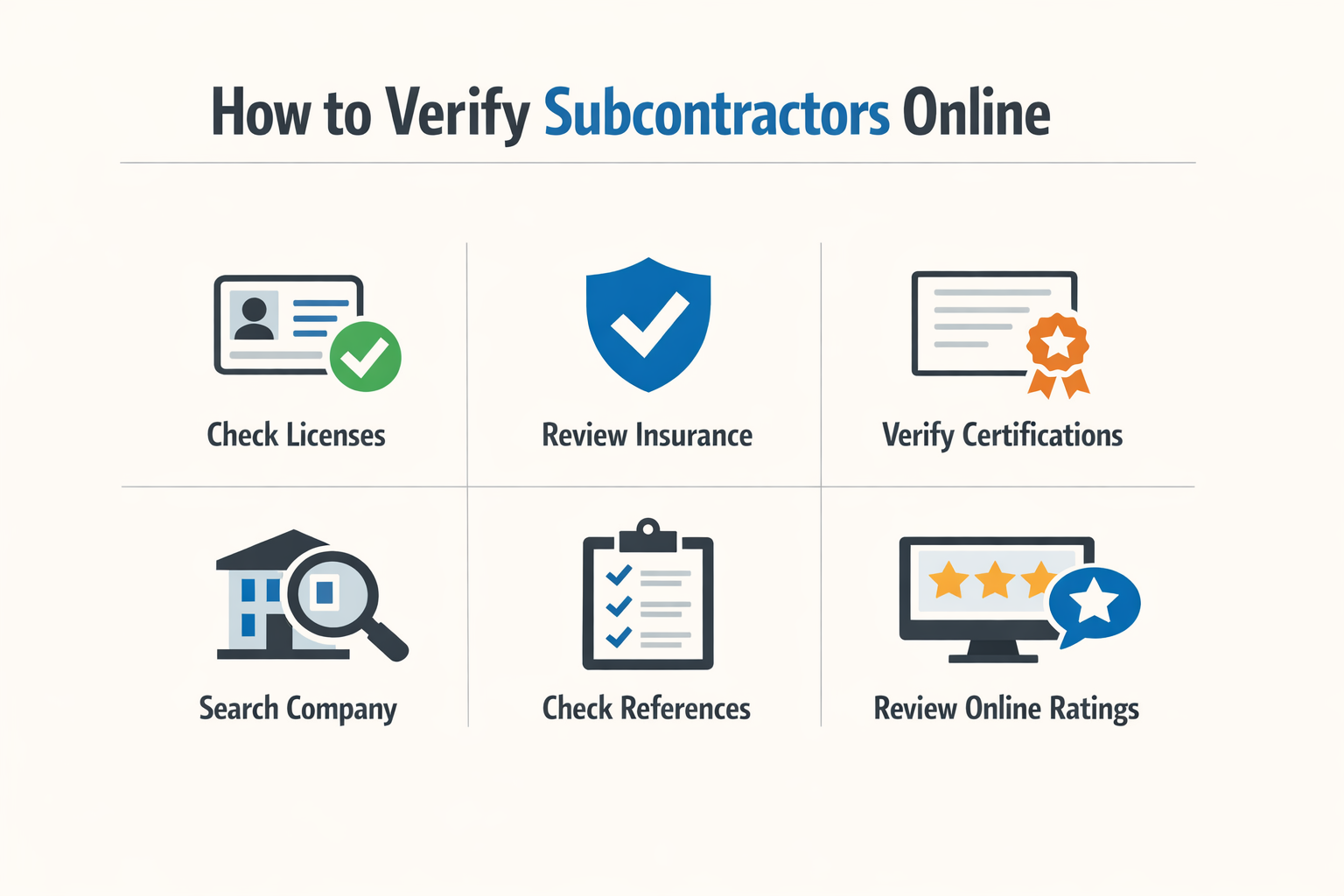
The standard requires verification. The provision permits online tools. Either remedy satisfies the obligation when you follow the sequence and retain the record.
Step 1: Confirm the Entity Name and License Number
Step 1
Confirm the entity name and license number
Before you authorize any work, obtain the contractor's full legal name and license number in writing. Cal. Bus. & Prof. Code § 7164 requires the contract to state the name, address, and license number of the contractor. Ask for it in writing, and verify that the entity on the quote matches the entity on the license. The obligated party must be the licensed entity — not an individual using a different trade name, not a related company, and not a verbal assurance that "we're all the same."
The license number is the anchor. Without it, the online search returns nothing useful, and you cannot establish whether the person quoting the work is permitted to perform it.
Step 2: Use the Board's Online License Check
Step 2
Use the board's online license check
Cal. Bus. & Prof. Code § 7018 requires the Contractors State License Board to maintain a current contractor license check search function on its website. You can search by license number, business name, or ZIP Code. The search returns the license status, the classification, the issue date, and the expiration date. Check the date on the license — an expired license is not a license.
The classification matters. A contractor licensed for one trade cannot perform another. If the quote is for fire alarm inspection and the license shows only general building, the contractor is not qualified for that work under the Contractors' State License Law.
Step 3: Verify Insurance Coverage
Step 3
Verify insurance coverage
Cal. Bus. & Prof. Code § 7164 requires the contract to include a statement about the value of commercial general liability insurance and a check box indicating whether the contractor carries it. If the box is checked, the contract must state the insurer's name and telephone number. Call that number and confirm the policy is in force, the coverage limits, and the named insured. The named insured on the policy must match the entity on the license and the contract.
The agreement provides the insurer's contact information, but the agreement does not prove coverage. The insurer proves coverage. If the contractor cannot or will not provide verifiable insurance information, that is a failure you can see before you sign.
For building owners managing fire protection systems or other mandated inspections, understanding mechanics lien procedures becomes relevant when subcontractors remain unpaid — even after you've paid the prime contractor.
Step 4: Confirm Preliminary Notice Compliance
Step 4
Confirm preliminary notice compliance
Cal. Civ. Code § 8216 states that a subcontractor whose contract exceeds four hundred dollars must give preliminary notice as provided in the mechanics lien statutes. Failure to give that notice constitutes grounds for disciplinary action. If you are the property owner and the subcontractor has not provided preliminary notice, ask why. The absence of the notice does not void the contract, but it signals that the subcontractor may not understand the statutory framework governing the work.
The preliminary notice is not a lien. It is a statement of the subcontractor's right to record a lien if not paid. You should receive it within twenty days after the subcontractor starts work or delivers material. If you do not receive it and the contract value exceeds four hundred dollars, the subcontractor is out of compliance with a licensing requirement.
Step 5: Retain the Documentation
After you verify the license, the insurance, and the notice compliance, retain copies of the search results, the insurance confirmation, and the preliminary notice in the project file. The record you retain is the record you produce when the authority having jurisdiction asks for it, or when a lien is recorded and you need to establish the chain of payments. What the report actually says matters more than what the contractor told you it would say.
What Are the Best Practices When You Verify a Subcontractor Online?
To verify a subcontractor online is not a courtesy check — it is a documented step that closes gaps between what a contract requires and what an authority having jurisdiction can enforce. The standard requires license verification, insurance confirmation, and entity identification before work begins. Either remedy satisfies the provision: the owner performs the check, or a licensed agency performs it, but one of those must happen and the record must be retained.
Ask for Preliminary Notices in Writing
Preliminary notices arrive from subcontractors and suppliers who want to preserve lien rights. The notice is not a lien — it announces that the sender can record one if payment fails. California law permits these notices up to twenty days after work begins or materials arrive. If you pay the prime contractor before that window closes, you may pay twice. Request a list of all subcontractors and suppliers from the prime, note when each started work or delivered goods, then wait the full twenty days and track which notices arrive. Where a subcontractor appears on the list but sends no notice, ask the prime for confirmation in writing before releasing payment.
Confirm the Entity on the Agreement Matches the License
A service agreement or subcontract names an obligated party. That name must match the licensed entity exactly — not a DBA, not an individual who works there, and not a parent company unless the parent holds the license. Check the Contractors State License Board record for the exact legal name and compare it to the signature block. If the agreement shows a personal guarantee, confirm who signed it and whether that person has authority to bind the entity. Retain a copy of the signed agreement and the license verification in the same file; if a dispute arises, the authority having jurisdiction expects both documents together.
Use the CSLB for Complaint and Disciplinary History
The Contractors State License Board maintains records of disclosable complaints, disciplinary actions and civil judgments reported against licensed contractors. Contact CSLB before awarding a contract to review the subcontractor's history. A complaint filed within four years gives CSLB authority to investigate; if you hire an unlicensed contractor, CSLB cannot help and your only remedy is civil court. The board's records show whether prior violations involved the same class of work you are contracting for, which intervals the contractor missed, and what remedies the board imposed.
If you use an unlicensed contractor, CSLB may not be able to help you resolve your complaint — your only remedy may be in civil court.
Retain the Record by Interval
Mandated inspections and service visits generate reports. Retain each report with the date performed, the licensed agency's name and license number, and the specific items inspected or serviced. Where a standard requires an action by interval — annual, quarterly, five-year — file the documentation under that interval so you can produce it when the authority having jurisdiction asks. If a subcontractor states that a system passed inspection, ask for the written report before you authorize payment. What the report actually says controls; a verbal summary does not close a code violation and will not satisfy an auditor or a fire marshal.
Verify Insurance Status at Contract Signing and Renewal
A certificate of insurance shows coverage on the date issued. It does not guarantee the policy remains in force. California law requires contractors to disclose whether they carry commercial general liability insurance and, if so, the insurer's name and telephone number. Call the insurer directly to confirm the policy is active, the coverage limits match what the certificate states, and the policy period covers the full duration of the contracted work. If the work extends across a policy renewal date, request an updated certificate before the renewal and verify it again.
Cross-Check the License Class Against the Scope of Work
A contractor's license specifies which classifications the licensee may perform. A C-16 (fire protection) license permits fire sprinkler and alarm work; it does not permit structural modifications or electrical panel replacement unless the contractor also holds the corresponding classification. Review the CSLB record to confirm the subcontractor's license class matches every element of the proposed scope. Where the scope crosses classifications, ask whether the subcontractor will self-perform all work or will hire additional licensed trades. If additional trades are involved, verify each one separately and request preliminary notice tracking for all of them.
For more guidance on managing contractor obligations and lien risks, see What Happens When a Mechanics Lien Is Filed?.
Conclusion
To verify a subcontractor online is not a courtesy check — it is a documented step that closes gaps between what a contract requires and what an authority having jurisdiction can enforce. The standard requires license verification, insurance confirmation, and entity identification before work begins. Either remedy satisfies the provision: the owner performs the check, or a licensed agency performs it, but one of those must happen and the record must be retained.
The agreement provides what it provides. Before you authorize work, establish who the obligated party is, what the dispute window permits, and what documentation the subcontractor must produce. A contract that names one entity in the signature block and a different entity in the guarantee block creates ambiguity that an owner cannot resolve after the fact. Ask for it in writing, check the date on the license, and confirm that the insurance certificate names the work location. These are not negotiable items — they are the minimum steps that keep a violation from opening in the first place.
Within the window permitted by Cal. Bus. & Prof. Code § 7030, the Contractors State License Board has jurisdiction to investigate complaints filed against licensed contractors. That window matters: a complaint regarding a patent act or omission must be filed within four years of the alleged violation. The edition matters, the interval matters, and the record you retain is what closes the failure when an inspector asks for it. Retain the license verification, the insurance certificate, and the signed agreement separately — not as one combined file — because each document answers a different question during an inspection.
For guidance on managing disputes and understanding enforcement timelines, see How to Deal with an Insurance Claims Adjuster for Commercial Buildings. The provision permits alternatives, but it does not permit skipping the step. Verify the subcontractor before the work starts, document what you verified, and keep that documentation where you can produce it without delay.
Frequently asked questions
How do I verify a subcontractor online in California?
Use the Contractors State License Board's online search tool at cslb.ca.gov to search by license number, business name, or ZIP Code. The search returns license status, classification, issue date, and expiration date. Confirm the entity name matches your contract exactly, then verify insurance coverage directly with the insurer listed on the certificate.
What happens if I hire an unlicensed subcontractor?
California Business and Professions Code § 7030 states that if you use an unlicensed contractor, CSLB may not be able to help resolve your complaint — your only remedy may be in civil court. Additionally, unlicensed contractors cannot enforce payment in court for work performed without a valid license.
Can a subcontractor file a mechanics lien if I already paid the general contractor?
Yes. California Civil Code § 8046 permits unpaid subcontractors to record a mechanics lien against your property even when you paid the general contractor in full. The lien attaches to the property, not to your contract, and foreclosure is a statutory remedy available to the lien claimant.
How long do I have to wait for preliminary notices before paying the contractor?
California law permits subcontractors and suppliers to send preliminary notice up to twenty days after work begins or materials arrive. Wait the full twenty-day period after the last known subcontractor starts work before releasing final payment to the general contractor to avoid double payment.
What should I do if the subcontractor's license is expired?
Do not authorize work. An expired license is not a license. The contractor cannot cure the defect retroactively by renewing after work is completed. Require proof of current licensure before any work begins on your property.