
Introduction
To verify contractor license Washington records, building owners must check the Department of Labor & Industries public registry before authorizing any work. The contractor's license status determines whether the resulting contract is enforceable, whether your insurance remains in force, and whether a future code violation can be closed with the documentation you retain. The record updates daily, and a license that was valid when you requested the quote may have lapsed by the time you sign.
The consequences of hiring an unlicensed contractor extend beyond the immediate project. If the work triggers a code violation, the authority having jurisdiction may refuse to accept inspection reports or certifications signed by an unlicensed individual, leaving the violation open until a licensed contractor repeats the work. If an injury occurs on site, your general liability carrier may deny coverage on the grounds that you failed to verify credentials before granting site access. And if a dispute reaches litigation, California law — which mirrors Washington's approach — bars unlicensed contractors from recovering payment in court, but it also permits property owners to recover all compensation paid to an unlicensed contractor regardless of whether the work was performed satisfactorily.
Washington's licensing system divides contractors into specialty classifications and general categories, each with distinct scope-of-work boundaries and bonding requirements. A contractor licensed for electrical work is not permitted to perform plumbing, and a residential specialty license does not authorize commercial projects. The registry shows the classification, the issue date, and the expiration date, but it does not flag work performed outside the licensed scope until a complaint is filed. That means the license verification step must include a comparison between the contractor's classification and the work described in your scope.
The standard also requires that certain inspections and certifications be performed by individuals holding specific credentials — for example, NFPA 25 internal assessments and NFPA 72 system testing. A general contractor's license does not satisfy those requirements, and the authority having jurisdiction will reject documentation signed by someone whose license does not match the work performed. Verify the license before the work begins, retain a copy of the verification record with the contract, and confirm that the individual who signs the final report holds the credential shown in your pre-work verification.
What This Article Covers
This article walks through the Washington contractor license verification process, the compliance intervals that trigger re-verification, the documentation you must retain, and the contractual and liability consequences of hiring an unlicensed individual. It does not provide legal advice, cost estimates, or recommendations for specific contractors.
Learn how to verify contractor license Washington credentials through L&I databases and ensure compliant hiring practices for your property projects.
What is a Contractor's License?
What the License Demonstrates
A contractor's license is a credential issued by a state regulatory body confirming that the holder has satisfied statutory requirements to perform construction work in one or more classifications. The license confirms that a qualifying individual passed a written examination covering the technical knowledge required for the classification, and that the applicant demonstrated the necessary degree of experience in that trade.
The examination tests knowledge of building, safety, health and lien laws, as well as administrative principles of the contracting business. An applicant qualifies by personal appearance or by designating a responsible managing employee or officer who holds the requisite knowledge and experience. The qualifying individual must be actively engaged in the classification of work—defined as working at least 32 hours per week or 80 percent of the business's total operating hours, whichever is less.
Entity Types and Qualifying Personnel
Licenses are issued to individual owners, partnerships, corporations, limited liability companies and participating tribes. Each entity type qualifies through designated personnel listed on the application as the personnel of record. A corporation or limited liability company must provide its identification number issued by the Secretary of State. A tribal business must provide verification of its status, which may include enacted resolutions, articles of incorporation or a current list of federally recognized tribes.
The qualifying individual for a partnership may be a general partner or a responsible managing employee. For a corporation, it is a responsible managing officer or employee. For a limited liability company, it may be a responsible managing officer, manager, member or employee. In each case, the qualifying individual must hold the same license classification as the one being applied for.
Bond and Financial Responsibility
As a condition of issuance, reinstatement, reactivation, renewal or continued maintenance of a license, the applicant or licensee must file a contractor's bond. The standard bond amount is $25,000. The aggregate liability of a surety on claims brought against the bond, excluding claims by specified beneficiaries, does not exceed $7,500; the excess is reserved exclusively for those beneficiaries. An applicant who has been convicted of or cited for unlicensed contracting that constituted substantial injury to the public may be required to post a bond in twice the standard amount until the license is renewed.
No examination is required of a qualifying individual if, within the five years immediately preceding the application, that individual personally passed the written examination for the same classification or served as the qualifying individual for a licensee whose license was in good standing during that period in the same classification. Statements made by or on behalf of an applicant regarding experience must be verified by a qualified and responsible person, and a percentage of such statements are randomly reviewed for veracity.
Why Verifying a Contractor Matters
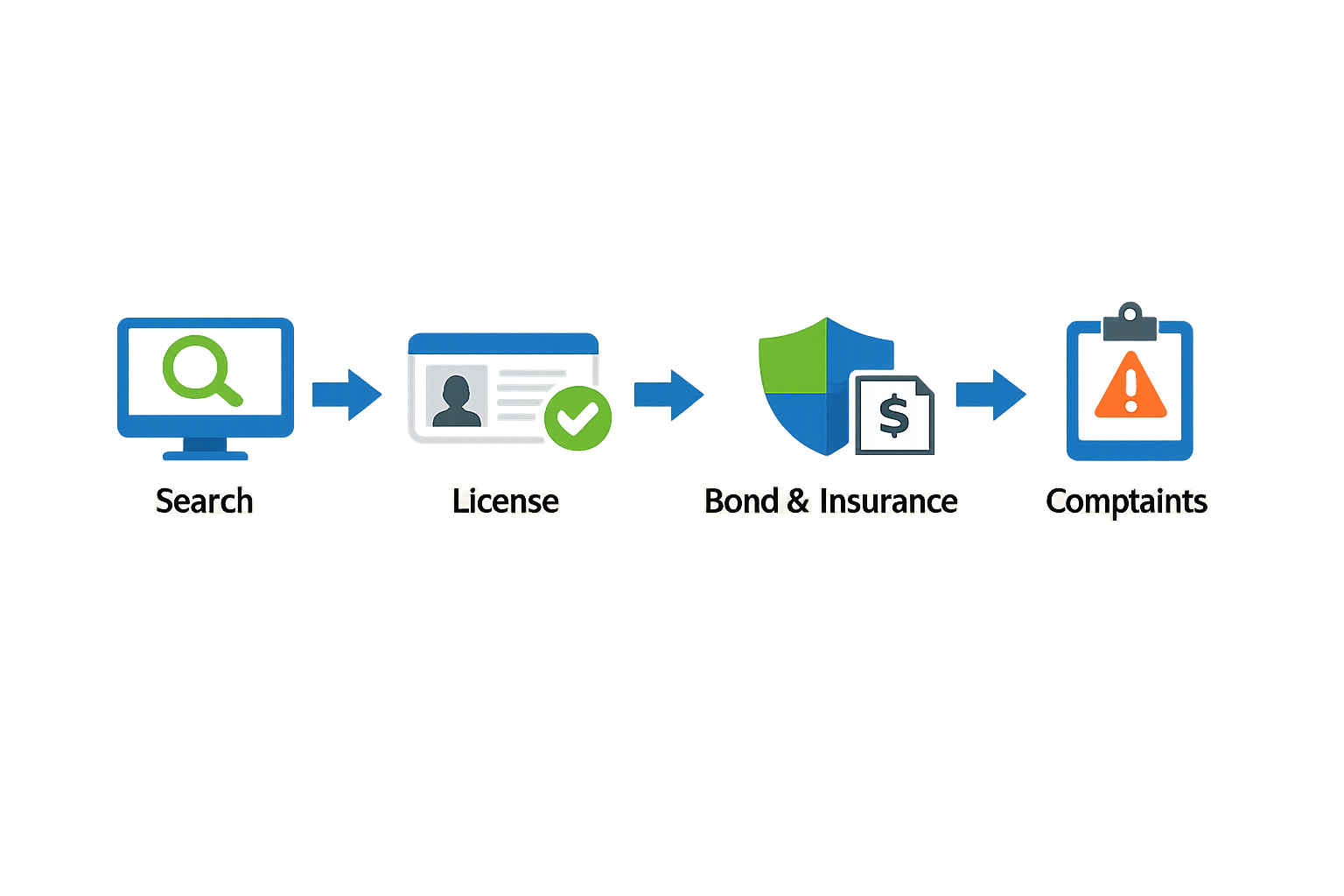
The license check is not ceremony. It determines whether you can collect on a contract if the work fails, and whether you can enforce a lien waiver if the contractor walks mid-job. A contractor who was not duly licensed at all times during the performance of a contract cannot bring or maintain any legal action for compensation in California, regardless of the quality of the work performed. The property owner, by contrast, may recover all compensation paid to an unlicensed contractor through legal action.
Legal and Financial Consequences
When you engage an unlicensed contractor, you lose the statutory protections that licensed contractors must carry. The contractor's state-mandated bond and insurance do not exist, and the state licensing board has no jurisdiction over the dispute. If the contractor abandons the job or performs defective work, your only recourse is civil court—where you bear the cost of litigation and the risk that the contractor has no recoverable assets. Worse, if an unlicensed contractor or their employees are injured on your property, you may be liable for damages that would otherwise have been covered by the contractor's workers' compensation insurance.
California law imposes escalating penalties on contractors who engage unlicensed subcontractors. A first offense is an infraction punishable by a fine between one thousand and three thousand dollars, with possible license revocation or suspension. A subsequent offense is a misdemeanor requiring license revocation or suspension, a fine between three thousand and five thousand dollars, or imprisonment in the county jail for up to one year, or both. These penalties apply when a contractor knowingly, negligently, or by reason of a failure to inquire, enters into a contract with an unlicensed person required to be certified.
The Compliance Window and Statute of Limitations
The Contractors State License Board has jurisdiction to investigate complaints if a complaint regarding a patent act or omission is filed within four years of the alleged violation. A complaint regarding a latent act or omission pertaining to structural defects must be filed within ten years. If you hire an unlicensed contractor, the board may not be able to help you resolve your complaint, and your only remedy is civil court. The four-year and ten-year windows apply only when the contractor was licensed; an unlicensed contractor is outside the board's enforcement reach from the start.
Verifying the license before you sign protects your ability to enforce the contract, to recover for defects, and to rely on the statutory complaint process. The check takes minutes; the cost of skipping it compounds for years. For guidance on managing contractor disputes in other contexts, see How to Deal with an Insurance Claims Adjuster for Commercial Buildings.
How to Verify Contractor License Washington Through L&I

To verify contractor license Washington records before authorizing work, building owners must use the Department of Labor & Industries public database. The verification process establishes that the contractor holds an active license in the classification you need, that the license is in good standing, and that the individual or entity named on the proposal matches the licensee of record. Where the contractor is a corporation or limited liability company, the license record will list the qualifying individual — the person whose examination and experience support the license. That person must be actively engaged in the work, not simply listed on paper.
Washington's licensing authority maintains a public search function that permits verification by contractor name, license number, or geographic location. The search returns the license status, the classification or classifications held, the expiration date, and any disciplinary actions or bond claims on record. A license that shows as expired, suspended, or revoked is not valid for new work, regardless of what the contractor states in a proposal. Where a contractor provides a license number but the search returns no match, or returns a different business name, the discrepancy must be resolved in writing before you proceed.
Step 1: Obtain the Contractor's License Number and Legal Business Name
Before you search, obtain the contractor's license number and the exact legal name under which the license is held. These details should appear on the contractor's proposal, bid, or service agreement. If the contractor is a corporation or LLC, the legal name on the license will match the entity name on file with the Secretary of State, not a trade name or DBA. Where a contractor provides only a trade name and no license number, request both the license number and the registered business name in writing. A contractor who is unwilling or unable to provide a license number on request is not in a position to perform licensed work.
Step 1
Request license number and legal name
Ask the contractor to provide the license number and the exact legal business name as it appears on the license. If the contractor operates under a trade name, ask for the registered entity name as well. Confirm that the name on the proposal matches the name you will search.
Step 2: Search the Public License Database
The licensing authority's online search function allows you to verify a license by number, by business name, or by location. Enter the license number exactly as provided; the search is case-insensitive but will not return partial matches. If the contractor provided only a business name, search by name and confirm that the classification and location match what the contractor represented. The search result will display the license status, the issue and expiration dates, the classifications held, and the name of the qualifying individual if the licensee is a corporation or LLC.
A license that shows as "active" and "in good standing" is current. A license that shows as "expired," "suspended," "revoked," or "inactive" is not valid for new work. Where the license expired recently, check the search again after a few days — renewals can take time to post. But do not authorize work in the interim; the contractor must hold an active license at the time the contract is signed and at the time work begins.
Step 2
Run the license search
Go to the licensing authority's contractor search page and enter the license number or business name. Review the result for status, expiration date, and classification. Confirm that the business name on the search result matches the name on the contractor's proposal.
Step 3: Verify the Classification Matches the Scope of Work
A contractor's license is issued in one or more classifications, each of which authorizes a defined scope of work. A contractor licensed only in electrical work is not authorized to perform plumbing or HVAC work, even if the contractor offers to do so. Where your project involves fire alarm inspection and testing, the contractor must hold a classification that permits fire alarm work — not simply an electrical classification. The search result will list every classification the contractor holds; confirm that at least one classification covers the work you are hiring for.
Where the contractor holds multiple classifications, the proposal or agreement should state which classification applies to your project. If it does not, ask the contractor to specify in writing which classification the work falls under. This matters for bond claims and for determining whether the contractor's insurance covers the work. A general contractor who performs specialty work outside the scope of the general classification may not be covered, and you may not be protected.
Step 3
Match classification to scope
Compare the classifications listed on the license search result to the scope of work in the contractor's proposal. If the work requires a specialty classification and the contractor holds only a general classification, or vice versa, raise the issue before you sign.
Step 4: Confirm the Qualifying Individual Is Actively Engaged
Where the contractor is a corporation or LLC, the license search will name the qualifying individual — the person who passed the examination and whose experience supports the license. That individual must be actively engaged in the contractor's business, which the licensing statute defines as working a minimum number of hours per week in the classification. A qualifying individual who appears on multiple licenses, or who is listed on a license but does not work for the contractor, does not satisfy the requirement.
You are not required to independently verify that the qualifying individual is on-site, but you are permitted to ask. If the contractor's proposal is signed by someone other than the qualifying individual, ask whether the qualifying individual will supervise the work. Where the contractor cannot or will not confirm that the qualifying individual is actively engaged, the license may not be valid for the work, regardless of what the search shows. For guidance on verifying contractor credentials and managing service agreements, see How to Deal with an Insurance Claims Adjuster for Commercial Buildings.
Step 4
Identify the qualifying individual
Note the name of the qualifying individual on the license search result. If the proposal or agreement is signed by a different person, ask the contractor to confirm in writing that the qualifying individual will supervise the work.
Step 5: Check for Disciplinary Actions and Bond Claims
The license search result will display any disciplinary actions, citations, or bond claims on record. A disciplinary action does not automatically disqualify a contractor, but it is information you are entitled to consider. Where the record shows a suspension that has since been lifted, the license is valid. Where the record shows an active suspension or revocation, the license is not valid, and the contractor cannot perform the work.
Bond claims indicate that the contractor failed to pay subcontractors, suppliers, or employees, or failed to complete work as agreed. A history of bond claims does not void the license, but it is a factor in deciding whether to hire the contractor. Where the bond claim is recent and the contractor has not posted a new bond, the contractor may not be able to obtain permits or renew the license. Ask the contractor to address any bond claims in writing before you proceed.
Step 5
Review disciplinary history
Scroll through the license search result for any disciplinary actions, bond claims, or citations. If the record shows an active suspension or multiple recent claims, request an explanation from the contractor in writing.
Step 6: Retain the Search Result and the Date You Verified
Print or save the license search result and note the date you verified it. The search result is a record that the contractor held a valid license on the date you checked, which may matter if a dispute arises later. Where the contractor's license expires during the term of your service agreement, verify the license again after the renewal date to confirm that the contractor renewed. A contractor who allows a license to lapse mid-contract is not permitted to continue work until the license is reinstated.
Retain the search result with your contract file. If an authority having jurisdiction asks for proof that you hired a licensed contractor, the search result and the date you verified it are the evidence you produce. Do not rely on a copy of the license card or certificate the contractor provides — those documents do not show current status, and they are not updated when a license is suspended or revoked.
Step 6
Document the verification
Save a PDF or screenshot of the license search result, note the date, and file it with the contractor's proposal and agreement. If the agreement spans a renewal period, set a reminder to verify the license again after the expiration date.
Best Practices for Hiring Contractors
Before you authorize any work, establish what the written agreement must contain and what records the contractor is obligated to produce. Every contract for construction work on a single-family dwelling you will retain for at least one year must include the contractor's name, address, and license number, the approximate start and completion dates, and a legal description of the property. The writing must also disclose whether the contractor carries commercial general liability insurance and, if so, the insurer's name and telephone number.
Request a Complete Subcontractor and Supplier List
To protect yourself from mechanics liens, ask your contractor for a written list of all subcontractors and material suppliers who will work on the project. The list should include when each subcontractor started work and when each supplier delivered goods or materials. Once you have the list, wait twenty days and monitor for Preliminary Notices. A Preliminary Notice is not a lien — it is a document that preserves a subcontractor's or supplier's right to record a lien if they are not paid. You will not receive Preliminary Notices from your prime contractor or from laborers, because the law assumes you already know they are improving your property.
One protective measure is to pay with joint checks. When your contractor indicates it is time to pay a subcontractor or supplier who sent you a Preliminary Notice, write the check payable to both the contractor and that subcontractor or supplier. This ensures the funds reach the party who performed the work or delivered the materials, reducing your exposure to a lien claim even if you have already paid the prime contractor in full. For additional guidance on protecting your property interests, see Mechanics Lien California: Mechanics Liens in California: Deadlines.
Verify Insurance Coverage and Status
The contract must state whether the contractor carries commercial general liability insurance. Before work begins, confirm the policy is active and covers the scope of the project. Contact the insurer directly using the telephone number provided in the contract, and ask for written confirmation of coverage dates and policy limits. If the contractor does not carry insurance, you assume greater risk for injuries or property damage that occur during construction.
Confirm Compliance with Permit Requirements
A contractor who willfully and deliberately violates state or local laws relating to building permits is subject to disciplinary action. There is a rebuttable presumption that construction performed without a permit is a willful and deliberate violation. Before you sign the agreement, ask the contractor which permits are required and when they will be obtained. Retain copies of all issued permits in your project file. If you discover later that required permits were not obtained, you may face enforcement action from the local building department, and the contractor's license may be suspended or revoked.
A person who utilizes the services of an unlicensed contractor may bring an action in any court of competent jurisdiction to recover all compensation paid to the unlicensed contractor.
Retain All Written Documentation
Keep a complete file for every project: the signed contract, all change orders, proof of insurance, copies of permits, payment records, and any correspondence with the contractor or subcontractors. If a dispute arises or a lien is recorded, these records are your primary defense. The contract itself must be legible and must clearly describe any other document incorporated into the agreement. You are entitled to a copy of the signed contract before any work commences.
Common Mistakes to Avoid When Hiring Contractors

The most frequent misstep is accepting a license number without verifying it independently. A contractor can recite a number; that does not prove the number is active, the classification matches the work, or the bond remains in force. Check the number yourself through the state database before any contract is signed.
Another common error is hiring before the documentation closes. A contractor states the license is current, the insurance is adequate, and the bond is posted. Until you retain a copy of each document—dated, issued, and naming the correct entity—the statement is not evidence. If a violation opens later, the burden of proof falls to the owner who authorized the work.
Relying on Verbal Assurances
Verbal confirmation that a license is active does not satisfy a compliance audit. The standard requires written proof: a current certificate, a bond acknowledgment, and a certificate of insurance that names your property. Anything less leaves the record incomplete when the authority having jurisdiction requests it.
If the contractor resists providing copies, that resistance is information. A licensed contractor with active coverage produces the documents without delay. Hesitation or deflection indicates a gap you will discover only after the work begins and the invoice arrives.
Skipping the Bond and Insurance Verification
A license number confirms registration; it does not confirm the bond or the insurance. The two are separate filings, and either can lapse while the license remains technically active. Verify the bond amount meets the statutory minimum for the classification, and confirm the insurance certificate lists your building as an additional insured or certificate holder.
If you hire without verifying the bond, and the contractor abandons the project or performs defective work, recovery depends on that bond. Discovering it lapsed six months before the contract was signed eliminates the remedy the statute provides.
Hiring Outside the License Classification
A contractor licensed in one classification cannot perform work that falls under another without obtaining the additional classification or partnering with a properly licensed subcontractor. Hiring a general contractor to perform specialized fire protection work, when the license does not include that classification, opens a violation that the owner must close.
The classification matters because the examination, the experience requirement, and the bond calculation all vary by type of work. A contractor who holds a valid license but works outside the authorized scope operates as if unlicensed for that portion of the project. The contract language stating the contractor is licensed does not cure the misclassification.
Ignoring Disciplinary History
A license can be active and still carry a disciplinary record. The state database discloses complaints, citations, suspensions, and revocations. A contractor with multiple unresolved complaints or a recent suspension presents a higher risk of non-performance or dispute. Review the disciplinary tab before the agreement is executed.
If the record shows a pattern—repeated failures to obtain permits, multiple bond claims, or unresolved complaints regarding abandonment—that pattern predicts future behavior. A single resolved complaint may be immaterial; a series of identical violations is a warning the next project will follow the same course.
Accepting Outdated or Incomplete Documentation
A certificate of insurance dated eighteen months before the contract is not current. A bond acknowledgment that lists a different business name than the one on the contract is not proof the entity you are hiring is bonded. Documentation must be current, must name the correct entity, and must cover the dates of performance.
If the contractor provides a license certificate but no bond confirmation, request the bond number and verify it separately. If the insurance certificate arrives without your property listed, request an amended certificate before work begins. Incomplete documentation discovered mid-project cannot be corrected retroactively for compliance purposes.
For guidance on managing disputes when documentation gaps emerge after work has started, see How to Deal with an Insurance Claims Adjuster for Commercial Buildings.
Frequently asked questions
What happens if I hire an unlicensed contractor in Washington?
Hiring an unlicensed contractor carries both legal and financial risk. An unlicensed contractor cannot bring or maintain any action in court to collect compensation for work performed, regardless of the quality of that work. If you discover you have hired an unlicensed contractor, you may bring an action in court to recover all compensation paid to that contractor. The prohibition applies even when the contractor's work meets the contract terms — licensure is a threshold requirement, not a quality standard.
The doctrine of substantial compliance does not apply when the contractor has never been licensed. A limited exception exists when the contractor held a prior license, acted in good faith to maintain it, and remedied the lapse promptly upon learning of it. That exception requires an evidentiary hearing and does not apply retroactively to all unlicensed work.
How often must a contractor renew their license?
Contractor licenses require periodic renewal. At the time of renewal, the qualifying individual must file a statement verifying their capacity as the qualifying individual to the licensee. A contractor's bond in the sum of twenty-five thousand dollars must remain on file as a condition of issuance, reinstatement, reactivation, renewal, or continued maintenance of the license. If the bond lapses, the license cannot be renewed or maintained.
A license that has been inactivated on the official records does not require a bond during the period it remains inactive. Reactivation, however, triggers the bond requirement again.
Can a contractor qualify for a license without taking the written examination?
The registrar may waive the examination under specific conditions. A qualifying individual who has personally passed the written examination for the same classification within the five years immediately preceding the application, or who has served as the qualifying individual for a licensee in good standing in that classification during the same period, does not require re-examination.
Additional waiver provisions apply when the qualifying individual has been listed on the board's official records as personnel of an active, good-standing licensee for five of the seven years immediately preceding the application and was actively engaged in construction activities in that classification. Family members continuing an existing business and corporate employees replacing a former qualifying individual may also qualify for a waiver under narrow conditions specified in statute.
What is a responsible managing employee, and how does that role differ from an officer?
A responsible managing employee is a bona fide employee of the applicant who is actively engaged in the classification of work for which that employee qualifies the applicant. "Bona fide employee" means permanently employed by the applicant. "Actively engaged" means working thirty-two hours per week, or eighty percent of the total hours per week that the applicant's business is in operation, whichever is less.
An individual owner may qualify by examination through the owner's own appearance or through a responsible managing employee. A partnership qualifies through a partner or a responsible managing employee. A corporation qualifies through a responsible managing officer or a responsible managing employee. A limited liability company qualifies through a responsible managing officer, manager, member, or employee. The distinction matters because the qualifying individual's role and employment status determine whether the entity can hold the license.
Does Washington accept out-of-state contractor licenses?
The registrar may accept the qualifications of an applicant licensed as a contractor in a similar classification in another state if that state accepts California qualifications on a reciprocal basis. The board must ascertain, case by case, that the professional qualifications and conditions of good standing for licensure and continued licensure in the other state are at least the same or greater than in California. The registrar may waive the trade examination if the applicant provides written certification from the other state that the applicant's license has been in good standing for the previous five years.
Reciprocity is not automatic. It depends on the other state's standards and its willingness to recognize California licenses. Review the specific state's licensing requirements before assuming reciprocity applies.
What must appear on a written contract with a licensed contractor?
Every licensed contractor acting as a prime contractor must include a specific statement in at least ten-point type on all written contracts. The statement identifies the Contractors State License Board, its jurisdiction to investigate complaints, and the time limits for filing complaints regarding patent acts or omissions and latent structural defects. Home improvement contracts and service and repair contracts require a longer disclosure in at least twelve-point type, including contact information for the board and a warning about the consequences of hiring an unlicensed contractor.
Failure to include the required notice is cause for disciplinary action. The notice requirement is not a formality — it establishes the complaint window and the board's investigative authority. For additional guidance on compliance documentation, see How to Deal with an Insurance Claims Adjuster for Commercial Buildings.
Can a contractor hold more than one active license?
Except under narrow statutory exceptions, no person qualifying on behalf of an individual or firm may hold any other active contractor's license while acting as the qualifying individual. This prohibition prevents one qualifying individual from serving multiple unrelated entities simultaneously. The restriction does not apply to a licensee adding an additional classification to an existing license, provided the qualifying individual meets the experience and examination requirements for the new classification.
An additional classification may be added without further examination if the qualifying individual has been listed as personnel of an active, good-standing licensee for five of the seven years immediately preceding the application, has at least four years of experience in the new classification within the last ten years, and is applying for a classification closely related to the existing license or a significant component of the licensed contractor's construction business.
What is the aggregate liability of a contractor's bond?
The contractor's bond required for licensure is twenty-five thousand dollars. Excluding claims brought by beneficiaries specified in statute, the aggregate liability of a surety on claims against the bond shall not exceed seven thousand five hundred dollars. Bond proceeds in excess of seven thousand five hundred dollars are reserved exclusively for statutory beneficiaries. A beneficiary specified in statute may claim or recover the full measure of the bond.
The board may require an applicant who has been convicted of a violation or cited for unlicensed contracting to post a bond in twice the required amount until the license is renewed, if the violation constituted a substantial injury to the public and the citation has been reduced to a final order.
Conclusion
To verify contractor license Washington credentials before authorizing work is not optional. The standard requires licensed agencies to perform certain inspections, and unlicensed contractors cannot close code violations regardless of the quality of their work. An owner who hires an unlicensed contractor loses the ability to enforce the agreement, loses access to bond recovery if the work fails, and may face liability for injuries to unlicensed workers on the property.
Washington's L&I database provides real-time license status, bond coverage, and complaint history at no cost. Check the license number, confirm the expiration date, verify the bond is active, and retain the verification record with the service agreement. If the contractor cannot produce a current license or if the database shows a suspended or expired status, do not proceed — the risk of unenforceable contracts and unresolved code failures outweighs any short-term cost advantage.
The agreement is only as strong as the entity that signs it. Verify that the licensed contractor is the party named on the contract, not an employee or subcontractor operating under someone else's license. If the work involves fire protection systems, confirm that the contractor holds the classification required by NFPA 25 or NFPA 72 as adopted locally. Retain the license verification, the signed agreement, and all inspection reports for the full retention period — these documents establish the chain of custody if an authority having jurisdiction opens a violation or if the work later fails.
Responsible hiring begins with a single database query. The record either supports the hire or it does not. For guidance on managing service agreements and compliance documentation for commercial properties, see How to Deal with an Insurance Claims Adjuster for Commercial Buildings. When the license is current, the bond is active, and the agreement names the licensed entity, you have a defensible record. Anything less leaves the owner exposed.