
Introduction
Mechanics liens in California exist because the law recognizes that labor and materials incorporated into real property create value for the owner. When that value is not paid for, the unpaid party may record a lien — a legal claim against the property itself. The lien does not guarantee payment, but it does create a cloud on title and, if enforced through foreclosure, can compel a sale to satisfy the debt.
The mechanics lien framework in California Civil Code Division 4, Title 2, Part 6 establishes strict deadlines for every stage of the process. These deadlines are not negotiable. A contractor who records a lien one day after the statutory window closes holds an unenforceable document. An owner who receives a lien recorded outside the permitted interval may move to expunge it without addressing the underlying debt.
Deadlines differ depending on who is filing. A direct contractor — the party with a contract directly with the property owner — operates under one set of intervals. Subcontractors, material suppliers, and others in the payment chain operate under another. The triggering event for those intervals is not always intuitive: "completion" has a statutory definition, and an owner's decision to record a notice of completion or cessation resets the clock for certain claimants.
Preliminary notice is a separate requirement. Most claimants must serve preliminary notice on the owner, the direct contractor, and the construction lender before they may enforce a lien. The statute specifies the timing and content of that notice. Miss it, and the lien right does not attach — even if the work was performed and the payment is genuinely owed. For property owners navigating disputes, understanding these notice and filing requirements clarifies what claims are valid and what documentation must be retained. For a broader view of California regulatory timelines in other contexts, see Insurance Adjuster Contact Timeline: California Regulations.
This article walks through the deadlines that bind parties in the mechanics lien process, the intervals that control when a lien may be recorded, and what documentation closes or defeats a claim. It does not provide legal advice, estimate costs, or tell you what to do in a specific dispute. It reads the statute to the end, names the interval, and stops where the record stops.
Understanding the Problem: The Complexity of Deadlines

The deadline structure for mechanics liens in California runs on multiple clocks, and each one starts from a different event. A direct contractor records the claim of lien within ninety days after completion of the work of improvement, or within sixty days after the owner records a notice of completion or cessation—whichever comes first. A claimant other than a direct contractor must record within ninety days after completion or within thirty days after the owner records a notice of completion or cessation. Miss the window, and the lien right expires before you file.
When the Lien Clock Starts and Stops
Completion of the work of improvement is not the same as the date you finished your scope. The ninety-day period begins when the entire project reaches completion, not when your crew left the site. If other trades continue work after you, the completion date moves forward and your recording window shifts with it. The owner can also trigger a shorter deadline by recording a notice of completion or cessation, which resets the countdown to either sixty days for direct contractors or thirty days for other claimants.
The provision permits either remedy satisfies the recording requirement, but only the earlier deadline binds the claimant.
A design professional operating under a separate lien provision faces a different set of intervals. The design professional lien expires ninety days after recording if the work of improvement has not commenced, or immediately upon commencement of that work. To convert an expired design professional lien to a mechanics lien, the claimant must act within thirty days of the design professional lien's expiration. These are not extensions—they are separate remedies with their own windows.
The Enforcement Deadline After Recording
Recording the claim of lien does not complete the process. The claimant must commence an action to enforce the lien within ninety days after recordation. If no action is filed within that period, the claim of lien expires and becomes unenforceable. The statute permits an extension of this deadline only when the claimant and owner agree to extend credit and a notice of that agreement is recorded before the original ninety-day period ends.
Once the action is filed, the plaintiff must record a notice of the pendency of the action within twenty days after commencement. Only from the time that notice is recorded does the action affect a purchaser or encumbrancer whose rights accrue after the action begins. The twenty-day window is not negotiable, and missing it can subordinate the lien to later interests even when the lien itself was timely.
For property owners navigating insurance timelines and regulatory obligations, understanding how different agencies enforce their own deadlines is essential. Learn more about Insurance Adjuster Contact Timeline: California Regulations to see how statutory windows operate in adjacent contexts.
Steps to Navigate Mechanics Liens Deadlines

Mechanics liens in California impose distinct intervals on direct contractors and subcontractors. The statute names the event that starts each clock, and the provision permits no extension unless the owner and claimant record an agreement in writing. What follows is the sequence that satisfies the recording requirement and preserves the right to enforce.
Establish Your Role in the Contract Chain
A direct contractor holds a contract with the owner. A claimant other than a direct contractor — subcontractor, material supplier, equipment lessor — holds a contract downstream. The statute assigns different deadlines to each, and the distinction matters from the first day of work. Before you calendar any interval, confirm whether you contracted directly with the owner or with another party on the project.
Step 1
Confirm preliminary notice compliance
A claimant may enforce a lien only if the claimant has given preliminary notice to the extent required by Chapter 2 of the Civil Code and made proof of notice. The preliminary notice window closes before the lien recording window opens. Retain the proof-of-service certificate; the county recorder does not verify notice compliance when you record the claim.
Step 2
Calendar the completion event
The 90-day interval for a direct contractor runs from completion of the work of improvement. For a claimant other than a direct contractor, the interval runs from the date the claimant ceases to provide work, but it terminates early if completion of the work of improvement occurs first. Mark the date you last furnished labor, service, equipment or materials to the site. Mark separately the date the entire project reaches completion — that event can shorten your window even when your own scope finished earlier.
Step 3
Monitor for notice of completion or cessation
The owner may record a notice of completion or a notice of cessation. Either filing accelerates the deadline. A direct contractor has 60 days after the owner records a notice of completion or cessation. A claimant other than a direct contractor has 30 days after that recording. The statute provides no grace period and no mailbox rule — the claim of lien must be recorded within the interval, not mailed or prepared within it.
Record the Claim of Lien Before the Deadline
The claim of lien is a written statement, signed and verified by the claimant. The statute requires a statement of the claimant's demand after deducting all just credits and offsets, the name of the owner or reputed owner if known, a general statement of the kind of work furnished, and the name of the person by whom the claimant was employed or to whom the claimant furnished work. Record the claim in the office of the county recorder where the property is located. Erroneous information relating to the claimant's demand, credits and offsets deducted, the work provided, or the description of the site does not invalidate the claim of lien unless the error is so substantial that it misleads a party to the party's prejudice.
Step 4
Commence the enforcement action within 90 days
The claimant shall commence an action to enforce a lien within 90 days after recordation of the claim of lien. If the claimant does not commence an action to enforce the lien within that time, the claim of lien expires and is unenforceable. This interval does not extend if you record early — it runs from the date you record, not from the date the underlying work was completed. After commencement of the action, record a notice of the pendency of the action in the county recorder's office within 20 days after commencement.
For property owners navigating related compliance intervals in other contexts, understanding how regulatory deadlines interact with contractual obligations can clarify what documentation to retain and produce. See Insurance Adjuster Contact Timeline: California Regulations for an example of how statutory intervals govern another class of claims.
Verify the Recorded Document
After the county recorder accepts the claim of lien, obtain a file-stamped copy and verify that the recorder's stamp shows the correct date and book-and-page or instrument number. That stamped copy is the record you produce if a dispute arises over whether the claim was timely. The statute does not permit a claimant to enforce a lien that was recorded outside the deadline, even by a single day, and the recorder's stamp — not your intent or your courier's affidavit — establishes the filing date.
| Claimant Type | Recording Deadline (No Notice of Completion/Cessation) | Recording Deadline (After Notice of Completion/Cessation) |
|---|---|---|
| Direct Contractor | 90 days after completion of work of improvement | 60 days after owner records notice |
| Other Claimant | 90 days after completion of work of improvement (or when claimant ceases work, if earlier) | 30 days after owner records notice |
The agreement to extend credit, if any, must be recorded before the original deadline expires. An unrecorded extension agreement does not suspend the interval, and a late-recorded agreement does not revive an expired lien. Ask for the extension in writing, and record it promptly — the statute provides no cure period for a missed recording.
Tips and Tricks for Managing Mechanics Liens
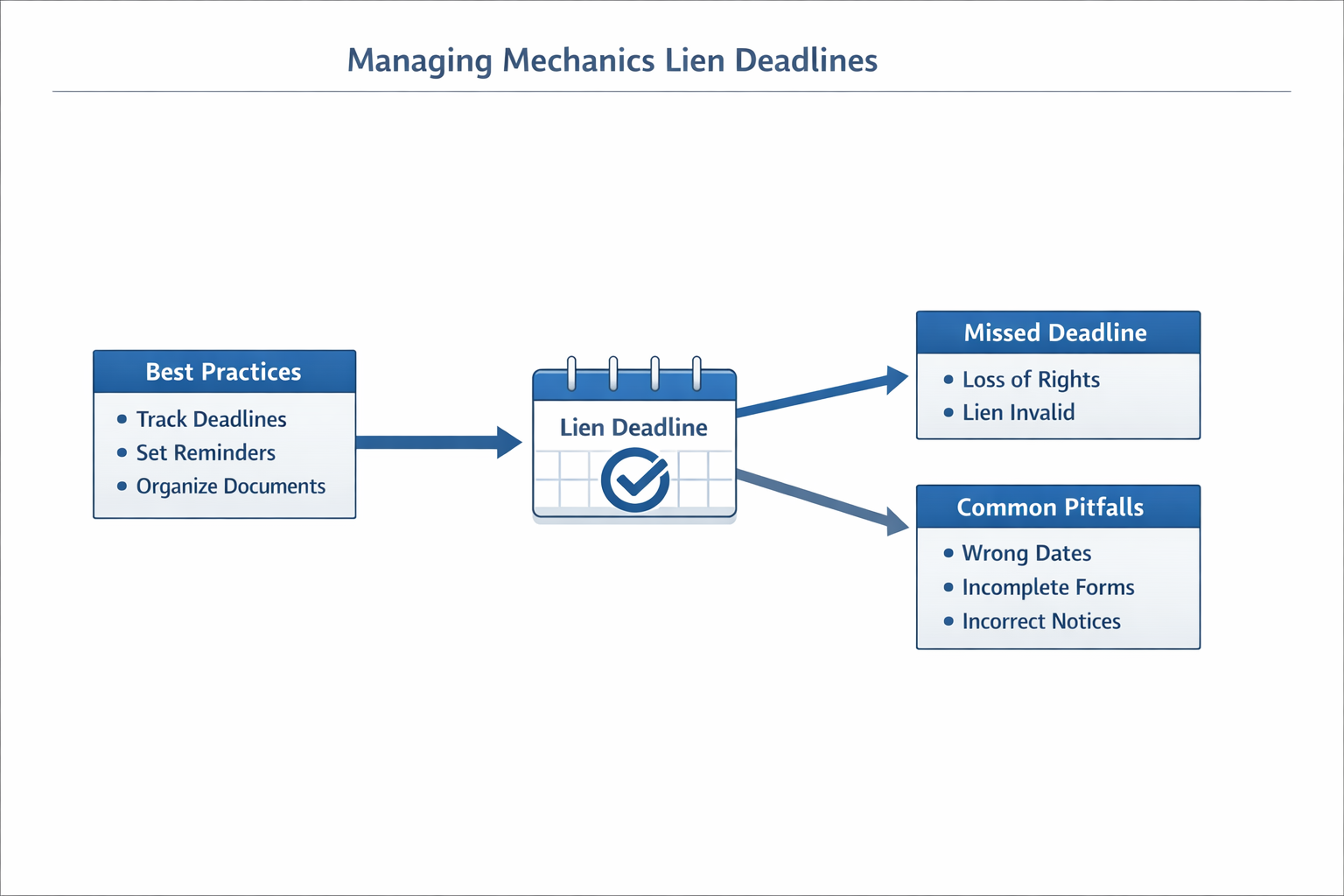
The standard requires preliminary notice, and the provision permits enforcement only when proof of notice accompanies the claim. A claimant who misses the preliminary notice window forfeits the lien, regardless of the work performed or the balance due. Ask for it in writing — the notice must be delivered within the statutory interval, and the claimant retains the burden of proving delivery.
Retain the Record Before the Deadline Passes
Record the claim of lien within the interval the statute provides. A direct contractor has ninety days after completion of the work of improvement, or sixty days after the owner records a notice of completion or cessation, whichever is earlier. A claimant other than a direct contractor has ninety days after completion of the work of improvement, or thirty days after the owner records a notice of completion or cessation, whichever is earlier. Check the date on the notice of completion — the interval matters, and the edition matters.
What the Report Actually Says
Erroneous information relating to the claimant's demand, credits and offsets deducted, the work provided, or the description of the site does not invalidate the claim of lien unless the error materially misleads a party to the detriment of that party. The provision permits minor variance — not the whole provision. When the claim states a general description of the kind of work furnished, the statute is satisfied. The obligated party is the person that contracted for the work, or the person with knowledge of the work unless that person gives notice of nonresponsibility.
Before You Authorize the Enforcement Action
After commencement of an action to enforce a lien, the plaintiff must record a notice of the pendency of the action in the county recorder's office within twenty days after commencement. Only from the time of recording the notice of pendency does the action affect a purchaser or encumbrancer of the property. What closes the failure is the recorded notice — absent that filing, the lien does not bind subsequent transferees. If you are managing compliance intervals for multiple properties, understanding Insurance Adjuster Contact Timeline: California Regulations can help you anticipate overlapping documentation windows.
A claimant may enforce a lien only if the claimant has given preliminary notice to the extent required and made proof of notice.
Separately Priced Claims on Multiple Works
The provision permits a claimant to record one claim of lien on two or more works of improvement when the works have or are reputed to have the same owner, or the work was contracted for by the same person. The claimant must designate the amount due for each work of improvement. The statute does not permit a single aggregate figure across multiple sites — each work stands separately in the claim.
Conclusion
The deadlines governing Mechanics Liens in California are not suggestions — they are statutory intervals that open and close rights. A design professional's lien expires ninety days after recordation if the work of improvement never commences, and a claimant must commence enforcement within ninety days of recording the claim of lien. Miss the window, and the lien becomes unenforceable regardless of the underlying debt. These intervals run from the date of recordation, not from the date of default or the date you discovered the problem.
Once an action to enforce the lien is filed, the claimant must record a notice of pendency within twenty days of commencement. That notice is what binds subsequent purchasers and encumbrancers — without it, the enforcement action does not affect interests recorded after the suit begins. The statute does not permit a grace period or a late filing cure. The twenty-day interval is measured from the date the action commences, and the notice must be recorded in every county where the property is situated.
Proactive calendar discipline protects rights that reactive scrambling cannot recover. Retain the recordation receipt, the proof of service for preliminary notices, and the filed complaint with its filing stamp. When a deadline approaches, ask for confirmation in writing that the required document was recorded or served. If an extension of credit is agreed, record the notice of that extension before the original ninety-day enforcement window closes — the statute permits the extension only if it is recorded in time.
For property owners and general contractors, understanding these intervals clarifies what a claimant can and cannot do at each stage. A lien that was not timely recorded, or an enforcement action that was not timely commenced, does not bind the property. Where a claimant asserts a lien outside the statutory window, the owner may move to expunge it without addressing the merits of the underlying claim. The intervals are independently enforceable, and a missed deadline is a complete defense to lien enforcement.
The mechanics lien framework in California rewards those who track the calendar and document each step. The statute provides remedies to claimants who perform the work and meet the intervals, and it provides defenses to owners and lenders when those intervals are missed. Neither remedy nor defense is available to a party who does not know what the statute requires or when it requires it. Read the provision to the end, name the interval, and retain the record that proves compliance. For related compliance obligations in other contexts, see our guide on Filing a Complaint With the California Department of Insurance.