
Introduction to Tenant Improvement Allowance
A tenant improvement allowance appears in commercial lease negotiations as a dollar figure the landlord agrees to contribute toward the cost of adapting the space. The tenant orders the work — partition walls, electrical upgrades, flooring, paint — and submits invoices or paid receipts to the landlord, who reimburses up to the allowance cap. In some markets the landlord contracts directly with the general contractor and pays from the allowance, but the tenant still directs the scope.
The allowance is not a gift in most cases. It is a negotiated lease term, and the lease specifies whether and when the tenant must repay it. One lease may treat the allowance as a true contribution, forgiven dollar-for-dollar over the lease term. Another may structure it as a loan, repayable in monthly installments or as a lump sum if the tenant breaks the lease early. A third may blend the two: forgiveness accrues monthly, but any unvested balance is due immediately upon early termination.
Understanding whether you must pay back a tenant improvement allowance requires reading the lease provision that created it. The title of the section — "Tenant Improvement Allowance," "Landlord Contribution," or "TI Advance" — does not control the obligation. The operative language appears in the repayment, amortization, or recapture clause, often several paragraphs below the allowance amount. If the lease is silent on repayment, the allowance is typically treated as a landlord contribution with no separate repayment obligation, but silence is rare in professionally drafted commercial leases.
California law governs retention payments on private works of improvement under Civil Code Division 4, Title 2, Part 6, Chapter 8, Article 2, but these provisions address payments withheld by an owner from a direct contractor or by a contractor from a subcontractor during construction. They do not apply to a tenant improvement allowance when the allowance is structured as a construction loan between landlord and tenant. The statutory retention rules — timing, percentage caps, and penalties for late release — operate in the contractor-payment chain, not in the landlord-tenant relationship. When a landlord withholds funds pending completion or lien waivers, that withholding occurs under the lease, not under the retention statutes that bind owners and contractors on private works.
For guidance on related compliance timelines in California, see Insurance Adjuster Contact Timeline: California Regulations, which covers statutory intervals that apply when an authority having jurisdiction must act by a fixed deadline.
The lease also defines what counts as "completion" for purposes of releasing the allowance or starting the forgiveness clock. Some leases tie completion to the issuance of a certificate of occupancy. Others require the tenant to submit final lien waivers from every subcontractor before the landlord disburses the last allowance dollar. A tenant who begins occupancy and starts paying rent may find that a portion of the allowance remains in the landlord's control, awaiting documentation the tenant has not yet assembled. That undisbursed portion does not reduce the repayment obligation if the lease calculates repayment from the full allowance amount rather than from amounts actually paid.
Understanding the Payback Obligation
The question of whether a tenant improvement allowance must be repaid depends entirely on what the lease says about early termination and default. The allowance itself is not a loan — it is a landlord contribution toward tenant-funded work — but the lease frequently ties the allowance to a minimum occupancy term. When a tenant vacates before that term expires, the lease may require repayment of all or part of the allowance, or it may permit the landlord to retain security deposits or pursue other remedies.
Common Lease Provisions That Trigger Payback
Most commercial leases that include a tenant improvement allowance contain a clause stating that if the tenant defaults or terminates early, the unamortized portion of the allowance becomes immediately due. The unamortized portion is the allowance divided by the lease term, multiplied by the number of months remaining. For example, a $100,000 allowance on a ten-year lease that terminates after five years leaves $50,000 unamortized, and the lease may require the tenant to pay that amount to the landlord.
Some leases do not require direct repayment but instead permit the landlord to offset the unamortized allowance against the security deposit or to pursue it as damages in a breach-of-lease action. The lease controls which remedy the landlord can invoke, and the tenant should read the default and early-termination sections carefully before signing.
What Happens When the Lease Is Silent
When the lease does not address repayment of the tenant improvement allowance, the landlord's remedies depend on whether the tenant's departure constitutes a breach. If the tenant completes the lease term, no repayment is owed. If the tenant abandons the premises or otherwise breaches the lease, the landlord may pursue damages, but the allowance itself is not automatically recoverable unless the lease or an ancillary agreement makes it so.
In the absence of a written repayment obligation, a landlord who wishes to recover the allowance must prove that the allowance was a loan or that the tenant's conduct caused damages equal to the allowance. That proof is difficult when the allowance was presented as a contribution rather than a debt, and when the improvements remain in place and benefit the landlord after the tenant departs.
Retention and Security Deposits
Some leases permit the landlord to retain all or part of the security deposit to cover the unamortized allowance. That retention is permissible only if the lease explicitly authorizes it. A landlord who retains a deposit without lease authority may be liable for wrongful withholding, and the tenant may recover the deposit plus statutory penalties.
For tenants who are considering early termination, understanding the insurance adjuster contact timeline and related regulatory obligations can help clarify what documentation the landlord must provide when asserting damages or offsets against the deposit.
Dispute Resolution and Acceleration
When a landlord claims that a tenant owes repayment of the allowance, the lease's dispute-resolution provisions govern how that claim is resolved. Some leases require mediation or arbitration before either party can file suit. Others permit the landlord to accelerate all future rent and the unamortized allowance immediately upon default, converting what might have been a negotiable exit into a large, immediate debt.
A tenant who receives a demand for repayment should review the lease's notice and cure provisions. Many leases permit the tenant a window — often ten to thirty days — to cure a default before the landlord can accelerate or terminate. If the lease permits cure, the tenant should respond in writing within that window, either disputing the default or proposing a payment arrangement.
The lease controls which remedy the landlord can invoke, and the tenant should read the default and early-termination sections carefully before signing.
Steps to Determine Payback Requirements
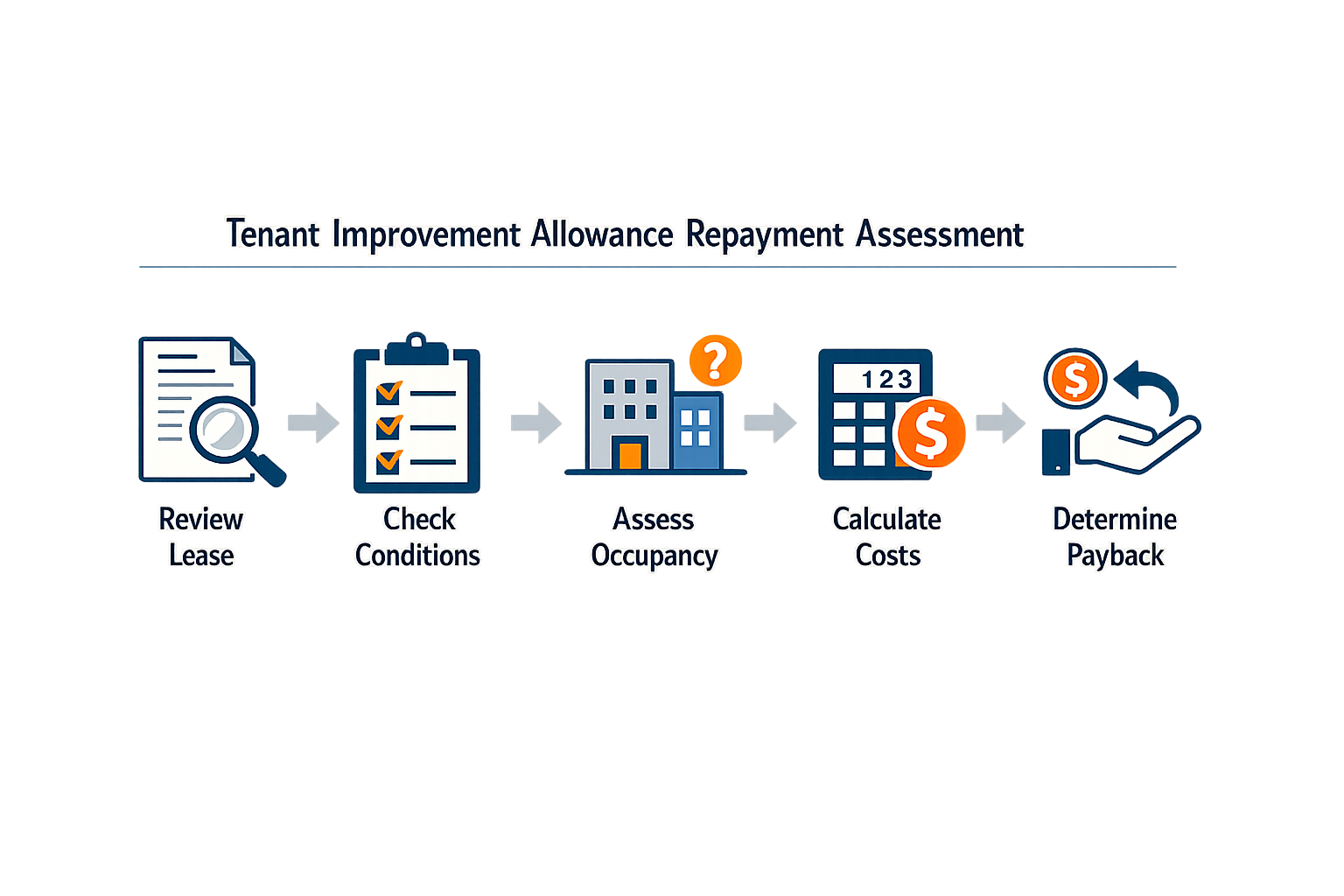
Establishing whether a tenant improvement allowance creates a repayment obligation requires a methodical review of the lease and any associated construction agreements. The allowance structure, the lease term, and the early-termination provisions all determine what happens to the money if the tenant vacates before the scheduled end date.
Step 1
Locate the improvement-allowance provision
Find the section of the lease that describes the tenant improvement allowance. It may appear in an addendum, a work letter, or a standalone construction exhibit. Note whether the provision uses the word "allowance," "credit," "contribution," or "reimbursement" — the label alone does not control the payback obligation, but it signals how the landlord structured the benefit.
Step 2
Identify the amortization or recapture clause
Look for language that ties the allowance to the lease term. Common structures include:
- Amortization over the initial term: The allowance is treated as a loan, amortized monthly into the base rent. If the tenant terminates early, the unamortized balance becomes due.
- Recapture on early termination: The lease permits early termination but requires the tenant to repay a prorated share of the allowance based on the remaining term.
- No recapture: The allowance is a one-time contribution with no repayment clause. Early termination does not trigger a clawback.
If the lease is silent on recapture, the allowance is typically not repayable — but confirm that silence with the landlord in writing before you rely on it.
Step 3
Check the default and acceleration provisions
Review the lease's default section. Some leases treat early termination as a default event, which can accelerate all future rent and allowance obligations. Others permit negotiated buyouts that include the unamortized allowance. The default provision shows whether the landlord can demand immediate payment of the full remaining balance or whether the obligation is limited to damages actually incurred.
Step 4
Examine any construction or retention agreements
If the improvement work was performed under a separate construction contract, review that agreement for retention-payment terms. California Civil Code Part 6, Title 2, Chapter 8, Article 2 governs retention payments withheld by an owner from a direct contractor. The statute requires that retention be paid within 45 days after completion of the work of improvement, and it imposes a penalty of 2 percent per month on amounts wrongfully withheld. If the landlord is holding retention and the tenant terminates early, the tenant may need to resolve the retention obligation before the landlord releases any remaining allowance funds.
For disputes over withheld amounts, the prevailing party in a collection action is entitled to costs and reasonable attorney's fees under the statute.
Step 5
Request written confirmation of the payback calculation
Before you authorize any improvement work, ask the landlord to provide a written schedule showing:
- The total allowance amount
- The monthly amortization (if applicable)
- The unamortized balance at each anniversary
- The recapture formula if you terminate early
This schedule becomes the reference document if a dispute arises. If the landlord cannot or will not provide it, the lease may not impose a repayment obligation — but confirm that interpretation with the landlord in writing.
Practical considerations for early termination
If you are evaluating an early exit, calculate the unamortized allowance balance at the proposed termination date. Compare that balance to the cost of remaining in the space through the end of the term. In some cases, the recapture obligation is less than the cumulative rent savings from vacating early; in others, it exceeds those savings and makes early termination uneconomical.
For additional guidance on resolving disputes with landlords or contractors, see our article on filing a complaint with the California Department of Insurance.
Tips for Managing Tenant Improvement Allowances
The allowance appears in the lease, but the payback obligation appears in the default and acceleration provisions. Before you authorize any improvement work, read the entire lease to establish where the allowance converts to a debt and what events trigger repayment.
Understand What the Agreement Actually Says
The lease provision typically states the allowance amount and the permitted use. It may permit either a direct payment to the contractor or a reimbursement to the tenant after the work is complete. The two are separately priced in practice — reimbursement shifts the financing burden to the tenant during construction, and some tenants negotiate a higher allowance in exchange for accepting that delay.
The payback trigger is usually found in a separate clause covering lease termination, default, or early exit. That clause may state that unused allowance funds revert to the landlord, or it may provide that the tenant owes the full allowance if the lease terminates before a specified date. Ask for it in writing if the lease is silent on the payback mechanism — what the lease does not address, the parties must negotiate if a dispute arises.
Confirm the Obligated Party Before You Sign
The lease identifies the tenant entity. If the tenant is a corporation or LLC, the allowance obligation binds that entity, not the individual signing the lease. Some landlords require a personal guarantee block — a separate signature section where an individual agrees to satisfy the tenant's debts if the entity defaults. The guarantee block matters: it determines who the landlord can pursue if the tenant vacates early and the allowance becomes due.
Before you authorize the improvement work, confirm which entity is obligated on the lease and whether a guarantee is in place. If the lease permits assignment or sublease, establish whether the allowance obligation transfers with the lease or remains with the original tenant. The provision may state that the original tenant remains liable even after assignment, or it may permit a release if the landlord approves the new tenant. Either remedy satisfies the lease, but the two produce different outcomes if the new tenant defaults.
Track Payment Intervals and Dispute Windows
Payment delays can impose financial hardship on contractors, particularly when the landlord reimburses the tenant and the tenant delays payment to the contractor. California law provides that a direct contractor must pay a subcontractor within 21 days after receipt of a progress payment from the owner, unless the parties agree otherwise in writing. Penalties accrue at 2 percent per month on disputed amounts, and those penalties can affect the overall cost of the improvement.
If the lease provides a dispute window — a period during which the tenant may contest a charge or a payback demand — use it. The window typically runs from the date the landlord provides written notice of the amount due. If the tenant does not respond within the window, the lease may treat the charge as accepted and accelerate the full amount. For guidance on dispute procedures in other contexts, see Filing a Complaint With the California Department of Insurance.
The cheapest allowance is the one whose payback provision you read before the lease term starts, not after you receive the default notice.
Retain Documentation the Lease Requires
The lease may require the tenant to provide the landlord with copies of all improvement invoices, lien releases, and completion certificates. That documentation closes the landlord's obligation to pay the allowance and opens the tenant's obligation to maintain the improvements for the lease term. If the lease is silent on retention, treat every improvement record as a document you must produce if a dispute arises.
Some leases require the tenant to provide as-built drawings or updated floor plans after the improvement is complete. The requirement is not decorative — the landlord uses those drawings to verify that the work matches the approved scope and to establish the building's condition for the next tenant. If the lease requires as-built drawings and the tenant does not provide them, the landlord may withhold final payment of the allowance or treat the omission as a lease default.
Conclusion: Navigating Tenant Improvement Allowances
The agreement controls. Whether a tenant improvement allowance must be repaid depends entirely on the lease language — specifically, whether the provision creates a debt obligation, ties the allowance to a minimum term, or structures it as a rent credit amortized over the lease period. The standard does not exist; each lease defines its own payback mechanics.
When early termination triggers a repayment clause, the lease will specify the calculation method — either a pro-rata return of unused months, a flat acceleration of the unamortized balance, or forfeiture of a security deposit earmarked for the allowance. The obligated party is the entity that signed the lease; if a personal guarantee block appears, that individual remains liable even after assignment or sublease. Ask for the repayment formula in writing before you authorize the improvements.
Retain the lease, any amendments that modify the allowance provision, and documentation of the actual expenditure. If a dispute arises over what was spent versus what must be returned, the record you produce determines whether the landlord's calculation stands or falls. In a collection action for an amount wrongfully withheld, the prevailing party is entitled to costs and reasonable attorney's fees — the lease may specify a dispute window, and missing it can forfeit your right to challenge the amount.
Before you sign, establish whether the allowance is a true grant, a loan with defined repayment terms, or a rent concession that evaporates if you break the lease early. The cheapest space is the one whose improvement clause you understand well enough to model the cost of an early exit. For guidance on managing related insurance obligations after property improvements, see Filing a Complaint With the California Department of Insurance.