
Introduction
Tenant improvement allowance tax treatment hinges on ownership of the completed improvements, not on the label the lease assigns to the payment. The landlord provides funds, the tenant directs construction, and both parties face reporting obligations that do not mirror the cash flow. The lease may call the payment an "allowance," a "credit," or a "contribution," but the IRS classification turns on who holds title to the improvements when the work concludes.
Commercial leases frequently separate the allowance from base rent in the financial terms, yet the tax code does not always honor that separation. When the landlord retains ownership of the improvements, the allowance may not be taxable income to the tenant. When the tenant owns the improvements, the allowance becomes income to the tenant and a capital expense to the landlord. The lease language and the filing a complaint with the California Department of Insurance process share a common principle: what the document says and what the authority recognizes are not always identical.
The distinction matters at tax filing, at audit, and when either party sells or assigns its interest. A landlord who treats the allowance as a rent reduction when the IRS expects a capital addition faces depreciation adjustments. A tenant who omits allowance income when the improvements vest in the tenant faces underreporting penalties. Both outcomes require amended returns and interest calculations that extend beyond the lease year.
Why Classification Drives Reporting
The IRS does not publish a tenant improvement allowance schedule. Instead, it applies existing rules for leasehold improvements, capital contributions, and rent concessions. The landlord and tenant must each determine whether the allowance is a payment for services, a reduction of rent, or a transfer of property. That determination controls the character of the income, the timing of the deduction, and the depreciation method.
When the lease states that improvements become landlord property at lease execution or at completion, the allowance is typically a capital expenditure for the landlord and not income to the tenant. When the lease grants the tenant ownership or a removal right, the allowance is income to the tenant and the tenant depreciates the asset. The tax treatment follows the property interest, and the property interest follows the lease terms as interpreted under state law and IRS guidance.
Documentation that supports the classification includes the lease, the construction contract, the certificate of occupancy, the title opinion, and any side letters that modify ownership. The landlord and tenant do not need matching tax positions, but they do need consistent facts. An auditor who sees conflicting ownership claims in the two parties' files will require reconciliation, and reconciliation often means one party amends.
What Are the Tax Challenges With Tenant Improvement Allowances?
The tax treatment of tenant improvement allowances creates friction at the threshold where lease negotiation meets tax compliance. A landlord extends a dollar amount for improvements; both parties must characterize that transaction for tax purposes, and the characterization determines who depreciates what, over which recovery period, and under which section of the Internal Revenue Code. The allowance appears in one line of the lease, but it splits into multiple tax consequences depending on who owns the improvement, who performs the work, and how the payment is structured.
Where the Record Stops and the Dispute Begins
Most commercial leases state an allowance amount and a permitted use. They do not state whether the payment is taxable income to the tenant, whether the landlord retains a depreciable interest, or which party must capitalize and depreciate the installed asset. The lease describes a business arrangement; it does not assign tax treatment. When an auditor or a preparer asks for documentation, the owner produces the lease and the final invoice. That record shows what was paid and what was built, but it does not show who owns the improvement for tax purposes or which recovery period applies. The gap between the lease language and the tax return is where most tenant improvement allowance disputes begin.
The Split Between Landlord-Owned and Tenant-Owned Improvements
When the landlord performs the work or contracts directly with the builder, the improvement is typically landlord property, capitalized by the landlord and depreciated over the applicable recovery period for nonresidential real property. The tenant receives no allowance income and claims no depreciation. When the tenant performs the work and the landlord reimburses the tenant, the reimbursement may be taxable income to the tenant, and the tenant may hold the depreciable interest if the improvement is removable or if the lease grants the tenant the right to abandon it. The distinction turns on facts the lease rarely addresses explicitly: who holds legal title, who directed the contractor, and what happens to the improvement when the lease expires.
The cheapest way to structure the allowance is the way that produces a tax position both parties can defend without amending a return three years later.
How Does Qualified Improvement Property Affect Recovery Periods?
Under current law, qualified improvement property placed in service after 2017 is eligible for a fifteen-year recovery period and bonus depreciation, but only if the improvement meets the statutory definition: an improvement to an interior portion of nonresidential real property placed in service after the building was first placed in service, excluding expenditures for enlargement, elevators, escalators, or internal structural framework. The lease does not determine whether an improvement is qualified improvement property. The nature of the work, the date the building was placed in service, and the specific code sections involved determine eligibility. A landlord who capitalizes a tenant improvement must establish that the improvement qualifies before claiming the shorter recovery period. A tenant who receives an allowance and performs the work must establish the same facts to support their own depreciation deduction. The lease provides the dollar amount and the work description; it does not provide the tax classification.
For guidance on documentation retention and compliance timelines in related property management contexts, see Insurance Adjuster Contact Timeline: California Regulations.
When the Allowance Exceeds the Cost
If the stated allowance is five dollars per square foot and the tenant completes the work for three dollars per square foot, the treatment of the unused portion depends on the lease terms. Some leases require the tenant to return the excess; others permit the tenant to retain it as a rent credit or a cash payment. If the tenant retains the excess as cash, it is generally taxable income to the tenant with no corresponding deduction to the landlord unless the payment is structured as reduced rent. If the excess is applied as a rent credit, the landlord reduces rental income and the tenant reduces rent expense. The lease may describe the allowance as a fixed sum, but the tax treatment of any surplus depends on how the lease disposes of it and how the payment is actually made.
How to Structure Tenant Improvement Allowance Tax Treatment
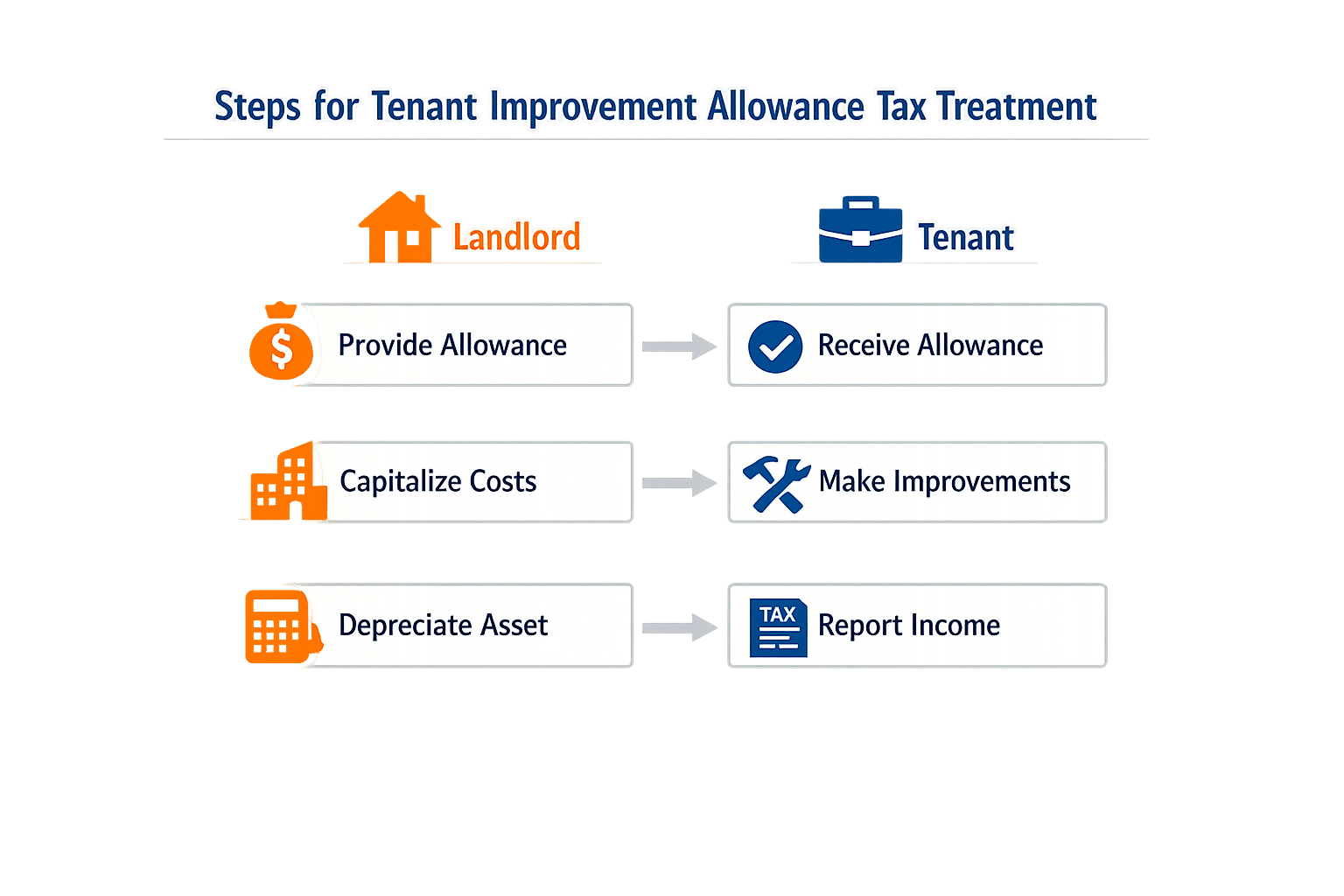
Navigating tenant improvement allowance tax treatment requires documentation at every stage. The agreement controls what the IRS sees, and what the agreement says determines which party carries the depreciation schedule and which party reports income. Establish the structure before construction starts — retroactive characterization invites examination.
Step 1: Document the Allowance in the Lease
Step 1
Specify the allowance amount and permitted use
The lease provision must state the dollar amount, the work it covers, and whether the landlord pays vendors directly or reimburses the tenant. A general "improvement allowance" without scope creates ambiguity that both parties resolve differently at filing time. Name the space, name the permitted categories, and state whether unused funds revert to the landlord or remain with the tenant.
The lease should identify the obligated party for each expense category. If the landlord retains title to the improvements, state that explicitly. If the tenant owns removable fixtures, separate those from structural work. The line between landlord property and tenant property determines who depreciates and over what recovery period.
Step 2: Retain Construction and Payment Records
Step 2
Collect invoices, lien releases, and payment proof
Every dollar of allowance spent requires a paper trail: contractor invoice, scope description, payment date, and method. If the landlord pays directly, retain the check image or wire confirmation tied to the invoice. If the tenant seeks reimbursement, the submission packet must match the lease's documentation standard — partial packets delay reimbursement and create gaps the IRS can recharacterize.
Lien releases confirm that subcontractors and suppliers were paid in full. An unpaid lien clouds title and complicates the depreciation basis. Obtain unconditional final releases before closing the construction phase. The release proves the improvement is complete and the landlord's basis is fixed.
Step 3: Determine the Tax Characterization
The allowance is either landlord income or a reduction in basis, depending on the structure. If the lease treats the allowance as rent abatement or a tenant inducement, the landlord does not report it as current income but reduces the building's basis by the allowance amount. If the lease treats it as reimbursement for landlord-owned improvements, the landlord capitalizes the cost and depreciates it under the applicable recovery period.
The tenant's characterization mirrors the landlord's. If the allowance is excludable, the tenant does not report it as income. If the tenant owns the improvements, the tenant capitalizes and depreciates them. Mismatched characterizations between landlord and tenant create an examination risk — both returns should reflect the same structure.
Step 4: Apply the Correct Depreciation Schedule
Qualified improvement property placed in service after a specified date may be eligible for shorter recovery periods or bonus depreciation. The applicable tax law at the time of placement in service controls the schedule. Verify the in-service date, the property classification, and any available elections before filing.
If the improvement qualifies as tangible personal property rather than real property, the recovery period shortens. Removable partitions, modular furniture systems, and certain fixtures may fall outside the building's 39-year schedule. Separate the components and apply the correct table to each. Lumping everything into a single schedule overstates current-year depreciation or understates it, depending on the mix.
Step 5: File Consistently Across All Parties
The landlord's return, the tenant's return, and any partnership or S-corporation allocations must all reflect the same allowance treatment. If the landlord reports the allowance as a basis reduction, the tenant cannot also claim a deduction for the same dollars. If the tenant depreciates tenant-owned improvements, the landlord does not.
Coordinate before filing. If the lease is ambiguous, amend it or issue a clarifying letter signed by both parties. The IRS examines mismatches — consistent reporting across returns reduces that risk. For disputes over past years, consider filing a complaint with the California Department of Insurance if the issue involves an insured loss tied to the improvements, though most allowance disputes resolve through lease interpretation rather than regulatory complaint.
The agreement controls what the IRS sees — state the ownership, state the reimbursement terms, and file what the lease says.
Retain the lease, all amendments, the construction invoices, the lien releases, and the filed returns for the full statute of limitations period. If the IRS opens an examination, produce the complete file. Gaps in documentation shift the burden to the taxpayer to prove the characterization.
Tips and Tricks
The standard requires documentation. The agreement provides terms. Between those two anchors, owners and tenants find room to structure improvements that satisfy both the code and the revenue authority — but only when the record supports what the parties actually did.
Separate the Allowance From the Rent Concession
A tenant improvement allowance and a rent abatement are not the same instrument. The allowance reimburses capital work; the abatement forgives operating expense. Mix them in one line on the lease, and the characterization becomes ambiguous. When the examiner asks which dollars bought depreciable property and which bought time, the lease should answer without interpretation. State the allowance separately, tie it to specific work, and require invoices before disbursement. What you can document, you can defend.
Retain the Record by Interval
The improvement becomes an asset. The asset depreciates over a recovery period. The recovery period runs fifteen or thirty-nine years, depending on classification. Retain every document that establishes the placed-in-service date, the cost basis, and the improvement's character: lease amendment, work letter, contractor agreement, payment records, final inspection sign-off. If the tenant removes the improvement at lease end, retain the removal documentation and the calculation that closed the asset. An auditor who asks for the 2011 build-out expects you to produce the 2011 record, not a reconstruction.
Ask for It in Writing Before You Authorize
The tenant proposes work. You agree to fund a portion. Before you authorize the expenditure, establish in writing what the allowance covers, what it excludes, and who owns the improvement when the lease ends. The work letter should name the permitted scope, the reimbursement cap, and the documentation required for each draw. If the tenant exceeds the scope or the cap, the excess is tenant cost — but only if the lease says so. Silence invites dispute. The agreement provides the boundary; the written record proves you stayed within it.
Confirm the Obligated Party
Commercial leases frequently name an entity — often a special-purpose LLC — as tenant. The tenant entity requests the allowance, performs the work, and takes the depreciation. If that entity dissolves or assigns the lease, the depreciation schedule does not follow the principal; it follows the asset and the obligated party on the agreement. Before you disburse allowance funds, confirm that the entity requesting reimbursement is the entity named in the lease, and that any personal guarantee block identifies the individuals who remain liable if the entity defaults. What the lease obligates, the tax return must reflect.
The allowance reimburses capital work; the abatement forgives operating expense. Mix them in one line on the lease, and the characterization becomes ambiguous.
Separately Price the Landlord Work and the Tenant Work
The improvement may include both landlord-owned base building work and tenant-owned fixtures. A demising wall is landlord property; modular office furniture is tenant property. When the allowance reimburses both categories, allocate the cost in the work letter. The landlord depreciates what the landlord owns; the tenant depreciates what the tenant owns. If the allocation is missing, the default rule applies — and the default rule may not match what the parties intended. Separately priced work produces separately supportable depreciation.
For guidance on documentation retention and dispute resolution in commercial agreements, see Filing a Complaint With the California Department of Insurance.
Check the Date on the Placed-in-Service Determination
An improvement is placed in service when it is ready and available for its intended use, not when the final invoice is paid or the certificate of occupancy is issued. If the tenant occupies the space and begins business operations before the contractor completes punchlist items, the placed-in-service date precedes final payment. That date starts the depreciation clock. Record the date the tenant took possession, the date the tenant opened for business, and the date the landlord accepted the work as substantially complete. When those dates differ, the earliest supportable date controls.
Frequently asked questions
What is tenant improvement allowance tax treatment?
Tenant improvement allowance tax treatment is the set of IRS rules that determine which party—landlord or tenant—reports the allowance as income, capitalizes the improvement, and claims depreciation. The treatment depends on who owns the completed improvement under the lease terms and applicable property law.
Who pays tax on a tenant improvement allowance?
If the landlord owns the improvements, the landlord capitalizes the cost and the tenant does not report income. If the tenant owns the improvements or has a removal right, the allowance is typically taxable income to the tenant, and the tenant depreciates the asset.
How do I know if my tenant improvement qualifies for bonus depreciation?
Qualified improvement property placed in service after 2017 may qualify for bonus depreciation if it meets the statutory definition: an interior improvement to nonresidential real property placed in service after the building was first placed in service, excluding enlargements, elevators, escalators, and internal structural framework. Verify the placed-in-service date and the nature of the work before claiming the benefit.
What records do I need to support tenant improvement allowance tax treatment?
Retain the lease, all amendments, the work letter, contractor invoices, lien releases, payment records, and the certificate of occupancy. If the IRS examines the return, you must produce documentation that establishes who owned the improvement, when it was placed in service, and how much was paid.
Can the landlord and tenant take different tax positions on the same allowance?
The landlord and tenant do not need matching tax positions, but they do need consistent facts. If the landlord claims the improvement as a capital asset and the tenant also depreciates it, the IRS will require reconciliation. Coordinate before filing to avoid amended returns.
Conclusion
Tenant improvement allowance tax treatment sits at the intersection of lease structure, capital classification, and interval-based documentation. The standard requires that both landlord and tenant maintain records showing which party owns the improvement, when it entered service, and what recovery period applies. Where the lease permits either party to claim depreciation, the agreement must state in writing which entity is obligated—ambiguity in the lease produces ambiguity in the tax position, and the authority having jurisdiction will not resolve that for you.
The edition matters. Tax code provisions change, safe harbor elections appear and disappear, and what qualified as a deductible repair under one rule becomes a capitalized improvement under the next. Retain the lease, the construction invoice, the placed-in-service certificate, and any election filed with the return. Ask for it in writing when the lease assigns ownership or when a tenant requests reimbursement—what the report actually says controls the classification, not what either party assumed at signing.
Before you authorize a tenant improvement allowance or accept one, establish who holds the asset on their books and what interval governs its recovery. The provision permits flexibility, but only when both parties document their intent at the time the improvement is made. Understanding tenant improvement allowance tax treatment means reading the lease to the end, naming the recovery period, and stopping where the record stops. For guidance on related compliance documentation and dispute resolution timelines, see our article on Filing a Complaint With the California Department of Insurance.