Introduction
A mechanics lien recorded against commercial property is not the same as a court judgment. The recordation creates a cloud on title, but what happens next depends on the type of lien, the date it was recorded relative to other encumbrances, and whether the claimant follows the statutory timeline. The provision permits the lien to remain in effect for a limited period, after which it expires automatically if the claimant does not file an enforcement action.
The standard requires property owners to distinguish between a design professional lien and a mechanics lien for construction work. A design professional lien expires 90 days after recording if the work of improvement has not commenced, or immediately upon commencement of construction. A mechanics lien recorded after work begins follows different rules and different deadlines. The edition matters — California Civil Code Part 6, Title 2, Chapter 3 governs design professional liens, while mechanics liens for contractors and material suppliers appear in separate chapters with separate enforcement windows.
Understanding what the lien actually encumbers is the first step. A mechanics lien does not affect or take priority over the interest of a purchaser, lessee, or encumbrancer if that interest was recorded before the lien. It also does not take priority over an encumbrance of a construction lender that funds the loan for the work of improvement. The lien attaches to the property, but its position in the priority stack determines whether it has practical leverage. For more information on related timelines and regulatory requirements in California, see Insurance Adjuster Contact Timeline: California Regulations.
Before you authorize payment or negotiate a release, ask for the recorded lien document in writing. The document shows the claimant's name, the amount claimed, the property description, and the recording date. That date is what establishes priority against other encumbrances. Retain the record — if the lien is later disputed or converted, the original recording date controls the timeline for enforcement and expiration.
What Happens When a Mechanics Lien Recorded on Your Title?
A mechanics lien recorded against your property creates an encumbrance on the title. That encumbrance remains visible to any party conducting a title search — prospective buyers, refinance lenders, or additional contractors — until the lien is released or expires. The recording does not, by itself, transfer money or force a sale, but it establishes a public claim that must be addressed before the title can be cleared.
What the Recorded Lien Permits
Once recorded, the lien holder may file a legal action seeking foreclosure on the real property. California Civil Code permits the claimant to initiate that action within a statutory window after the lien is recorded. If the court finds the lien valid, the property may be sold to satisfy the debt. The owner faces the prospect of paying the claim, bonding it off, or defending the lien's validity in litigation.
Priority and Encumbrances
The recorded lien's priority against other interests depends on the date each document was recorded. A lien recorded after a purchase-money mortgage or construction loan typically takes junior position to those earlier encumbrances. Conversely, a lien recorded before a subsequent refinance or sale may take priority over those later interests. The order matters when multiple claims compete for limited equity, and establishing that order requires examining the chain of title by date.
The Foreclosure Timeline
The lien holder must commence a foreclosure action within 90 days of recording the lien (for most mechanics liens on private works). If no action is filed within that period, the lien expires by operation of law. The statute does not require the owner to take affirmative steps to remove an expired lien from the record, but title companies and lenders will demand a formal release or a court order before closing a transaction. An expired lien that remains on file creates a cloud on title until it is formally released.
Bonding the Lien Off
California law permits an owner to post a lien release bond in an amount equal to 125 percent of the claim. Recording the bond releases the real property from the lien, transferring the claimant's security interest to the bond surety. The claimant may then pursue the bond rather than the property. Bonding does not resolve the underlying dispute — it shifts the collateral and allows the owner to sell or refinance while the claim is litigated.
No lien created under this chapter affects or takes priority over the interest of record of a purchaser, lessee, or encumbrancer, if the interest was duly recorded before recordation of the claim of lien.
For guidance on statutory timelines in other California compliance contexts, see Insurance Adjuster Contact Timeline: California Regulations.
Solution Steps
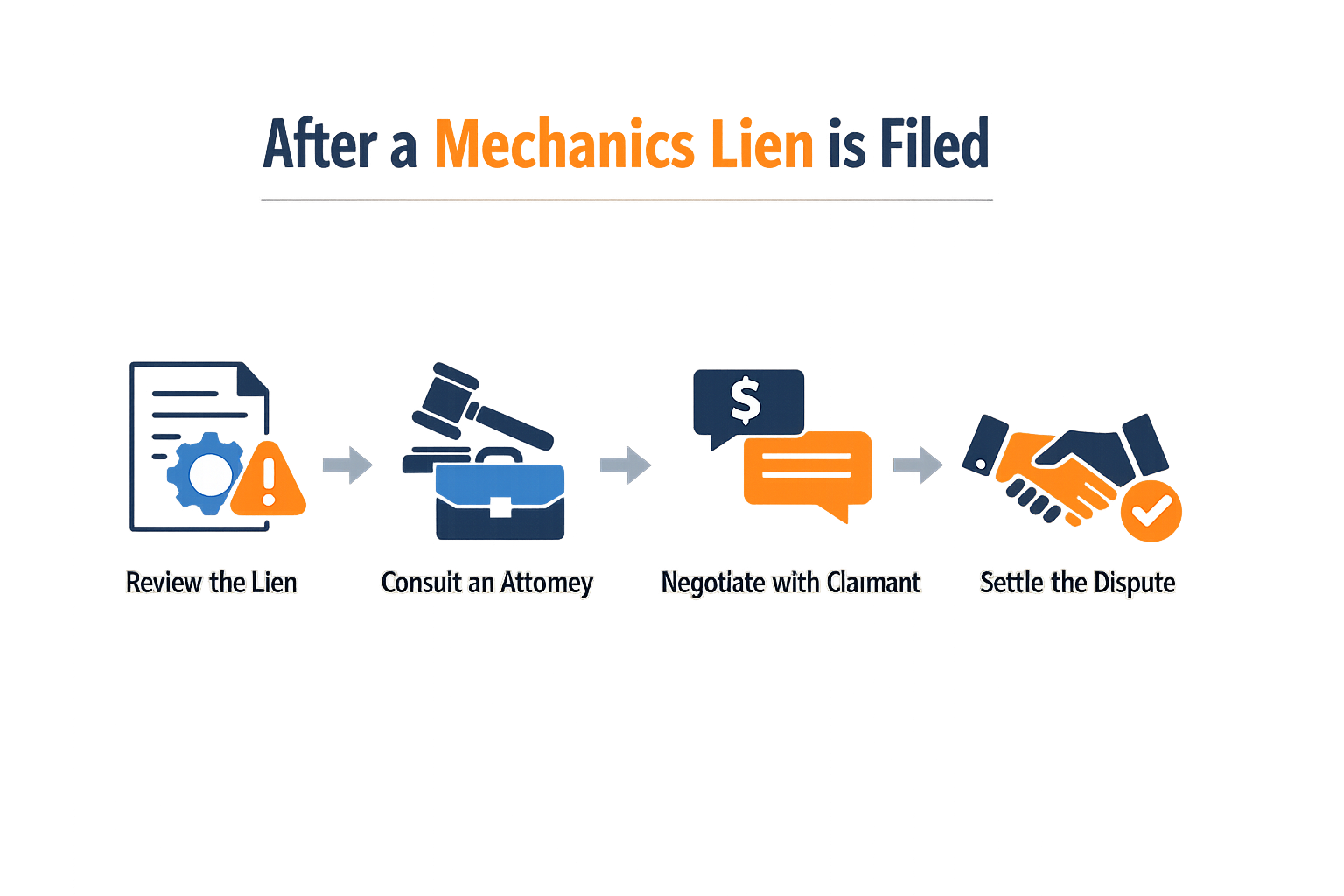
Once a mechanics lien is recorded against your property, the record is public and the claimant has 90 days to commence an action to enforce it. The steps below outline what an owner can do to address the lien, remove it from title, or prepare for litigation.
Step 1
Verify the lien details
Obtain a copy of the recorded claim from the county recorder. The claim must include the claimant's demand after deducting all just credits and offsets, the name of the owner or reputed owner, a general statement of the kind of work furnished, and the name of the person by whom the claimant was employed. If any required element is missing or incorrect, the lien may be defective.
Step 2
Determine whether the claim is valid
Compare the recorded claim to your records: the contract, invoices, payment history, and any disputes over performance. A lien is valid only if the claimant provided labor or materials for a work of improvement and has not been paid. If the work was not authorized, not performed, or already paid for, you may have grounds to dispute the claim.
Step 3
Consider posting a lien release bond
An owner of real property or an owner of any interest in real property subject to a recorded claim of lien may obtain release of the real property from the claim by recording a lien release bond. The bond must be in an amount equal to 125 percent of the claim of lien. Recording the bond releases the real property from the claim of lien and any action to enforce it. After obtaining the bond, the person must give notice to the claimant, including a copy of the bond.
Step 4
Monitor the 90-day enforcement window
The claimant must commence an action to enforce the lien within 90 days after recordation of the claim. If the claimant does not commence an action to enforce the lien within that time, the claim of lien expires and is unenforceable. The deadline may be extended if the claimant and owner agree to extend credit, and notice of the fact and terms of the extension is recorded. In that case, the claimant must commence an action within 90 days after the expiration of the credit, but no later than one year after completion of the work.
Step 5
If an action is commenced, record a notice of pendency
After commencement of an action to enforce a lien, the plaintiff must record a notice of the pendency of the action in the office of the county recorder on or before 20 days after the commencement of the action. Only from the time of recording the notice is a purchaser or encumbrancer of the property affected by the pendency of the action.
Steps to Take After a Mechanics Lien Is Recorded
The sequence above applies whether you intend to pay the claim, dispute it, or wait for the claimant to act. If you choose to do nothing, the lien remains on record for 90 days, and the claimant may file suit. If no suit is filed within that window, the lien expires by operation of law. If you need to clear title before the 90 days expire, the bond is the statutory remedy.
For related guidance on timelines and regulatory obligations in other contexts, see Insurance Adjuster Contact Timeline: California Regulations.
Tips and Tricks
The recorded lien is an encumbrance, not an instruction. What you retain, what you pay, and what you permit on the property during the enforcement window determines whether the claimant can collect — or whether you introduce new claims by acting without checking who holds the right to receive payment.
Ask for the Lien in Writing Before You Pay Anyone
The recorder stamps the document. The claimant may send you a copy, or you may retrieve it from the county. Either way, obtain the recorded claim before you authorize any payment to the original contractor. The claim of lien names the claimant, states the amount due, and designates the work of improvement. If the claimant did not segregate the amount due for each work of improvement, the lien may become subordinate to other existing liens — but that subordination does not extinguish the claim, and you remain obligated to verify priority before you release funds.
Use Joint Checks When the Contractor and Subcontractor Both Have Claims
When the general contractor remains on the job and a subcontractor has recorded a lien, paying the contractor alone does not discharge the lien. Paying the subcontractor alone may breach your agreement with the contractor. The joint check — payable to both parties, endorsed by both — ensures that the payment reaches the claimant and satisfies the contractor's obligation. This method reduces the risk that a second lien will follow because the contractor failed to remit the funds.
The joint check closes the loop: both parties acknowledge receipt, and the record shows the payment satisfied the disputed amount.
If the contractor refuses to endorse the joint check, that refusal is evidence of a dispute between the contractor and the subcontractor. Do not release the funds until the parties resolve the dispute or a court orders payment. Releasing funds to one party over the objection of the other exposes you to a second claim for the same work.
Retain Every Notice, Every Agreement, and Every Payment Record
The lien attaches to the interest of the person that contracted for the work of improvement, and to the interest of a person that did not contract for the work if that person had knowledge of the work. Knowledge is a question of fact, and the record you retain determines what you can prove. Keep the preliminary notice, the contract, every change order, every payment check image, and every lien waiver or release. If the claimant later asserts that you knew of the work and failed to give a notice of nonresponsibility, your record establishes the timeline and the parties' positions.
For additional guidance on navigating disputes with service providers and understanding documentation requirements in California, see Filing a Complaint With the California Department of Insurance.
FAQ
How long does a mechanics lien recorded against my property remain valid?
A mechanics lien recorded on private works expires automatically 90 days after recordation if the claimant does not file a foreclosure action. The deadline may be extended by written agreement between the claimant and owner, but no later than one year after completion of the work.
Can I sell my property if a mechanics lien recorded against it?
You may sell the property, but the lien remains attached to the title. Most buyers and title companies will require the lien to be released or bonded off before closing. Recording a lien release bond transfers the claimant's security interest to the bond and clears the title.
What happens if I ignore a mechanics lien recorded on my property?
If you take no action and the claimant files a foreclosure suit within 90 days, the court may order the property sold to satisfy the debt. If the claimant does not file suit within the statutory window, the lien expires by operation of law, but it remains on the public record until formally released.
Does a mechanics lien recorded after my mortgage take priority over the loan?
No. A mechanics lien does not take priority over interests recorded before it. A mortgage or deed of trust recorded before the lien retains senior position. The lien attaches only to the owner's remaining equity in the property.
Conclusion
A mechanics lien recorded against your property triggers a documented chain — the lien appears in the county recorder's index, affects title, and sets deadlines for enforcement or expiration. The standard requires action within specified windows: California Civil Code provisions establish when a lien expires automatically and when the claimant must file suit to enforce it. Once the lien is recorded, the property owner performs a review of the underlying contract, verifies the amounts claimed, and determines whether the lien satisfies the statutory prerequisites. A licensed agency does not perform this review; the owner or the owner's attorney performs it, because the record retention obligation and the response strategy belong to the obligated party on the contract.
The agreement provides dispute windows and default provisions that govern how unpaid invoices escalate to liens. Before you authorize payment or settlement, ask for documentation in writing: the signed contract, the preliminary notice if one was required, and the recorded claim itself with its county recorder stamp and date. What the report actually says matters — a lien that recites work never authorized or amounts already paid may be subject to release or bond substitution, but only if the owner retained the records that prove the discrepancy. Retain the record of every payment, every change order, and every written communication about scope or delay. The edition matters when interpreting lien deadlines, because amendments to the Civil Code have shortened or lengthened enforcement windows over successive legislative sessions.
Understanding insurance adjuster contact timelines can also help property owners navigate related claims and obligations that arise when liens intersect with casualty events or construction defects. Either remedy satisfies the statutory obligation to respond: pay the claim and obtain a release, or post a bond and contest the lien in court. Not the whole provision, but the specific subdivision that applies to your lien type — design professional liens, stop notice claims, and standard mechanics liens each carry different expiration rules and enforcement procedures. What closes the failure is a recorded release or a court judgment; verbal assurances do not close it, and partial payments do not automatically reduce the encumbrance unless the claimant executes a partial release in recordable form. By interval, the owner performs quarterly reviews of open liens and upcoming deadlines, ensuring that no enforcement action proceeds by default. The obligated party remains responsible for monitoring the county index and for instructing counsel before any statute runs.
Sources
- California Civil Code Part 6, Title 2, Chapter 3 (Design Professional Liens)
- California Civil Code Part 6, Title 2 (Mechanics Liens)