
Introduction
When a building requires mandated service or repair, the owner selects a contractor to perform the work. That selection carries consequences: the contractor's license status determines whether the work closes a code violation, whether the agreement is enforceable, and whether the owner has recourse if the work fails. The decision is not a consumer preference — it is a compliance step with a documented outcome.
California law defines a contractor as any person who undertakes to construct, alter, repair, add to, subtract from, improve, move, wreck, or demolish any building, structure, project, development, or improvement, or to do any part thereof. The definition includes subcontractors and specialty contractors. It also covers those who maintain or service air-conditioning, heating, or refrigeration equipment that is a fixed part of a structure, and those who perform tree removal, stump removal, or well drilling. The breadth of the definition means that many service providers fall under the licensing requirement, and the owner must confirm that status before authorizing work.
The Contractors State License Board maintains a contractor license check search function on its website, permitting searches by ZIP code or geographic location. This tool is the starting point for verification. When vetting a contractor, it is essential to delve into the specifics of their compliance with relevant standards. Understanding which edition of a standard governs a particular requirement can be crucial, as local adoption may vary. Reviewing submitted documents carefully can reveal discrepancies, such as an inspection report and an invoice describing two different visits to the same building — an anomaly that prompts further investigation.
The vetting process is not about finding the lowest bid or the most reassuring sales presentation. It is about establishing that the contractor holds the license the work requires, that the agreement obligates an identifiable entity, and that the documentation trail will satisfy the authority having jurisdiction when the work is inspected. The standard requires specific intervals, specific remedies, and specific records. The contractor either produces those records or does not. For more guidance on managing compliance and service agreements, see How to Deal with an Insurance Claims Adjuster for Commercial Buildings.
What follows is a framework for confirming that a contractor can deliver what the standard requires and what the agreement promises.
Understanding the Risks of Hiring the Wrong Contractor
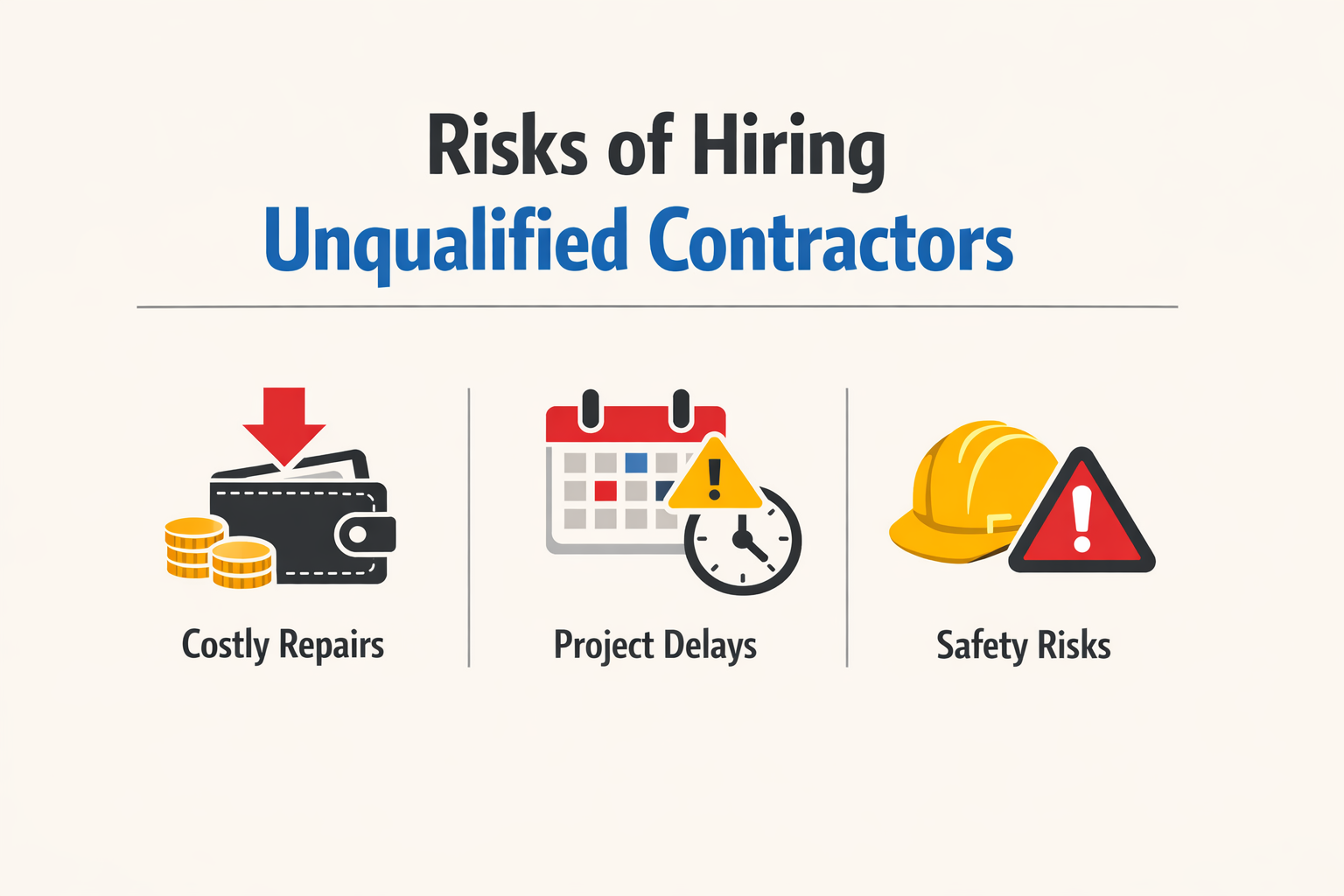
The decision to engage a contractor carries consequences that extend beyond the immediate work. When the contractor lacks proper licensing, the owner assumes exposure that the standard does not contemplate. California Business and Professions Code Section 7118 establishes that entering into a contract with an unlicensed contractor constitutes cause for disciplinary action. The statute does not distinguish between knowing and unknowing violations — the contract itself triggers the exposure.
What Vetting a Contractor Prevents
A contractor operating without the required license cannot close a code violation that demands a licensed agency's signature. The owner who hires such a contractor remains out of compliance regardless of the work performed. The authority having jurisdiction will not accept documentation from an entity that lacks standing to certify the remedy. The owner then faces two costs: the payment already made and the cost of repeating the work through a properly licensed agency.
The statute addresses not only general licensing but also specialized certifications. Section 7118.6 specifies penalties for contractors who engage with persons required to be certified under Section 7058.7 for removal or remedial action but who lack that certification. A first offense is an infraction punishable by a fine of one thousand to three thousand dollars and possible license revocation or suspension. A subsequent offense becomes a misdemeanor requiring license revocation or suspension, a fine of three thousand to five thousand dollars, imprisonment up to one year, or both.
Documentation and Record Retention
An unlicensed contractor cannot produce the records that close an inspection failure. The owner must retain documentation showing that the entity performing mandated service holds the license the standard requires. When an authority having jurisdiction opens a violation, the owner produces the service record, the entity's license number, and proof that the license was active on the date of service. An unlicensed contractor's invoice does not satisfy that requirement, and the violation remains open.
The agreement itself becomes unenforceable when the contractor lacks the required license. The owner cannot compel performance, cannot recover for defective work through the agreement's dispute provisions, and cannot rely on any guarantee the agreement purports to provide. The unlicensed status voids the mechanisms the owner expected to have available.
For property owners navigating the aftermath of such issues, understanding the broader claims process is essential. Learn more in our guide on How to Deal with an Insurance Claims Adjuster for Commercial Buildings.
Steps to Vet a Contractor Effectively
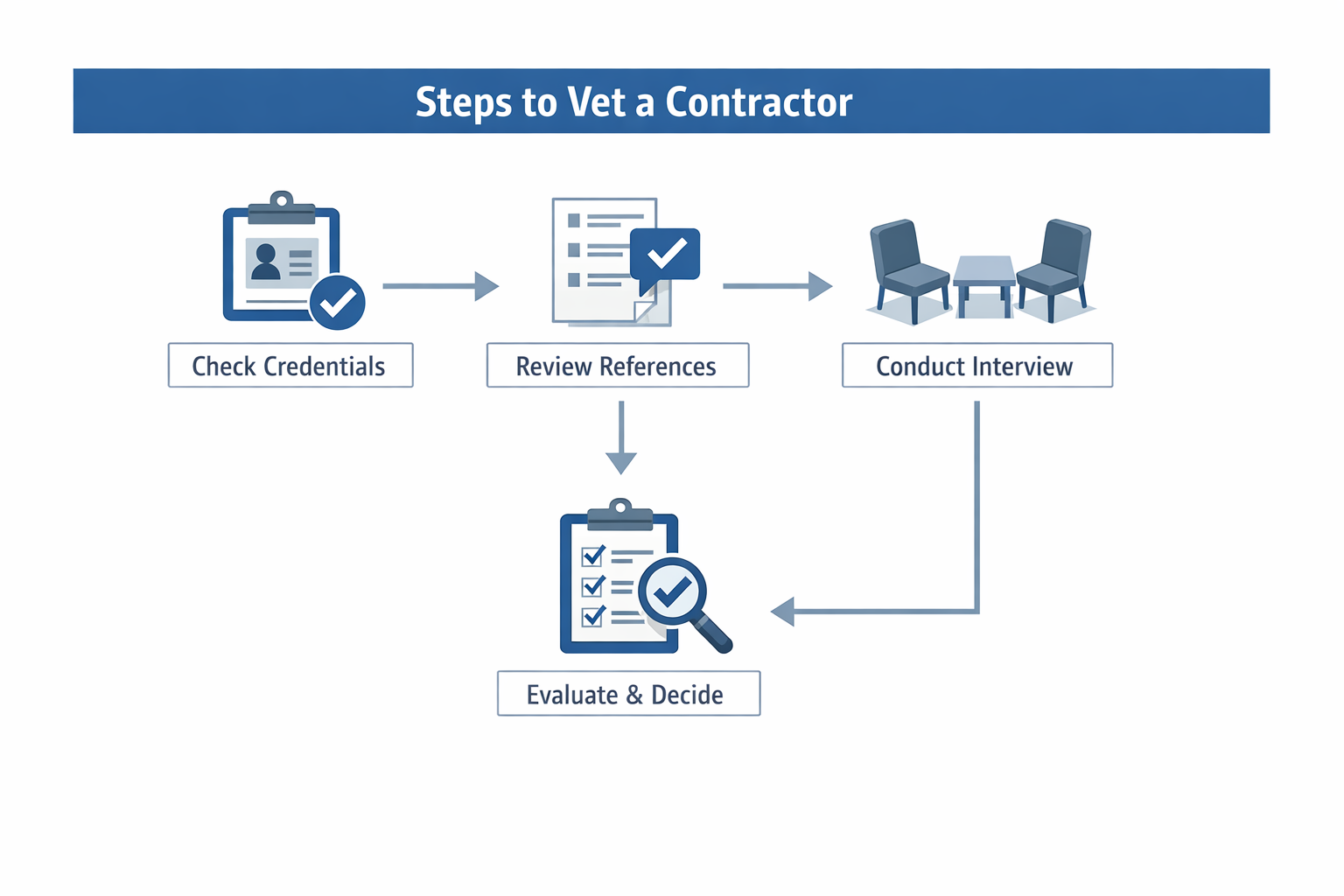
Vetting a contractor requires a systematic approach that moves from license verification through contract review. The steps below establish what documentation to request, what the law requires a contractor to provide, and where to confirm the facts a contractor states.
Verify the License Number and Classification
Step 1
Check the license on the board's website
California maintains a contractor license search function on the Contractors State License Board website that permits searches by ZIP Code or geographic location. Enter the contractor's license number exactly as stated on their proposal or business card. The result shows the license status, classification, issue date, and expiration date.
The classification matters. A contractor licensed as C-10 (Electrical) cannot lawfully perform C-36 (Plumbing and Heating) work under that license. Cal. Bus. & Prof. Code § 7065 governs how classifications are issued and what examination or experience qualifies a contractor for each one. If the scope of your project crosses classifications, confirm that the contractor holds every classification the work requires, or that they will subcontract the out-of-classification portions to a properly licensed firm.
Confirm Insurance Coverage and Bond Status
Cal. Bus. & Prof. Code § 7164 requires a written contract to state whether the contractor carries commercial general liability insurance, and if so, the insurer's name and telephone number. Ask for a certificate of insurance naming you as certificate holder, and call the insurer directly to confirm the policy is active and the coverage limits.
The bond requirement is separate. Every licensed contractor must maintain a contractor's license bond. The bond protects the public from certain violations; it does not cover ordinary breach of contract or workmanship disputes. The bond amount and the entity holding it are matters of public record through the license search.
Review the Qualifying Individual's Role
Every contractor qualifies for licensure through a specific individual—either an owner, partner, officer, manager, or responsible managing employee. Cal. Bus. & Prof. Code § 7068.1 defines "supervision and control" to mean direct supervision, managing construction activities, checking jobs for proper workmanship, or monitoring and being available to assist others to whom supervision has been delegated.
When comparing two contractors, ask who the qualifying individual is and what their role will be on your project. A qualifier who appears on three separate licenses and rarely visits a jobsite raises questions about how supervision and control actually occur. The statute permits a qualifying individual to act for no more than three firms in any one-year period, and only under specific common-ownership or subsidiary conditions.
Step 2
Request the contract in writing before work begins
Cal. Bus. & Prof. Code § 7164 mandates that every contract for construction of a single-family dwelling contain the contractor's name, address, and license number; approximate start and completion dates; and a legal description of the work location. Even where the statute does not apply to your building type, request the same information in writing.
The contract must also include a Mechanics Lien Warning. This warning explains that subcontractors and suppliers who are not paid may record a lien against the property, and that preliminary notices arrive up to 20 days after work begins. Understanding how a mechanics lien works helps you evaluate whether the contractor's payment practices protect you from downstream claims.
Obtain References and Verify Completed Work
Ask for contact information for three projects completed within the last two years, preferably in the same building type and scope as yours. When you call the references, ask specific questions: Did the contractor meet the schedule stated in the contract? Did the final invoice match the estimate? Were there any disputes over scope or change orders, and how were they resolved?
If the contractor states that a project satisfied a particular code requirement or standard edition, ask for the inspection report or certificate of compliance by name. An invoice and an inspection report describing two different visits to the same building indicate incomplete documentation, and you should request clarification before proceeding.
The contract shall be legible and shall clearly describe any other document which is to be incorporated into the contract.
Clarify Dispute Resolution and Default Terms
Read the dispute resolution clause in full. Some contracts require binding arbitration; others permit litigation but specify a venue or a shortened limitations period. Note whether the contractor's standard agreement includes a clause accelerating payment upon any dispute, or suspending work if you withhold payment pending resolution of a defect.
Where the agreement names a corporation or LLC as the contractor, confirm that the entity matches the licensed entity exactly. If a personal guarantee block appears, identify who is guaranteeing performance and what that guarantee covers. These details determine which party you pursue if the contractor defaults, and what remedies are available under the agreement.
Tips and Tricks for Successful Contractor Vetting
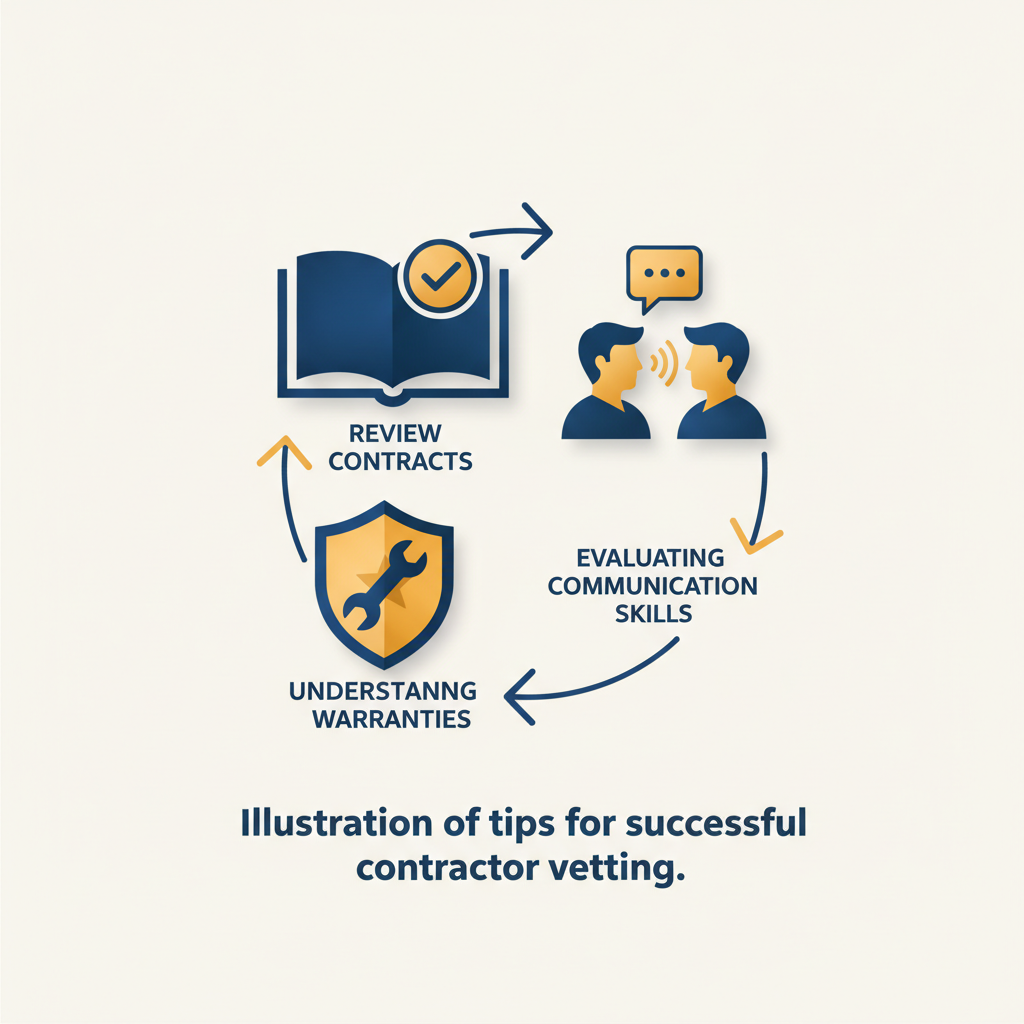
When vetting a contractor, read provisions in full — summaries can omit clauses that offer a more cost-effective compliance path. Comparing two editions of the same standard, where the interval changed, highlights why the edition matters. Determining which one applies is a matter of local jurisdiction. Review submitted documents carefully: an inspection report and an invoice describing two different visits to the same building prompt further investigation into the contractor's practices.
Obtain a Complete Subcontractor List Early
Before authorizing any payment, obtain a list of all subcontractors and material suppliers from your contractor. Cal. Bus. & Prof. Code § 7164 requires that you know who is working on your property to protect yourself from mechanics liens. Each subcontractor and material supplier can send a Preliminary Notice up to 20 days after starting work or providing material. If you pay your contractor before receiving these notices, you risk paying twice — once to the contractor and again to satisfy a lien.
Wait 20 days after subcontractors start work or suppliers deliver material, paying attention to the Preliminary Notices you receive. This interval gives you the documentation you need to close any later dispute about who was paid and when.
Verify the Contractor's Classification Matches the Work
A general building contractor may take a prime contract for a project requiring at least two unrelated building trades or crafts, or may subcontract with appropriately licensed contractors for work outside their classification (Cal. Bus. & Prof. Code § 7057). A general building contractor cannot take a prime contract for a project involving trades other than framing or carpentry unless the contract requires at least two unrelated trades other than framing or carpentry, or unless the contractor holds the appropriate license classification.
For specialty work — fire protection systems, well drilling, or other projects requiring specialized knowledge — confirm that the contractor holds the correct classification or has subcontracted with someone who does. A contractor whose license does not cover the work cannot close a code violation in that area, and the authority having jurisdiction will not accept their certification.
Step 1
Check the contractor's classification
Use the Contractors State License Board search function to verify the contractor's classification. The board maintains a current contractor license check on their website that permits searches by ZIP Code or geographic location (Cal. Bus. & Prof. Code § 7018). Confirm that the classification listed matches the work described in your project.
Ask for Contract Language in Writing
Every written contract must include the contractor's name, address, and license number; approximate start and completion dates; and a legal description of the work location (Cal. Bus. & Prof. Code § 7164). The contract must also include the mechanics lien warning and a statement about commercial general liability insurance, including a check box indicating whether the contractor carries it and, if so, the insurer's name and telephone number.
If a contractor offers two remedies — one requiring specialized equipment and one requiring only a visual check — ask for both options in writing with separate pricing. What the report actually says determines what you can present to the authority having jurisdiction. An incomplete summary or a verbal assurance does not close a violation.
Read the CSLB Notice Requirement
Every person licensed under California's contractor licensing law must include a specific notice in at least 10-point type on all written contracts (Cal. Bus. & Prof. Code § 7030). The notice states that contractors are required by law to be licensed and regulated by the Contractors State License Board, which has jurisdiction to investigate complaints if filed within four years of the alleged violation (or within ten years for latent structural defects). Failure to include this notice is cause for disciplinary action.
If the contract you receive does not include this notice, the contractor is not in compliance with the statute. That omission does not void the contract, but it signals that the contractor may not be following other requirements either.
Cross-Check Reports Against Invoices
When you receive an inspection report and an invoice, confirm that both documents describe the same visit, the same building, and the same work. A report dated in January and an invoice describing work in March indicate two separate visits. If you are paying for an annual inspection, the report should reflect the interval required by the standard and the edition adopted locally. If the report and the invoice do not match, ask for clarification in writing before you authorize payment.
For more guidance on managing payment disputes and lien risks, see Mechanics Lien California: Mechanics Liens in California: Deadlines.
What the report actually says determines what you can present to the authority having jurisdiction — an incomplete summary does not close a violation.
Conclusion
Vetting a contractor is not a formality—it is the step that separates a compliant project from one that generates liability, unenforceable agreements, and unresolved code violations. The provisions are clear: California requires licensure, and entering into a contract with an unlicensed contractor constitutes grounds for disciplinary action. The Contractors State License Board maintains a public search function by ZIP code or location, and every written contract must carry the disclosure statement naming the board's jurisdiction and complaint deadlines. These are not suggestions; they are statutory requirements that bind both parties.
Thorough vetting means reading the contract to the end, verifying the license number against the board's records, confirming that the entity named on the agreement matches the licensed entity, and retaining documentation of every verification step. When comparing two editions of the same standard, the interval may have changed, and determining which one applies is a matter of local jurisdiction. Reviewing submitted documents carefully can reveal discrepancies—an inspection report and an invoice describing two different visits to the same building prompt further investigation. Reading provisions in full matters because summaries might omit clauses that offer a more cost-effective compliance path.
The owner who asks for license verification in writing, who checks the date on the contractor's insurance certificate, and who confirms that the obligated party is the licensed entity—not an unlicensed affiliate—positions the project to survive scrutiny when the authority having jurisdiction opens a file or when a dispute reaches the four-year complaint window. What closes a failure is documentation that the standard was met by the interval it specifies, performed by the party the provision permits, and recorded as the edition requires. Vetting a contractor is the step that makes that documentation possible. For more guidance on managing contractor relationships and compliance obligations, see How to Deal with an Insurance Claims Adjuster for Commercial Buildings.
Related reading
Contractor Identification: Verify Credentials and Avoid Fraud